IEC 61439 Panel Type
Automatic Transfer Switch (ATS) Panel
Automatic changeover between mains and generator/UPS. Open or closed transition, with or without bypass.
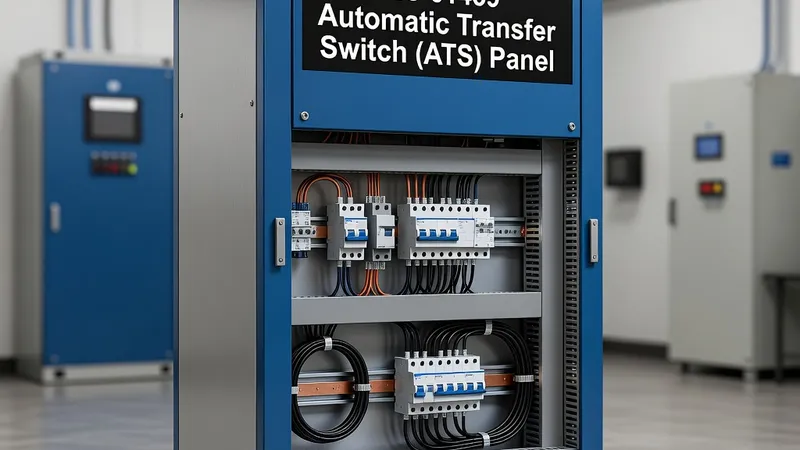
Automatic Transfer Switch (ATS) Panels are IEC 61439-2 compliant low-voltage assemblies engineered to perform reliable, automatic changeover between a utility mains supply and an alternate source—typically a diesel generator, generator set, or UPS output. Typical ATS assemblies integrate motorized break-before-make or make-before-break mechanisms, breaker-based solutions using ACBs/MCCBs, or static (solid-state) transfer modules for near-zero interruption. Proven commercial platforms include Siemens SIVACON and MNS line-ups, Schneider Electric Prisma Set and Masterpact/Emax ACB ranges, ABB/Tmax families, Eaton large-frame breakers, and Noark/Hager MCCBs used for feeder protection. Design and verification follow IEC 61439-1 (general rules) and IEC 61439-2 (power switchgear assemblies) with switching device selection referenced to IEC 60947 series (eg. IEC 60947-6-1 for transfer switching and IEC 60947-2 for circuit-breakers). For hazardous-area or marine/offshore ATS, additional standards such as IEC 60079 and IEC 60092 must be applied. Key verification activities include temperature-rise, dielectric tests, IP/IK enclosure rating checks, and short-circuit withstand verification (Icw/Ik) by calculation and type testing per IEC 61439 clause requirements. Typical ratings and capabilities: ATS panels are commonly specified from 100 A up to 4,000 A incoming; typical short-circuit withstand levels range from 25 kA to 100 kA RMS symmetrical depending on busbar design and installed ACBs. Load-side selective coordination and peak let-through energy limits must be assessed with IEC 60947-2 coordination curves and time-current characteristics. Forms of internal separation influence maintainability and safety: IEC 61439 defines Forms 1, 2a/2b, 3a/3b, and 4a/4b. For mission-critical installations (data centers, hospitals) segregated or Form 4b arrangements are preferred to allow maintenance on the ATS or incoming breaker without de-energising the entire distribution. Closed-transition (make-before-break) ATS implementations require synchronous paralleling control, circulating-current management and protection to prevent overload during paralleling. Control and protection: PLC or dedicated transfer controllers provide source availability monitoring (voltage, frequency, phase sequence), automatic start/stop logic for gensets, synchronizing relays for closed transition, load-shedding logic and alarms. Mechanical and electrical interlocks prevent backfeed and unsafe conditions; bypass isolation switches are common for service and testing. Applications: commercial buildings, data centers and healthcare facilities often require closed- or static-transfer ATS for zero interruption; renewable-energy/inverter integration and microgrids use sophisticated synchronizing and sequencing; marine/offshore and utilities require ruggedized cabinets with explosion-proof options. For procurement and build, specify rated current, fault level, transition mode, forms of separation, and local product preferences (Siemens SIVACON/MNS, Schneider Prisma Set/Masterpact, ABB/Eaton breakers) to ensure compliance and operability under IEC 61439 series requirements.
Available with Components From
Industries Served
Frequently Asked Questions
Request a Quote
Tell us about your panel requirements and our engineering team will get back to you within 24 hours.
Email Us
[email protected]Call Us
+90 232 332 22 78