Industry
Infrastructure & Utilities
IEC 61439 panel assemblies for power substations, transportation networks, telecommunications, and public infrastructure projects.
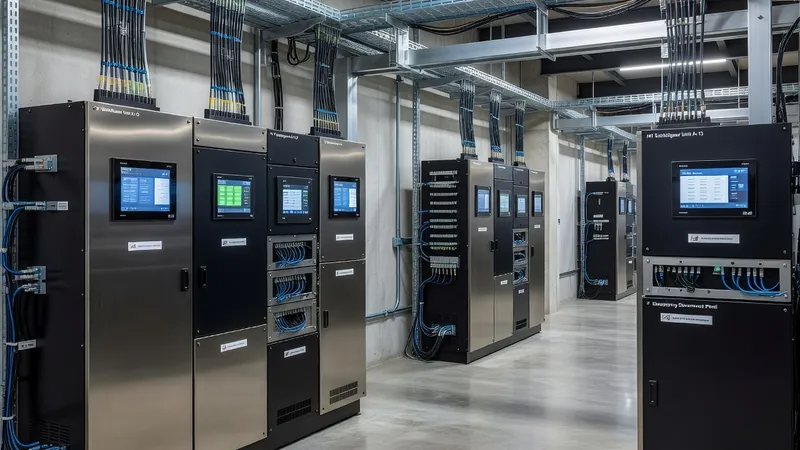
Infrastructure & Utilities projects demand IEC 61439 panel assemblies designed to perform reliably under heavy duty, long-life conditions found in substations, railways, airports, tunnels, water/wastewater plants and telecommunications hubs. Typical panel families deployed include main-distribution-board (MDB), power-control-center (PCC), automatic-transfer-switch (ATS) panels, metering panels, generator-control-panels (GCP), lighting-distribution-boards (LDB), busbar-trunking-systems (BBTS), PLC/automation-panels and custom-engineered assemblies. Industry platforms such as Siemens SIVACON and MNS, Schneider Electric Prisma Set, and ABB/ Eaton low-voltage switchgear are commonly used as reference architectures; enclosure and accessory vendors include Rittal, Legrand and Noark Electric, with DC power and rectifier solutions from Phoenix Contact and LS Electric. Design and compliance follow IEC 61439-1 (general rules) plus the applicable part (for example IEC 61439-2 for power switchgear assemblies, IEC 61439-3 for distribution boards and IEC 61439-6 for busbar trunking systems). Low-voltage switching and protective device performance must meet IEC 60947 series requirements. Hazardous-area installations require coordination with IEC 60079 for Ex-rated equipment and installation methods. Key technical requirements: rated currents and busbar sizing for infrastructure MDB/PCC commonly range from 1,600 A to 4,000 A (and BBTS up to 6,300 A in heavy applications); short-circuit ratings for utility panels are typically specified from 25 kA to 100 kA (1 s) depending on system fault level and must be verified by short-circuit withstand testing per IEC 61439. Forms of separation (Form 1, 2a/2b, 3a/3b, 4a/4b) are specified to prevent fault propagation and enable safe maintenance—Form 4b (full segregation of busbars, functional units and cables) is standard for critical utility switchgear. Environmental and installation considerations include IP/IK ratings (IP54/IP55 for outdoor kiosks; IP65/IP66 for washdown or marine environments), corrosivity class (ISO 12944 C3/C4/C5-M for coastal or industrial sites), temperature derating (-25 °C to +55 °C typical design range), altitude derating and ingress/condensation control. Battery rooms and DC rectifier panels for telecom follow stricter ventilation, fire and battery-management constraints. Internal arc mitigation and personnel protection are achieved with segregated compartments, pressure-relief channels and remote racking/instrumentation, coordinated with customer risk assessment and applicable arc-flash guidance. Testing and acceptance include routine and type tests: dielectric/insulation, temperature-rise, short-circuit withstand, mechanical operation and functional verification as defined in IEC 61439. For turnkey infrastructure projects, panels are delivered as type-tested or partially type-tested assemblies with full test reports and factory witness testing. Integration with SCADA/automation (IEC 61850-compatible IEDs in substations, Modbus/IEC 60870 in utilities), metering (class 0.2/0.5 CT/PT schemes), and protective relays completes the engineered solution for 25–30 year design lives and extended maintenance intervals.
Panel Solutions for Infrastructure & Utilities
Main Distribution Board (MDB)
Primary power distribution from transformer to sub-circuits. Rated up to 6300A. Houses main incoming breaker, bus-section, and outgoing feeders.
Power Control Center (PCC)
High-capacity power distribution for industrial facilities. Controls and distributes incoming power to MCC, APFC, and downstream loads.
Automatic Transfer Switch (ATS) Panel
Automatic changeover between mains and generator/UPS. Open or closed transition, with or without bypass.
Metering & Monitoring Panel
Energy metering, power quality analysis, and multi-circuit monitoring with communication gateways.
Generator Control Panel
Genset start/stop sequencing, synchronization, load sharing, and paralleling controls.
Lighting Distribution Board
Final distribution for lighting and small power. MCB/RCBO-based with DALI or KNX integration options.
Busbar Trunking System (BTS)
Prefabricated busbar distribution per IEC 61439-6. Sandwich or air-insulated, aluminum or copper.
PLC & Automation Control Panel
Process and machine control panels housing PLCs, I/O modules, relays, HMIs, and communication infrastructure.
Custom Engineered Panel
Bespoke panel assemblies for non-standard requirements — special ratings, unusual form factors, multi-function combinations.
Recommended Component Brands
Frequently Asked Questions
Request a Quote
Tell us about your panel requirements and our engineering team will get back to you within 24 hours.
Email Us
[email protected]Call Us
+90 232 332 22 78