IEC 61439 Panel Type
Busbar Trunking System (BTS)
Prefabricated busbar distribution per IEC 61439-6. Sandwich or air-insulated, aluminum or copper.
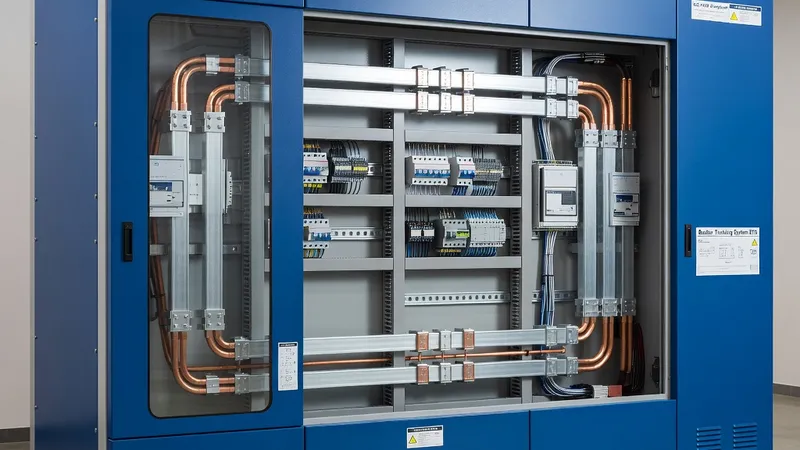
Busbar Trunking System (BTS) assemblies are factory-assembled, factory-tested power distribution products standardized by IEC 61439-6 and integrated with the broader IEC 61439 family (61439-1 general rules; 61439-2 switchgear interfaces; 61439-3 distribution boards). BTS replaces long cable runs with bolted modular sections (straight runs, elbows, tees, and tap-off units) to deliver power from incoming transformer/switchboard locations to sub-distribution points with minimal site labor. Manufacturers such as Siemens (SIVACON busway), Schneider Electric (Prisma SeT), Eaton, Legrand and accessory vendors such as Rittal supply complete systems and enclosure interfaces. BTS is offered in sandwich/encapsulated designs for high current density and reduced clearances, and air-insulated designs for economical straightforward maintenance. Conductor materials are typically electrolytic copper or extruded aluminum; copper is used where higher short-circuit withstand and lower impedance are required, aluminum where weight and cost are primary drivers. Rated currents commonly range from small tap-off modules (16–125 A) up to feeder trunking sizes of 400–6300 A. Short-circuit withstand (rated short-time withstand and peak current) is a function of conductor cross-section, mechanical bracing, and connection method and is verified by manufacturer type tests per IEC 61439-6 and IEC 61439-1; common factory ratings span symmetric ICW values from ~25 kA to 100 kA depending on system design and reinforcement. Coordination of BTS with protective devices follows IEC 60947 series guidance (MCCBs, circuit-breakers, fuses) to achieve selectivity and thermal/stability criteria. Design considerations include thermal rise limits, derating for ambient temperature and harmonic loading, torque-controlled bolted joints, busbar support spacing, expansion gaps for thermal growth, and oxidation protection for aluminum busbars. Tap-off units are available as fixed, withdrawable or load-break capable options; their degree of separation and enclosure IP rating must meet the intended application. Forms of internal separation (Form 1 to Form 4b) per IEC 61439-1 are selectable when BTS interfaces with LV switchboards or when individual protection and earthing segregation are required. For hazardous areas, busways can be specified to meet IEC 60079 requirements using sealed/encapsulated tap-offs and appropriate enclosures. Type and routine tests—temperature-rise, dielectric withstand, IP and mechanical operation, short-circuit performance and verification of protective separation—are mandatory under IEC 61439-6; site joint testing and torque verification are also best practice. Typical real-world applications include large commercial buildings, reconfigurable manufacturing floors, data centers requiring redundant distribution trunks, and utilities/infrastructure substations where rapid erection, clear routing and maintainability are essential. When specifying BTS, coordinate conductor material, SCCR, tap-off type, enclosure/IP class, and manufacturer type-test certificates (SIVACON, Prisma SeT, Eaton Busway) to ensure compliance with IEC standards and project protection/continuity requirements.
Available with Components From
Industries Served
Frequently Asked Questions
Request a Quote
Tell us about your panel requirements and our engineering team will get back to you within 24 hours.
Email Us
[email protected]Call Us
+90 232 332 22 78