Understanding IEC 61439: The Complete Guide
Comprehensive guide to the IEC 61439 standard series for low-voltage switchgear and controlgear assemblies.
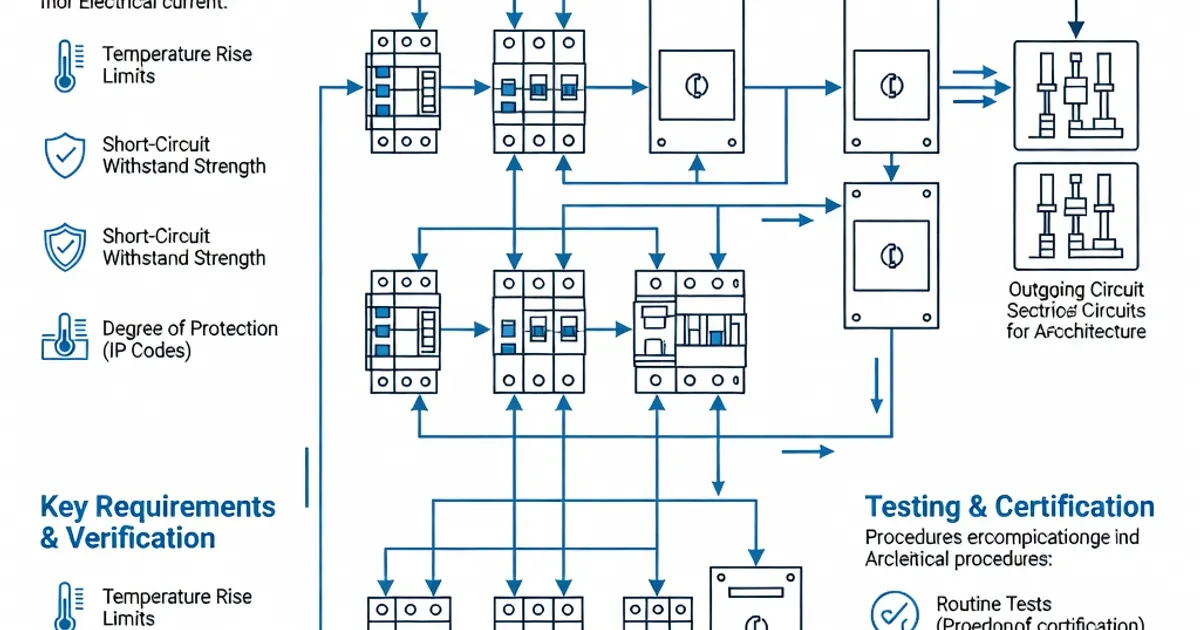
Understanding IEC 61439: The Complete Guide
This guide explains IEC 61439 — the international standard series that governs the design, verification and documentation of low-voltage switchgear and controlgear assemblies (LV assemblies) up to 1,000 V AC or 1,500 V DC. IEC 61439 superseded IEC 60439 and shifted the industry from mandatory type testing to a modern, engineering-driven model of design verification that distributes responsibilities between component suppliers, assembly manufacturers and specifying engineers. This article summarizes the standard structure, key technical requirements, verification methods, practical design rules and examples from industry, with direct clause references and source material for further reading.
Scope and Purpose
IEC 61439 is a series of standards with Part 1 (general rules) and multiple product-specific parts (for example, Part 2 for power switchgear and controlgear assemblies — PSC). The series covers electrical, thermal, mechanical and dielectric performance criteria, and it applies to assemblies intended for distribution and control of electrical energy in industrial, commercial and residential installations. The standard applies to assemblies rated up to 1,000 V AC or 1,500 V DC and defines verification methods that ensure safety, serviceability and performance while enabling modular design and reduced testing burden where justified by design rules or calculations (IEC 61439-1 and IEC 61439-2) [7][3].
Key Terms and Rated Characteristics (with Clause References)
IEC 61439 defines a core set of rated characteristics that an assembly manufacturer must declare and verify. These characteristics affect thermal, dielectric and short-circuit performance and are expressed as rated values with applicable test or calculation methods:
- Rated voltage (Un): highest r.m.s. value of voltage for which the assembly is designed (Clause 3.8) [3][7].
- Rated current (In): maximum current that the assembly can carry while meeting temperature-rise limits (Clause 3.8, Clause 10) [2][3].
- Rated impulse withstand voltage (Uimp): defined for dielectric separation and surge withstand (Clause 11.2) [2][4].
- Rated short-time withstand current (Icw) and rated peak withstand current (Ipk): values used to verify mechanical and thermal short-circuit performance (Clause 11.5) [2][5].
- Rated diversity factor (RDF): used in temperature-rise calculations for outgoing circuits and for sizing busbars and protection (detailed in IEC 61439-2 Table 101 and related clauses) [5].
Manufacturers must publish the declared rated characteristics with the assembly’s documentation and ensure verification by test, calculation, or by adherence to design rules based on a reference or similar verified assembly (Clause 11) [4][7].
Verification and Design Principles
IEC 61439 emphasizes three equivalent verification routes: testing, calculation, or application of design rules from a reference assembly that has been verified. This allows manufacturers to minimize full-scale type tests where sound engineering justification exists. The standard lists 12 verification characteristics (covering construction, mechanical and electrical performance) that must be satisfied by one of the three routes (Clause 11) [4][7].
- Testing: full or partial tests following normative procedures for temperature-rise, dielectric strength, short-circuit withstand, and electromagnetic compatibility where required [7].
- Calculation: validated thermal and mechanical calculations, including 3D thermal modelling or standardised analytical methods up to specified current ratings (calculations are permitted and normative limits are given) [2][3].
- Design rules: application of documented design rules derived from a proven reference assembly. Rules must maintain essential dimensions, materials, separation, and power-loss characteristics of the reference unit [1][2].
The intent: provide equivalent confidence of safety and performance irrespective of verification route while sharing responsibility between suppliers (component data) and assemblers (final verification and declaration of conformity) [1][3].
Temperature Rise and Thermal Design (Clause 10)
Temperature-rise verification ensures that terminals, busbars and functional units do not exceed specified temperature limits under rated current conditions. Key points include:
- Temperature limits: terminal temperatures are not to exceed 70 K rise above a reference average ambient of 35 °C unless otherwise declared (Clause 10) [2][3].
- Calculation scope: thermal calculations are valid for assemblies up to 1,600 A for multi-compartment arrangements when performed according to the standard’s prescriptive methods; tests are required for higher currents or atypical configurations (Clause 10) [2][3][5].
- Rated diversity factor (RDF): calculations use RDF values (per IEC 61439-2 and relevant tables) to determine realistic losses in outgoing circuits; busbars and main circuits often use RDF = 1.0 in short-circuit verification (IEC 61439-2 Table 101) [5].
- Ventilation and environmental corrections: assemblies must consider free convection, forced ventilation, enclosure height, and installed orientation when calculating temperature rise for real installations [2].
Short-Circuit Withstand and Mechanical Integrity (Clause 11.5)
Short-circuit verification covers both the mechanical integrity of conductors and busbars and the post-fault operational state of the assembly. Essential requirements include:
- Structural integrity: busbars and supports must withstand electrodynamic forces produced by Ipk and thermal effects of Icw without deformation that compromises safety or function (Clause 11.5) [2][5].
- Post-test functionality and IP rating: the assembly must retain its declared degree of protection (IP) and continue to operate safely after short-circuit tests; there must be no permanent opening that would expose live parts (Clause 11.5) [2].
- Diversity in short-circuit: for main busbars and single-unit sections the RDF is commonly taken as 1.0 for conservative sizing during short-circuit verification (IEC 61439-2 and industry practice) [5].
Dielectric Properties and Clearances (Clause 11.2)
IEC 61439 prescribes dielectric testing procedures and minimum clearances/creepage distances according to pollution degree and material insulating properties:
- Power frequency and impulse tests: assemblies must pass specified power-frequency withstand tests and impulse withstand voltages appropriate to their rated voltages (Clause 11.2) [2][4][7].
- Clearances and creepage: dimensions depend on rated voltage and pollution degree; designers must select insulating materials or barriers to meet required distances and avoid tracking or flashovers in service [4][7].
Protection Against Electric Shock, IP and IK Ratings (Clauses 8.4, 11.1)
The standard enforces basic and fault protection requirements to limit touch voltages, leakage currents and to ensure PE continuity:
- Basic protection: live parts must be inaccessible (minimum IP2X for many applications) and enclosures must provide appropriate mechanical barriers (Clause 8.4, Clause 11.1) [2][7].
- Protective earth continuity: PE paths must show low resistance (industry guidance uses <0.1 Ω measurement targets for bolted connections and busbar joints) and must be verified during assembly testing [2][3].
- IK mechanical impact: for PSC and outdoor-rated assemblies, IK08 or higher is often required per IEC 62262 where environmental conditions demand resistance to mechanical impacts (supplementary requirement) [5].
Internal Separation Forms (Clause 3.5, Table 8)
IEC 61439 defines internal separation forms (Forms 1 to 4b) that dictate access between functional units and compartments. The form chosen affects compliance testing, fault studies and maintenance procedures:
- Form 1: all live parts in a single compartment (lowest segregation).
- Form 2/2b: separation of incoming and outgoing circuits into different compartments; Form 2b requires vertical segregation for outgoing feeders.
- Form 3/3b: segregation of busbars from functional units and outgoing feeders; Form 3b adds segregation between functional units.
- Form 4a/4b: highest segregation level — individual cells for functional units and busbar segregation; Form 4b includes segregation for busbars and devices and is recommended for critical installations (Clause 3.5, Table 8) [3].
Verification Methods and Manufacturer Responsibilities
IEC 61439 clarifies responsibilities: the assembly manufacturer must verify the assembly’s compliance and provide documentation; component manufacturers must supply accurate rated data. Key procedural points:
- Documentation: assembly documentation must include rated characteristics, wiring diagrams, cable schedules, weight, handling instructions, maintenance intervals, and instructions for installation and earthing (IEC 61439-1 Clause 8 and manufacturer guides) [1][7].
- Shared data: equipment such as breakers, contactors and cable trays must be accompanied by manufacturer data (losses, thermal ratings, short-circuit withstand, clearances) so the assembler can perform calculations or apply design rules [3].
- Declaration of conformity: after verification, the assembler issues a declaration of conformity and marks the assembly with required information per IEC 61439 (rating plate, IP/IK, mass, and rated characteristics) [7][1].
Standards and Normative References
IEC 61439 interacts with other standards that provide device-level and environmental requirements. The most relevant companion standards include:
- IEC 60947 series — requirements for low-voltage switchgear and controlgear devices installed inside assemblies (circuit-breakers, contactors, switches) [3].
- IEC 60529 — degrees of protection (IP code) used to specify enclosure ingress protection (Clause 11.1 references this standard) [5][7].
- IEC 62262 — classification of mechanical impact protection (IK codes) often applied in PSC and outdoor applications [5].
- IEC 62271 — high-voltage switchgear standards used where HV-LV interfaces exist or for substations; applied as supplementary guidance [5].
Users must consult IEC 61439-1:2020 and the relevant product part (for example IEC 61439-2:2020 for PSC) for normative text and referenced clauses (notably Clauses 3–11 for general rules and verification) [7][9].
Practical Implementation: Design Rules, Best Practices and Industry Experience
Industry experience and manufacturer guides highlight practical measures that reduce verification effort and improve reliability:
- Use proven reference designs: applying documented design rules from a tested reference assembly (matching functional units, conductor cross-sections, separation and cooling paths) reduces the need for full type testing (Hager, Legrand guides) [1][8].
- Design for 35 °C ambient: thermal ratings are typically declared for a 35 °C average ambient; if installed in hotter environments, deratings or forced ventilation are necessary (Schneider and ABB guidance) [2][3].
- Adopt Form 4b segregation for critical systems: Form 4b provides superior maintainability and safety for parallel-feeding and critical distribution systems (Siemens and Schneider recommend this for industrial plants) [3][4].
- Ensure PE continuity and low contact resistance: target <0.1 Ω at PE joints and busbar connections; use bolted joints with proper torque and periodic verification [2][3].
- Labeling and documentation: include assembly drawings, single-line diagrams, protective device settings, maintenance instructions, and weight/handling info as required by IEC 61439 and manufacturer guides [1][3].
Product Examples and Market Offerings
Major manufacturers provide commercially available assemblies and modular systems designed, manufactured and verified under IEC 61439. Below is a representative comparison of market offerings and declared capabilities drawn from manufacturer literature and industry documentation:
| Brand | Product / Series | Typical Rated Current (In) | Typical Icw / Ipk | Forms / IP / Notes |
|---|---|---|---|---|
| Siemens | NXPLUS C / SIVACON | up to 4,000 A | Icw up to 50 kA (typical modules) | Form 4b options; IP44–IP54 depending on enclosure; full documentation per IEC 61439-2 [3] |
| ABB | UniGear ZS1 | up to 4,000 A | Icw up to 100 kA (1 s) | Form 4a/4b; IP42–IP54; long established IEC 61439 certified range [3] |
| Schneider Electric | Okken / Blokia | up to 6,300 A | Icw up to 150 kA | Form 4b designs; IP54 typical; RDF-optimised layouts for lower losses [4] |
| Eaton | Power Xpert UX | 630–5,000 A | Icw up to 100 kA | Modular verification options; Form 3b/4a; IP31–IP54 variants [1] |
| Rittal / Hager | Perforex VX25 / VML | up to 2,500 A | Icw 50–100 kA depending on busbar | Compact depths (800–1,000 mm), metal doors, IP2X internal protection; modular cells [1] |
Specification Checklist for Panel Builders and Specifiers
When specifying or building an IEC 61439 assembly, ensure the following items are documented and verified prior to declaration of conformity:
- Declared rated characteristics (Un, In, Uimp, Icw, Ipk, RDF) and rated voltages for ancillary circuits [7].
- Chosen internal
Related Panel Types
Frequently Asked Questions
Request a Quote
Tell us about your panel requirements and our engineering team will get back to you within 24 hours.
Email Us
[email protected]Call Us
+90 232 332 22 78