Switchgear Safety Standards Overview
Safety standards applicable to personnel working with and around panel assemblies.
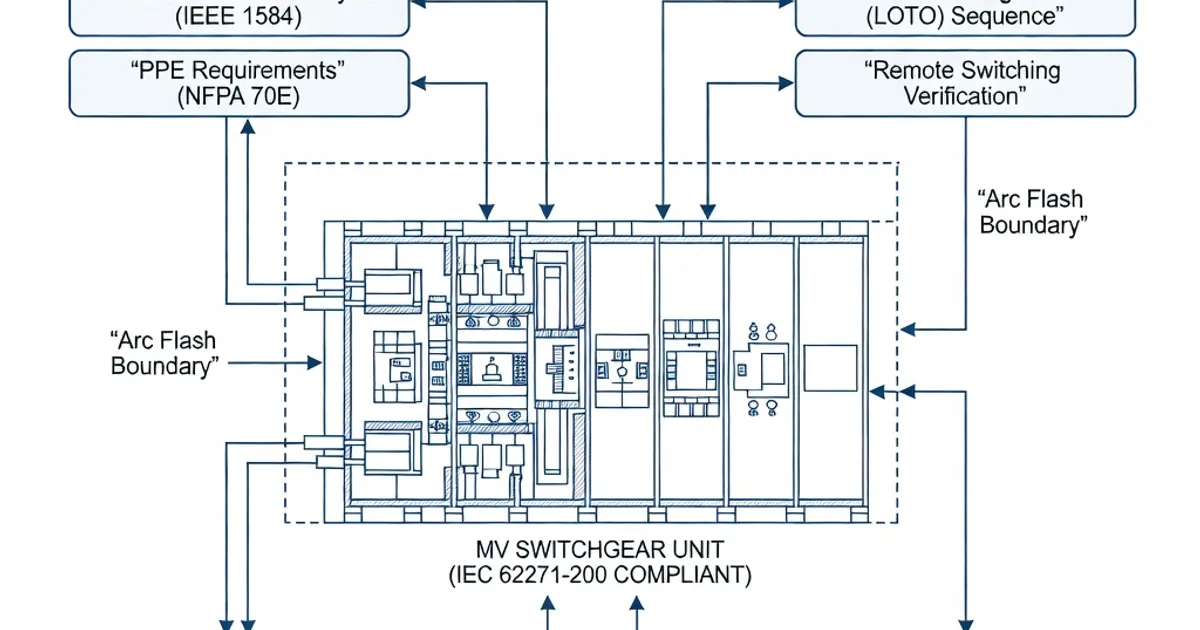
Switchgear Safety Standards Overview
This article summarizes the safety requirements, verification tests, and practical design rules for low-voltage switchgear and controlgear assemblies (PSC) in accordance with IEC 61439 and related standards. It consolidates the key technical specifications you must design, verify, document, and maintain to deliver safe, reliable low-voltage panels for industrial and commercial installations. The guidance below references authoritative sources and practical limits used in conformity assessment and factory testing.
Scope and Objectives of IEC 61439
IEC 61439 establishes the rules for the design and verification of low-voltage switchgear and controlgear assemblies. The standard imposes performance and safety objectives intended to protect personnel, limit damage to equipment, and ensure continuity of service under normal and fault conditions. IEC 61439 applies to assemblies intended for rated voltages up to 1 000 V AC and defines the responsibilities of the manufacturer for design verification, testing, and documentation (see BEAMA guide and IEC guidance) [3][2].
The standard addresses seven primary safety objectives commonly used by panel manufacturers and designers:
- Operational continuity — ensuring assemblies support their rated currents and operational duty.
- Current-carrying capacity — ensuring conductors and busbars do not overheat during rated loading and foreseeable overloads.
- Short-circuit resistance — ensuring mechanical and electrical strength during prospective short-circuit faults.
- Electromagnetic compatibility — avoiding interference that would degrade protection or measurement functions.
- Electric shock protection — preventing contact with live parts and ensuring protective circuits operate under fault conditions.
- Fire protection — limiting ignition sources and maintaining compartmentation to reduce fire propagation.
- Mechanical durability — ensuring doors, hinges, and mounting maintain IP rating and structural integrity over life.
Manufacturers must demonstrate compliance through a combination of standardized tests, calculations, and documentation in accordance with the verification approach specified in IEC 61439-1 and IEC 61439-2 [3][2].
Key Safety Technical Specifications
Electric Shock Protection
IEC 61439 requires assemblies to protect personnel from direct and indirect contact with live parts. Compliance relies on two complementary concepts:
- Basic insulation and enclosure design — making live parts inaccessible under normal operation and maintenance.
- Fault protection — bonding exposed conductive parts to protective earth (PE) and ensuring protective devices clear earth-fault currents so that accessible parts do not present shock hazards [2].
Verification activities include:
- IP and accessibility testing, including IP XXB/XXIP checks where applicable, to confirm that access to live parts is prevented under specified conditions [2].
- Continuity and resistance measurement between each exposed conductive part and the PE terminal (to verify equipotential bonding) [2].
- Verification of short-circuit strength and protective device operation so that fault clearing occurs within safe time/current limits [2].
Practically, designers ensure PE conductors and bolted connections use cross-sections sized to carry prospective fault currents for the required clearing time and use test records to prove continuity and resistance values.
Voltage Stress Withstand Capability (Clearances, Creepage, and Dielectric Tests)
IEC 61439 enforces safe clearances and creepage distances to prevent flashover under steady-state and transient conditions. When geometric clearances fall below the standard's prescriptive values, manufacturers must demonstrate dielectric performance by testing.
- For assemblies intended for 400/230 V earthed neutral systems, measured clearances as low as 3 mm have been accepted where impulse testing demonstrates acceptable behaviour; however, designers commonly maintain larger clearances to provide margin and insulation coordination [3][2].
- The power-frequency dielectric test (routine or type test per IEC 61439-1) for rated insulation voltages between 300 V and 690 V uses a test voltage of 1 890 V AC applied for 1 second (commonly referenced value) to verify the assembly's basic insulation [4].
- Impulse withstand testing may also be required to demonstrate resistance to transient overvoltages if physical clearances are reduced or if the installation environment presents elevated overvoltage risk [2].
When documenting clearances and creepage, the manufacturer must record the measurement methodology and ambient conditions used during verification (IEC 61439 typically assumes test ambient ~35 °C unless otherwise stated) [2].
Neutral Conductor Cross-Sectional Requirements
IEC 61439 specifies minimum neutral conductor cross-sections relative to phase conductors to ensure acceptable temperature rise and fault performance:
| Phase Conductor Cross-Section | Required Neutral Cross-Section | Notes |
|---|---|---|
| Up to 16 mm² | 100% of phase conductor | Neutral must match phase size for most installations [2] |
| Above 16 mm² | Minimum 50% of phase cross-section (but not less than 16 mm²) | Applies where phase conductors exceed 16 mm²; non-copper conductors must meet equivalent copper requirement [2] |
For non-copper conductors (e.g., aluminum), the neutral cross-section must exceed the equivalent copper cross-section to compensate for reduced conductivity [2]. These rules ensure acceptable impedance and heating behaviour under normal and unbalanced loading.
Circuit Breaker and Protective Device Requirements
Circuit breakers and protective devices installed within IEC 61439 assemblies must comply with the device standards IEC 60947-1 and IEC 60947-2. The panel manufacturer must select devices whose declared short-circuit and thermal capabilities match or exceed the assembly's verified values [1][3].
Typical technical requirements enforced in practice include:
- Short-circuit capacity — devices must be capable of withstanding and interrupting prospective fault currents (Icu/Ics/Icw ratings). Example short-circuit ratings used in industrial panels include values such as 50 kA to 65 kA symmetrical for 1 s systems depending on installation and device family; manufacturers must use the device's certified Icu/Ics values in assembly calculations [1].
- Trip coil design — shunt trip coils must be continuously rated and have low holding VA. Momentary or mechanically latched trip coils are not permitted for standard remote tripping applications because they can fail to operate correctly under extended duty [1].
- Front-connectable control and auxiliary wiring — where practicable, breakers and switching devices should allow front access for easier maintenance and safer operation inside enclosures [1].
- Advanced electronic (microprocessor) trip units — where used, these must provide adequately adjustable settings and diagnostics. Common preset ranges used in design verification include overload settings from 70%–100% of breaker rating, short-circuit protection settings from 1.5–10 times overload, and earth-fault protection adjustable around 20%–40% of rated current with time delays to coordinate with upstream protection [1].
Power Quality, Metering and Monitoring
IEC 61439 requires that assemblies serving critical loads or where incoming and outgoing feeders are managed must include adequate measurement and monitoring. Modern LV assemblies typically integrate four-quadrant power meters with waveform capture and harmonic analysis capability.
- Meters should measure per-phase parameters: current (A), voltage (V), power factor (Pf), frequency (Hz), active power (kW), apparent power (kVA), and reactive power (kVAr) [1].
- Energy metering must record energy (kWh), reactive energy (kVArh), and demand values when required for billing or demand management [1].
- Power quality metrics should include THD for voltage and current and individual odd harmonics up to the 31st order; waveform capture capability assists in fault and disturbance analysis [1].
- Integration of monitoring with control systems allows automated protection actions, logging of trips, and predictive maintenance strategies. Manufacturers must verify that any integrated electronic modules meet electromagnetic compatibility requirements so metering accuracy and protective functions remain within specification [1][3].
Internal Arc Withstand (Internal Arcing Faults)
IEC 61439 and associated guidance require manufacturers to consider internal arcing faults separately from conventional bolted short-circuits because an arc is a dynamic, high-impedance fault that generates thermal and pressure effects not captured by short-circuit withstand ratings alone. Internal arc withstand is commonly specified as a prospective fault current and duration pair (for example, 50 kA for 0.1 s) and must be verified in accordance with applicable internal arc testing protocols [7].
Typical internal arc rating examples used in design and selection are:
- 50 kA for 0.1 s (low-duration event)
- 65–100 kA for 0.1 to 0.5 s depending on busbar size, compartmentation, and assembly layout
Manufacturers must document the assembly's internal arc classification and provide appropriate instructions and protective measures (for example, arc-rated doors, remote racking, and safe working clearances) in operation and maintenance manuals. Internal arc testing is a specialized procedure and usually performed by accredited laboratories; the energy released increases nonlinearly with arc duration and configuration and therefore requires careful selection of test points representative of worst-case conditions [7].
Design Verification Approach and Required Tests
IEC 61439 replaced the earlier 60439 "type-tested" concept with the unified notion of a "verified assembly." The manufacturer demonstrates conformity using a mix of type tests, routine tests, and design calculations. The BEAMA verification guide and manufacturer application notes outline the required verifications and documentation [3][6].
Typical verification activities include (not exhaustive):
- Power-frequency dielectric tests (type or routine)
- Impulse voltage withstand testing where required
- Temperature-rise testing to verify heating under rated currents
- Short-circuit withstand testing (electromechanical strength and functional tests at prospective fault current)
- Internal arc testing for assemblies where an internal arc hazard is a credible risk
- Mechanical tests (door hinging, locking, operator interface durability)
- Ingress protection (IP) verification
- Continuity and resistance checks of protective bonding
- Electromagnetic compatibility checks for integrated electronic components
- Verification of control circuitry and auxiliary power integrity
- Routine functional tests for accessories and switching devices
- Documentation of calculations proving clearances, creepage, and conductor sizing
In some guidance documents this set of checks is described as a twelve-point verification approach covering electrical, mechanical, thermal, dielectric and documentation verifications required to declare an assembly compliant [7]. Manufacturers must retain full test reports, test setups, schematics, and ambient conditions for independent audit and for proving conformity during the lifetime of the product [2][3].
Design Best Practices and Manufacturer Responsibilities
To meet IEC 61439 requirements in production and field use, manufacturers and specifying engineers should follow these design best practices:
- Specify components (breakers, contactors, busbars) with certified short-circuit and thermal ratings equal to or higher than the assembly's verified prospective values. Do not rely on component marginal ratings without calculation and testing evidence [3].
- Document clearances, creepage, dielectric tests, temperature-rise data and assembly wiring diagrams as part of the Declaration of Conformity. Maintain test records showing ambient temperatures used for thermal verifications (commonly 35 °C as the test reference) [2].
- Apply current-limiting devices where components lack the mechanical or thermal withstand strength to survive the prospective fault current; current-limiting fuses or breakers can reduce the let-through energy and protect downstream devices [3].
- Design compartmentation and busbar supports to reduce the chance of internal arcing propagation and provide predictable arc energy paths for test correlation [7].
- Maintain IP ratings after installation of equipment and after modifications — door seals, cable entries, and ventilation must preserve declared ingress protection levels [2].
- Ensure front-accessible wiring where required for safe maintenance and that auxiliary circuits (trip coils, interlocks) use continuously rated trip actuators and rated wiring [1].
- Provide clear operation and maintenance instructions including safe working distances, PPE requirements, arc-flash hazard data if available, and procedures for testing and periodic inspection [3][7].
Specification Comparison Table: Typical Panel Test/Rating Values
| Parameter | Typical Value / Requirement | Notes / Reference |
|---|---|---|
| Rated insulation voltage (Uins) | 300–690 V (typical LV range) | Used to select power-frequency and impulse test levels [4] |
| Power-frequency dielectric test | 1 890 V AC for 1 s (for Uins 300–690 V) | Commonly cited verification voltage per guidance documents [4] |
| Minimum measured clearance (example) | 3 mm (for 400/230 V earthed systems when impulse-tested) | Physical clearance may be lower if supported by impulse/dielectric tests [3][2] |
| Neutral conductor sizing | 100% of phase ≤16 mm²; ≥50% for phases >16 mm² (min 16 mm²) | IEC 61439 conductor sizing rules [2] |
| Short-circuit withstand | Device and assembly-rated; typical Icu examples 50–65 kA | Must match device certificates; assembly must be verified for prospective fault current [1] |
| Internal arc rating (examples) | 50–100 kA for 0.1–0.5 s |