Sustainable Panel Design & Eco-Efficiency
Environmental considerations and sustainable design practices for panel assemblies.
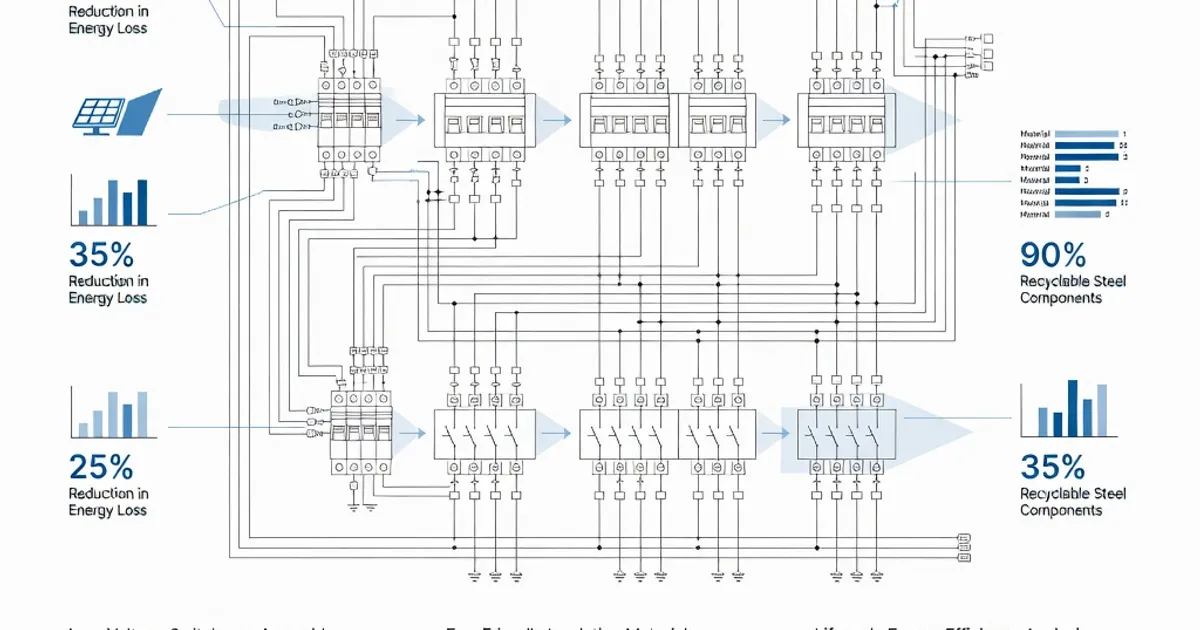
Sustainable Panel Design & Eco-Efficiency
Sustainable low-voltage panel design reduces environmental impact across manufacture, operation, and end-of-life while increasing reliability and lowering operational costs. For IEC 61439 assemblies, sustainability is not an add-on: it follows directly from verified performance criteria in thermal management, corrosion and UV resistance, mechanical integrity, dielectric strength, and short‑circuit withstand. Per IEC 61439-1:2020, designers must combine tests, calculations, and comparisons to demonstrate performance and therefore deliver eco-efficient assemblies that last longer, consume less energy, and generate less waste over their lifecycle [3][9].
Why sustainability matters for LV panels
Panels represent long-lived installed hardware that can account for substantial lifecycle energy use and embodied carbon. Failures from overheating, corrosion, UV degradation, or poor EMC increase maintenance, cause premature replacement, and create waste. By designing to IEC 61439 verification criteria (Clause 10), manufacturers reduce failure modes that raise lifetime environmental cost. Verified temperature-rise behaviour reduces conductor and component losses and extends insulation and device life; robust IP/IK and UV performance reduce corrosion and repaint/rework cycles for outdoor equipment; and correct short‑circuit and earthing design prevents catastrophic failures that would create large-volume replacements [3][1][4].
Applicable standards and where they drive eco-efficiency
- IEC 61439-1:2020 (General rules) — sets verification methods for construction and performance, including Clause 10 (verification by tests, calculations, and comparisons), Clause 8 for construction requirements such as clearances and creepage, and Clause 10.9–10.11 for short-circuit, dielectric, temperature-rise and EMC performance. IEC 61439 replaces traditional type testing with a flexible verification approach that enables targeted sustainability improvements while assuring safe, efficient operation [3][9].
- IEC 61439-2 — applies product-specific rules for power switchgear and controlgear assemblies (up to 6300 A) and informs high-current sustainable design choices (selection of busbars, cooling, and mechanical strength) [3].
- IEC 60529 — defines IP degrees of protection for enclosures against dust and water; correct IP selection directly reduces maintenance and corrosion‑related replacements [1].
- IK codes and mechanical impact (IEC 61439-1:10.101) — mechanical robustness reduces repair cycles and waste from impact damage; outdoor enclosures often require IK08–IK10 ratings [1].
- DIN EN 60890 — provides accepted methods for thermal calculations and current-carrying capacity used when verifying temperature rise to reduce losses and extend component life [4][5].
- ISO 2409 — adhesion testing for paints/coatings; for outdoor panels UV/corrosion tests expect no cracks and at least 50% adhesion retention per ISO 2409 to ensure long-term coating performance [1][5].
- IEC 60947 series — component performance and selection (switches, breakers) that affect losses, switching efficiency and lifecycle [3].
Key performance parameters that drive eco-efficiency (and relevant clauses)
- Temperature rise and thermal management (IEC 61439-1:10.10) — designers must verify temperature rise under declared service conditions by test, calculation (e.g., DIN EN 60890), or comparison. Lower temperature rise reduces resistive losses and prolongs insulation and device life; manufacturers commonly verify up to distribution ratings such as 630 A in product workbooks [4][5].
- Short‑circuit withstand (IEC 61439-1:10.9) — verified mechanical and thermal withstand reduces the risk of catastrophic failures that generate large waste streams and require replacement of assemblies [3].
- Ingress and mechanical protection (IEC 60529 and IEC 61439-1:10.101) — selection of IP (e.g., IP54, IP55, IP65 for different outdoor exposure) and IK ratings (IK08–IK10) preserves internal components and reduces maintenance and replacement [1].
- Dielectric properties and impulse withstand (IEC 61439-1:10.9) — adequate dielectric testing reduces the risk of insulation breakdown and ensuing replacements [3].
- Earthing and conductor routing (IEC 61439-1:8.6) — correct earthing, bonding and limitation of non-protected live conductor length (≤3 m per Table 4 of Clause 8.6) prevent stray heating and reduce losses and safety incidents [4].
- Environmental limits — define and verify service temperature range and altitude for reliable operation. Product workbooks commonly specify ranges such as −25 °C to +40 °C and 100% humidity for outdoor-rated assemblies; altitude limits are commonly set at ≤2000 m unless otherwise verified [4][2].
Design strategies to maximize eco-efficiency
Apply these strategies during concept, detailed design, and verification.
- Material selection and busbar design — use high-conductivity copper or properly sized aluminium with low-resistance joints and insulation systems selected for long-term thermal stability. Minimize resistive losses by optimizing cross-sectional area, spacing to improve natural convection, and by using welded or bolted busbar joints with controlled torque to avoid hotspots [2][4].
- Thermal design and verification — combine calculations per DIN EN 60890 with representative temperature-rise testing to prove declared ratings. Use diversity factors where permitted to size conductors more efficiently while ensuring hotspots do not develop. Implement ventilation, conductive heat paths, or forced cooling only where lifecycle analysis justifies the extra energy for fans versus the losses prevented [4][5].
- Reactive power compensation — integrate power factor correction at panel or area level to reduce line currents and distribution losses; Schneider Electric documents energy-efficiency gains when reactive compensation reduces losses and thermal stress on components [6].
- Robust enclosures and coatings — choose enclosures and coatings that meet required IP/IK ratings and pass UV/adhesion tests (ISO 2409). For outdoor applications choose IP65/IK10 enclosures and corrosion-resistant finishes or stainless/galvanized steel where local conditions demand [1][5].
- Component selection and lifecycle — specify devices with proven long-term performance (e.g., breakers and switches rated per IEC 60947) and predictable replacement intervals; select components with lower maintenance needs and higher MTBF to reduce lifecycle waste [3].
- Layout and connection quality — minimize length of unprotected live conductors (≤3 m where applicable), use secure bolted connections, appropriate torque, and ensure conductor routing prevents heat accumulation and facilitates inspection and maintenance [4].
- End-of-life considerations — design for disassembly: use separable fasteners, label materials for recycling, avoid mixed-material bonding where possible to simplify recycling and lower embodied carbon impact.
Verification approach per IEC 61439 and how it supports sustainability
IEC 61439’s verification framework (Clause 10) permits a mix of tests, calculations and comparisons that lets manufacturers target full tests where they have the biggest sustainability impact while using validated calculations or comparison with proven designs elsewhere to avoid unnecessary testing costs and material use [3]. Practical verification steps:
- Define declared conditions — ambient range, altitude, humidity, load scenarios and diversity factors; accurate definitions avoid over-design and associated material waste [4].
- Thermal verification — perform temperature-rise tests or calculate using DIN EN 60890; compare with reference assemblies where applicable. Verified thermal margins prevent overheating and premature component replacement [4][5].
- Mechanical and IP/IK testing — carry out IP tests per IEC 60529 and IK tests per IEC 61439-1:10.101; for outdoor panels include UV and adhesion tests (ISO 2409, ≥50% adhesion retention) to ensure coatings last [1][5].
- Short-circuit and dielectric testing — verify short-circuit withstand and dielectric strength to prevent catastrophic failures that drive disposal and re-manufacture [3].
- Document and reuse verified elements — maintain a design verification workbook (as ABB and others do) so validated modules can be reused and only novel parts require testing, minimizing material and test-energy consumption [4].
Practical specification targets and example values
Below are practical targets commonly used in sustainable IEC 61439 panel design. Use these as starting points; always verify for the declared service conditions of each assembly.
| Performance Area | Practical Target / Typical Value | Reference / Rationale |
|---|---|---|
| Declared service voltage | ≤ 1000 V AC / ≤ 1500 V DC | IEC 61439 general limits for LV assemblies [3] |
| Temperature range | −25 °C to +40 °C (outdoor rated); specific verification for wider ranges | Common product workbooks specify −25 °C to +40 °C, 100% humidity for outdoor assemblies [4] |
| Altitude | Declared ≤ 2000 m for standard verification; higher altitudes require derating/verification | Industry guidance and risk assessment best practice [2][4] |
| Ingress protection | IP54–IP65 depending on exposure (IP65 recommended for heavy outdoor exposure) | IEC 60529; higher IP reduces maintenance and corrosion-related failures [1] |
| Mechanical protection | IK08–IK10 for outdoor/industrial areas | IEC 61439 requirements for mechanical integrity (10.101) [1] |
| Coating adhesion | No cracks; ≥ 50% adhesion retention after UV/aging tests (ISO 2409) | ISO 2409 adhesion requirement used in product verification [1][5] |
| Non-protected live conductor length | ≤ 3 m (per Table 4 of IEC 61439-1:8.6) | Reduces risk of arcing and heating, preserves efficiency [4] |
Product examples and how major suppliers address eco-efficiency
Leading manufacturers embed sustainable design into both enclosure and internal layout choices:
- Siemens — SIVACON and related control panels implement IEC 61439 verification with efficient busbar and thermal verification up to distribution levels such as 630 A; documentation highlights flexible, low-loss layouts and sustainable long-term operation through verified short-circuit strength [5][8].
- ABB — provides a practical workbook on IEC 61439 application that includes temperature rise verification using DIN EN 60890, earthing and environmental specifications (for example declared service ranges and humidity tolerance) and guidance to minimize over-design [4].
- Schneider Electric — integrates thermal, dielectric and mechanical considerations and promotes reactive power compensation to reduce distribution losses and thermal stress on components [6].
- Rittal — focuses on enclosure engineering with high IP/IK ratings and corrosion/UV‑resistant finishes that pair with IEC 61439 assemblies for durable outdoor installations [1].
- Eaton — publishes guidance for design verification and supports eco-focused arrangement choices that reduce losses and maintenance [2].