Routine Verification Tests for Panel Assemblies
Guide to routine verification tests performed on every manufactured panel assembly.
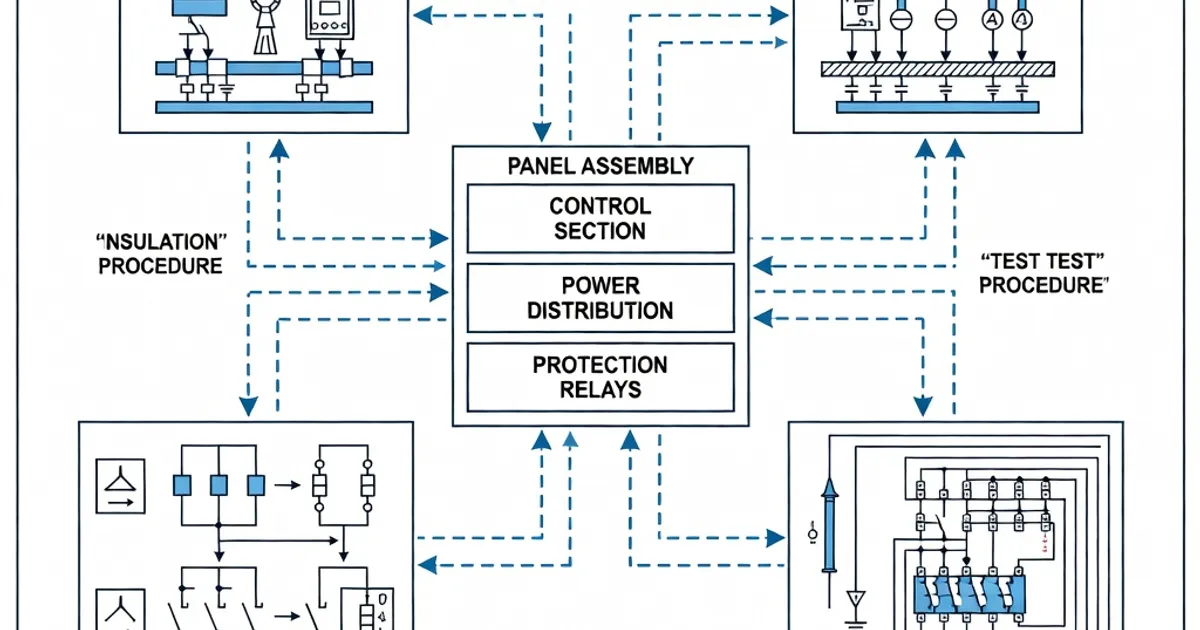
Routine Verification Tests for Panel Assemblies
Every finished low-voltage switchgear and controlgear assembly (hereafter "assembly" or "panel") must undergo a set of routine verification tests before it leaves the manufacturer. These routine verifications verify workmanship, correct functioning of installed devices, and safety elements that can be affected during assembly and transport. They are distinct from type (design) tests: routine tests apply to every manufactured unit and constitute production quality control as defined by IEC 61439-1 and IEC 61439-2.
Scope and Regulatory Basis
Routine verification tests for low-voltage assemblies are defined in IEC 61439-1:2020 Clause 11. Part 2 of the standard (IEC 61439-2:2021) references and requires these routines for power assemblies (typically >25 A) while Part 3 addresses distribution boards with the same routine principles applied as appropriate for the product family. Annex D of IEC 61439-1 explains the verification methods (test, calculation, design rules) and clarifies that routine verifications represent a simplified subset of full design verification suitable for production QC rather than prototype validation.
Per the standards, the manufacturer must perform the routine tests on every assembly and record results in production documentation. The objective: confirm that the delivered unit corresponds with the verified design and that no assembly-induced defect compromises electrical safety or operation (IEC 61439-1 Clause 11) [1, 2].
What Routine Tests Cover
Routine verifications concentrate on those parameters most susceptible to assembly faults: insulation integrity, protective conductor continuity, correct wiring and connections, functional operation of switching devices, mechanical integrity, and marking/documentation. Below is a concise list of the mandatory and commonly applied routine checks, together with their standard references and pass criteria used in production practice.
- Insulation resistance (IEC 61439-1 Clause 11): measured between live parts and exposed conductive parts or earth. The minimum requirement is 1000 Ω per volt of rated voltage (1000 Ω/V). Practically, manufacturers target at least 0.5 MΩ for 230/400 V systems and higher values for higher-rated systems; many set production limits of 1 MΩ as a conservative pass criterion [1].
- Continuity of protective circuits: verification of the low-impedance connection between exposed conductive parts and protective conductor terminals. Typical acceptance targets used in industry are 0.1 Ω or less for main protective bonding between frame and protective terminal, but the standard requires a "low impedance path" and that the resistance shall be measured and recorded (IEC 61439-1 Clause 11) [1, 2].
- Conductors, wiring and accessories: visual inspection and, where necessary, measurement to confirm proper routing, secure fixing, correct insulation, separation of circuits, marking, and segregation of Class II parts (IEC 61439-1 Clause 11). Inspectors verify that no unauthorised metal parts penetrate enclosures and that wiring in ducts is fixed to prevent chafing [1].
- Protection against electric shock: verification that exposed conductive parts are either connected to protective conductors or insulated as Class II, correct application of labels/warnings, and integrity of covers and barriers (IEC 61439-1 Clause 11) [1].
- Clearances and creepage distances: visual and, where needed, measured verification to ensure compliance with the values required by the design verification (refer to IEC 61439-1 Clause 10.4). Where design rules apply, the manufacturer may confirm by inspection or calculation that distances are maintained [4].
- Mechanical and electrical operation: functional testing of switches, breakers, interlocks, AC drives, and auxiliary devices. Mechanical endurance checks typically apply—for some devices, industry practice calls for 200 operations to demonstrate correct mechanical behavior after assembly (IEC 61439-1 Clause 11, industry guidance) [1, 5].
- Degree of protection (IP): where required, verification of enclosure protection against ingress per IEC 60529. Production IP checks may include visual confirmation of gaskets and fasteners and, where necessary, IP XXB fingertip/probe checks or sample water/ dust tests depending on declared IP code (IEC 61439-1 Clause 11 and IEC 60529) [1, 4].
- Labels, marks and documentation: verification that the unit nameplate shows rated insulation voltage (Ui), rated operational voltage (Ue), rated impulse withstand voltage (Uimp), current type/frequency, and references to applicable standards. Also confirm enclosure and circuit identification, warnings, and auxiliary circuit details (IEC 61439-1 Clause 11) [1].
- Final visual inspection: comprehensive visual check for foreign objects, loose parts, correct fastening torques, paint and corrosion protection, and transport restraints removed. Industry practice treats this as a pass/fail gate prior to shipment [9].
Routine Test Specification Table
| Test | IEC Clause / Reference | Method | Typical Pass Criteria / Notes |
|---|---|---|---|
| Insulation resistance | IEC 61439-1 Clause 11 | Megger between live parts and earth; test voltage per manufacturer / local practice | Minimum 1000 Ω/V (manufacturers typically use ≥0.5 MΩ for 230/400 V; many use ≥1 MΩ) |
| Protective conductor continuity | IEC 61439-1 Clause 11 | Low-resistance ohmmeter between exposed conductive parts and PE | Typically ≤0.1 Ω for main bonds; record reading |
| Clearances / Creepage | IEC 61439-1 Clause 10.4 | Visual measure or gauge against design values | Meet design verification values; measure critical distances |
| Functional / Mechanical operation | IEC 61439-1 Clause 11 | Operate devices; mechanical endurance cycles where applicable | Devices operate correctly; typical 200 cycles for mechanical checks |
| Degree of protection (IP) | IEC 60529 / IEC 61439-1 Clause 11 | Inspection; sample tests (probe, water) where declared | Achieve declared IP rating (e.g., IP2X, IP54) or document alternative verification |
| Labels & documentation | IEC 61439-1 Clause 11 | Visual check against order and type certificate | All required markings present and legible |
Test Methods, Equipment and Typical Settings
Manufacturers use calibrated test equipment and documented procedures to ensure reproducible routine checks. Typical tools and settings include:
- Insulation resistance tester (Megger): test voltage commonly 500 V DC for general-purpose checks; result interpreted against 1000 Ω/V criterion. Many workshops apply a 1-minute test duration and record the final reading [1].
- Micro-ohmmeter / low-resistance ohmmeter: for protective conductor continuity and main bonding; typical resolution down to milliohms; acceptance commonly ≤0.1 Ω for main bonding paths per industry practice (Siemens/ABB/Eaton practice references) [8].
- Insulation visual gauges and calipers: for clearance / creepage checks per the design rule values in IEC 61439-1 Clause 10.4.
- Functional test rigs: to energise auxiliary circuits, actuate control switches, and verify interlocks without applying full fault-level stress. Use of mock loads or control test fixtures is common.
- IP check tools: probes for IP2X/IPXXB; spray and dust chambers for sample tests if required by contract or declared IP rating (IEC 60529) [4].
- Torque wrenches: to verify terminal and busbar connection torques as part of final inspection.
Pass/Fail Criteria and Record Keeping
IEC 61439 requires manufacturers to record routine verification results and to maintain traceability. Typical production practice is:
- Record measured values for insulation resistance and protective conductor continuity for each unit.
- Log functional test outcomes and any corrective actions taken.
- Attach or supply a certificate of conformity with the assembly indicating completion of Clause 11 routines and referencing the applicable type test report and design verification method (test, calculation or design rule per Annex D) [2].
Common Failures Found During Routine Verification and Typical Remedies
Routine tests primarily detect workmanship and assembly errors. Typical faults encountered in production and corrective actions include:
- Poor wiring routing causing insufficient clearances — remedy: re-route wiring, secure with clips, verify creepage/clearance.
- Loose bolted connections or incorrect torque — remedy: retorque to specified value, re-measure continuity.
- Missing or incorrect labels/documentation — remedy: apply correct marking, update documentation pack.
- Low insulation resistance due to contamination or moisture — remedy: clean, dry, re-test; if persistent, isolate and repair the faulty component or replace wiring harness.
- Protective conductor continuity above acceptable limit — remedy: check bonding conductors, re-tighten bonds, replace corroded/bad lugs, re-test.
Manufacturers systematically document root-cause and corrective action for any failed routine test to prevent recurrence in subsequent units [9].
Industry Examples — How Leading Manufacturers Implement Routines
Major panel builders and switchgear vendors certify designs via type tests or verified design and then perform the full set of Clause 11 routine verifications on every
Related Panel Types
Frequently Asked Questions
Request a Quote
Tell us about your panel requirements and our engineering team will get back to you within 24 hours.
Email Us
[email protected]Call Us
+90 232 332 22 78