Panel Upgrade & Retrofit Guide
Guidelines for upgrading or retrofitting existing panel assemblies.
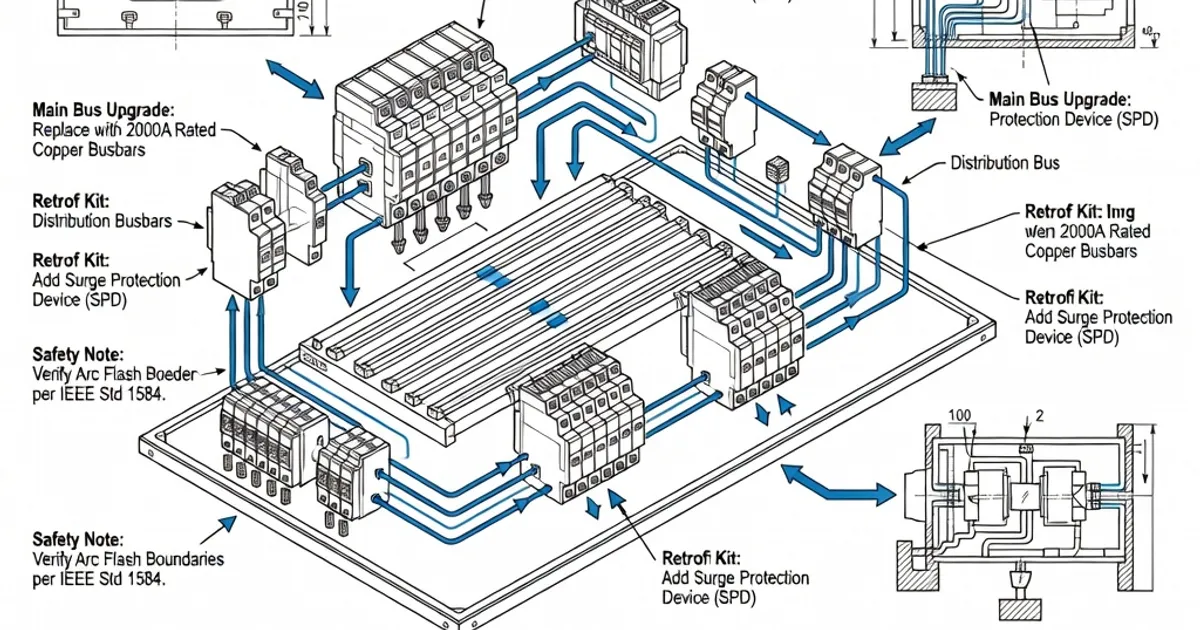
Panel Upgrade & Retrofit Guide
This guide explains technical best practices, compliance requirements, verification methods, and practical steps for upgrading or retrofitting low-voltage panel assemblies to meet IEC 61439 (and EN 61439) performance and safety expectations. It integrates manufacturer guidance, normative clauses, and industry design experience so you can plan retrofit projects that deliver verified short-circuit, temperature-rise, dielectric and mechanical performance with minimum service disruption.
Purpose and Typical Retrofit Objectives
Panel retrofit projects focus on extending service life, improving safety, and increasing capacity while minimizing downtime compared to full replacement. Typical retrofit objectives include:
- Upgrading protective device interrupting ratings and modernizing trip units (short-circuit and selective coordination improvements) [1].
- Replacing obsolete breakers, relays and auxiliary equipment with IEC/EN-conforming modern equivalents [1][4].
- Adding circuits or space for load growth without disturbing existing feeders and distribution topology.
- Adding ground-fault protection or adjustable electronic trip units for better earth-fault discrimination [1].
- Addressing thermal problems identified by field thermography by improving busbar connections, cooling paths and conductor sizing.
Why Retrofit Instead of Replace?
Retrofitting typically reduces installation time and user disruption. Eaton documents that retrofit interior conversion reduces on-site labor and can maintain service continuity during staged upgrades compared to full panel replacement [1]. However, retrofit delivers these benefits only when the existing enclosure and buswork can meet IEC 61439 verification either directly or by reference to a tested assembly; otherwise full replacement or major rebuild may be necessary [3][4].
IEC 61439 Compliance: Verification Options and Key Limits
IEC 61439 introduced a verification-based approach to compliance. The standard permits three primary compliance routes: full type-testing of the assembly, design verification by calculation, or verification by application of design rules referencing a similar tested assembly [3][5]. Choosing the correct route impacts how you engineer a retrofit and what tests you must perform.
- Full type-testing: Conduct all mandatory type tests described in IEC 61439-1/-2 for the specific assembly configuration.
- Verification by calculation: Perform engineering calculations (electrical, thermal, short-circuit) to demonstrate compliance—limited to assemblies with rated currents up to 1600 A and tested/assumed ambient ≤35 °C during verification [3].
- Verification by design rule from a similar tested assembly: Demonstrate that the retrofit assembly matches or improves on the reference assembly with respect to construction, separation, power losses, dimensions, and number of outgoing circuits; components and units must be identical or proven equivalent [3].
Per IEC 61439-1 and associated guidance, you must document the chosen verification route and generate a verification file, including calculations, test reports, and routine test outcomes, as evidence of compliance [2][3].
Temperature Rise and Current Limits
Temperature rise verification is critical in retrofits. Assemblies verified by calculation are limited to rated currents of 1600 A maximum. Additionally, the average ambient temperature used during verification must not exceed 35 °C unless additional allowances are justified and documented [3]. If the retrofit increases power losses, you must re-evaluate temperature rise and potentially perform type tests or use an appropriate reference assembly.
Electrical Performance Requirements for Retrofits
IEC 61439 requires that assemblies — including retrofitted ones — demonstrate the following electrical capabilities:
- Short-circuit withstand strength: Confirm that busbars and connections can withstand prospective short-circuit levels without catastrophic failure and that protection devices coordinate to clear faults safely. Verification may be by test or calculation and must be documented [4].
- Dielectric properties: Validate insulation, clearances, and creepage distances per IEC 61439 and IEC 60947 series requirements to ensure safe operation at the intended system voltages [2][3].
- Temperature-rise limits: Demonstrate that temperature rises on current-carrying parts stay within the limits defined by IEC 61439 for the verification method chosen [3].
Retrofitted panels must also preserve or improve protective conductor continuity, equipotential bonding and external conductor terminal accessibility for routine inspection and maintenance [3].
Mechanical, Environmental and Safety Considerations
A retrofit must not degrade the physical integrity, IP rating, or mechanical operation of the enclosure and removable parts. IEC 61439 verification encompasses:
- Material strength and mechanical integrity — parts must resist handling, lifting and installation stresses per IEC 62208 and the assembly's documented verification method [3].
- Degree of protection (IP rating) — retrofits must maintain or upgrade the enclosure's IP rating as required by the application (IEC 60529) [3].
- Clearances and creepage — maintain required distances for the new configuration to avoid breakdown or tracking during operation [2][3].
- Arc-fault mitigation — consider internal arc testing or mitigation measures per IEC 61641 for installations where arc energy or personnel risk is significant; manufacturers like ABB test modular systems for internal arcing performance and implement gas-tight seals and forms of separation to reduce propagation [7].
Standards and Normative References
Key standards to reference when planning or executing a retrofit include:
- IEC 61439-1 – General rules for low-voltage switchgear and controlgear assemblies [3].
- IEC 61439-2 – Power switchgear and distribution assemblies (specific requirements for power distribution) [3].
- IEC 60947-1 and IEC 60947-2 – Requirements for switchgear and circuit breakers, including EMC and CE marking for trip units [1].
- IEC 60529 – Degrees of protection by enclosures (IP codes) [3].
- IEC 61641 – Guidance and tests for internal arcing due to faults, used for arc-resistant design verification [7].
- IEC 62208 – Requirements for enclosures and mechanical tests, including lifting and handling [3].
Manufacturer Examples and How They Inform Retrofit Design
Eaton Pow-R-Line Retrofit Solutions
Eaton’s retrofit panels (Pow-R-Line 1RX and 2RX) support voltages of 240 Vac, 480 Vac and 600 Vac and conform to IEC 60947-2 test programs including EMC testing for electronic trip components. Eaton documents four-point in-and-out adjustment of the interior to meet flush installation depths, and main lugs suitable for both copper and aluminum conductors, simplifying conductor reuse in many retrofit scenarios [1]. Eaton trip units commonly carry CE marking consistent with low-voltage directives [1].
ABB MNS Modular System
ABB’s MNS low-voltage switchgear is designed and verified to IEC 61439-1/-2. The system offers modular widths (recommended 400, 600, 800, 1000 and 1200 mm) and a basic grid size of E = 25 mm per DIN 43660 for standardized accessory spacing. ABB documents form 4 separation options, gas-tight compartmentalization, and arc-mitigation measures validated to IEC 61641, making it a practical choice for retrofits that must deliver high short-circuit withstand and arc safety [7].
Hensel ENYSTAR and Mi Power Distribution Boards
Hensel’s ENYSTAR and Mi Power families include guidance for compliance with IEC 61439/EN 61439. Typical ratings include ENYSTAR boards up to 250 A and Mi Power assemblies up to 630 A. Their guide lays out the five-step approach: define operational requirements, perform design verification, verify maximum temperature rise, complete routine verification and tests, and provide marking and an EC declaration of conformity [2]. Hensel guidance is especially useful as a procedural checklist for retrofit documentation and routine tests.
Retrofit Design and Verification Workflow
Use this structured workflow to execute compliant retrofit projects efficiently:
- 1. Site survey and data collection: Record existing busbar sizes, material (Cu/Al), clearances, breaker types, short-circuit levels, protective-coordination study data, and enclosure IP/condition. Capture thermographic images and mechanical condition of bus clamps and connections.
- 2. Load and short-circuit studies: Verify prospective fault currents, system earthing type, and load growth projections to size new devices and busbars appropriately per IEC 61439 requirements [3].
- 3. Select verification route: Choose type-test, calculation, or reference-design rule approach based on available test data, current rating (note 1600 A limit for calculation verification) and similarity to a tested assembly [3].
- 4. Mechanical and electrical design modifications: Design or select modification kits that preserve enclosure strength, separation (forms of separation), and IP rating; specify new devices that match or improve component ratings (interrupting capacity, thermal losses, power dissipation).
- 5. Perform required verification and routine tests: Execute insulation resistance, polarity, continuity, functional operation, mechanical operation tests, and temperature-rise verification (test or calculation). If applicable, perform short-circuit verification and arc-fault testing or analyze equivalent protective measures [2][3][7].
- 6. Documentation and marking: Prepare a verification file containing drawings, calculations, test reports, routine test results, component certificates and an EC declaration of conformity as required by IEC 61439 and manufacturer guides [2].
- 7. Commissioning and handover: Implement labeling, provide maintenance instructions and routine test reports, and ensure that external conductor terminals are clearly marked and accessible for future inspection [3].
Routine Tests and Typical Measured Values
Routine verifications on retrofitted assemblies generally include:
- Visual inspection and verification of marking and identification of external conductors [3].
- Insulation resistance test at prescribed voltages (dependent on rated voltage per IEC 61439 and IEC 60947 series).
- Continuity checks of protective conductors and interlocks.
- Functional trip and operation tests for protection devices (including electronic trip unit functional checks and settings verification per vendor instructions) [1].
- Temperature rise verification (either measured during a type-test or calculated and validated where permitted) [3].
Temperature Rise, Short-Circuit and Arc-Fault Considerations
Temperature rise: For calculation-based verification, verify that conductor heating, contact resistance and device losses keep temperature rise within IEC 61439 limits for the selected rated current and ambient conditions (≤35 °C average) [3]. An increase in power losses compared to the reference assembly invalidates reliance on a reference type-test unless you prove equivalence.
Short-circuit: Busbars, bolted connections and mounting hardware must withstand prospective short-circuit stresses. If the retrofit increases fault levels beyond the original design or alters the number/position of outgoing circuits, you must re-evaluate the short-time withstand and peak values using test data or calculation per IEC 61439 requirements [4].
Arc-fault and personnel safety: For high-energy systems or locations with personnel exposure, consider arc prevention, segregation and pressure relief measures validated to IEC 61641. ABB’s documented MNS approach provides an example of modular physical separation and gas-tight seals that reduce arc propagation and protect adjacent compartments [7].
Design Best Practices and Common Pitfalls
Best practices for retrofit projects include:
- Maintain or improve the form of internal separation (Form 2, 3, 4 as applicable). Ensure any removable units maintain safe isolation states (ABB documents INSERTED / ISOLATED / MOVE positions for withdrawable modules) [7].
- Match or upgrade busbar materials and cross-sections; use manufacturer-approved connection torque, clamp types and contact surfaces to reduce contact resistance and heating [1].
- Confirm trip device CE/EMC compliance and ensure settings provide discrimination with upstream devices to limit damage during faults [1][2].
- Document equivalence thoroughly when relying on a tested reference assembly; demonstrate identical or improved dimensions, losses and separation per IEC 61439 design-rule criteria [3].
- Avoid cosmetic-only retrofits. Superficial component swaps without verifying thermal, dielectric and mechanical properties can violate IEC 61439 and increase risk [4].
Common pitfalls include: assuming legacy enclosures will meet IP/clearance rules after modification without verification, underestimating short-circuit levels, and failing to document the verification route and routine tests adequately for the future owner or authority having jurisdiction [2][3][4].
When Not to Retrofit
Consider full replacement when:
- Busbar or enclosure condition is poor (corrosion, mechanical deformation) and repair cannot restore original rated strength or IP limits.
- Prospective fault currents are significantly higher than the original design and the bus or structure cannot be economically uprated.
- Required modifications change the assembly beyond the allowable limits for reference verification (increased losses, reduced separations, or changes in number/type of outgoing circuits) [3].
Related Panel Types
Frequently Asked Questions
Request a Quote
Tell us about your panel requirements and our engineering team will get back to you within 24 hours.
Email Us
[email protected]Call Us
+90 232 332 22 78