Thermal Management in Panel Assemblies
Cooling strategies and thermal design for IEC 61439 panel assemblies.
Thermal Management in Panel Assemblies
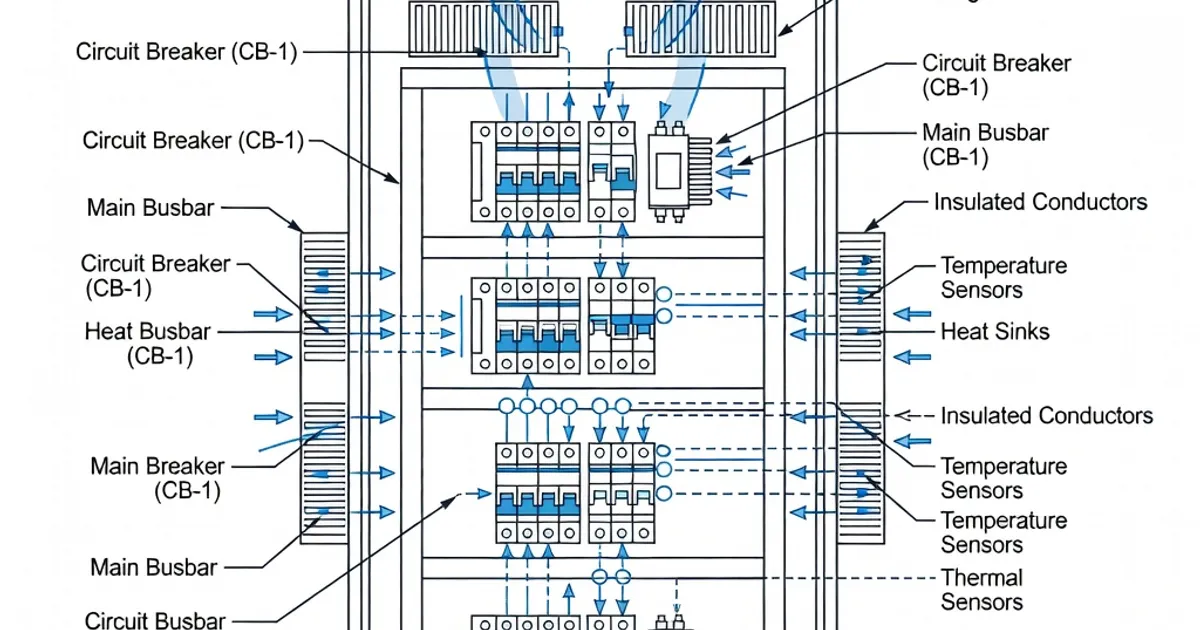
Thermal management is a fundamental design requirement for IEC 61439-compliant low-voltage panel assemblies. Effective temperature control prevents component ageing, avoids insulation and conductor damage, and ensures continued functional integrity under rated conditions. This article summarizes mandatory limits from the standard, explains verification routes and calculation methods, and provides practical design and maintenance guidance—supported by industry guidance and vendor examples.
Regulatory framework and key clauses
Per IEC 61439-1 (common rules) the principal thermal requirement is the temperature rise verification defined in Clause 10.10. Verification ensures that no functional unit, busbar, or the complete assembly produces excessive hot spots when operated at rated conditions and with a reference ambient temperature of 35°C (Clause 4.4). Insulating materials are required to meet a ball pressure test in Clause 10.11 to demonstrate resistance to thermal deformation.
IEC 61439-2 (power switchgear and controlgear assemblies) supplements these rules with application-specific limits and test arrangements commonly used for distribution switchboards. For calculation-based temperature prediction in ventilated enclosures, IEC TR 60890 provides a recognised analytical method. Other referenced standards that affect thermal design include IEC 60947 (component characteristics), IEC 60529 (degree of protection / IP ratings affecting airflow and heat dissipation) and vendor technical application notes such as ABB’s Technical Application Paper No. 11 for practical verification guidance (temperature rise verification and use of IEC TR 60890) (see ABB Technical Paper and IEC literature).
Mandatory temperature limits and material constraints
IEC 61439 sets explicit temperature limits for different assembly parts. Designers must ensure that temperatures measured under test or predicted by calculation do not exceed these maximums:
| Element | Maximum Permissible Temperature | Notes / Clause |
|---|---|---|
| Bare copper busbars | 140°C | IEC 61439-1 Clause 10.10 |
| Bare aluminium busbars | 80°C | IEC 61439-1 Clause 10.10 |
| Individual functional units (components) | 125°C | IEC 61439-1 Clause 10.10 |
| External insulated conductors | 105°C | IEC 61439-1 Clause 10.10 |
In addition, insulating materials used to support live parts or to maintain creepage/clearance must pass the ball pressure test defined in Clause 10.11. The test calls for samples ≥2 mm thick to be held at 125°C for parts that support live components, and at 70°C for other insulating parts; the samples are held for one hour during the test.
Verification routes: test, partial test, calculation, and comparison
IEC 61439 recognises three verification routes for temperature rise and thermal behaviour. Manufacturers must choose an approach consistent with the assembly complexity and rated current:
- Complete assembly type test: Temperature rise is verified on the fully assembled switchboard at rated currents and under specified ambient conditions. This route provides the highest level of assurance and is strongly preferred where practical (IEC 61439-1 Clause 10.10).
- Combination of functional-unit tests plus complete-assembly test: Individual functional units (for example, outgoing feeders or sectionalized units) can be type-tested separately and complemented by a reduced-scope complete assembly test to verify interaction and internal heat distribution.
- Unit-level testing with busbar and complete-assembly verification: Each functional unit and busbar arrangement is verified independently and then again as part of the complete assembly when necessary.
IEC 61439 emphasises a hierarchy: direct testing of the final assembly is preferred; calculations or comparisons to tested reference designs are acceptable only where permitted by the standard and supported by conservative design assumptions (same material, equal or greater dimensions, equal or greater separation distances, same functional unit grouping and power losses) (see IEC 61439-1 and ABB application guidance).
Limits on calculation-only verification and the 1,600 A threshold
For multi-compartment assemblies, IEC 61439 restricts the exclusive use of calculation methods to assemblies with rated currents up to 1,600 A. Above this rating the standard expects type-testing or combination test methods since thermal interaction and complex heat paths become more significant. When designers extrapolate from a tested reference assembly, the standard requires that the new assembly must maintain the same or more conservative values for dimensions, separations, functional unit grouping, and power losses for the comparison method to be valid.
In practice, this means that for large distribution panels, assemblies rated for 2,500–4,000 A (common in industrial distribution switchgear) are usually verified by type-test or by using conservative engineering judgement supported by trusted vendor test data (see ABB Technical Application Paper No. 11 and IEC TR 60890 for calculation guidance).
Ventilation and cooling strategies
Thermal management typically combines enclosure design, conductor/busbar sizing, and heat removal strategies. The industry favours a staged approach:
- Design for low losses first: Select conductors and components sized to reduce I2R losses. Use copper busbars of appropriate cross-section where practical—remembering copper busbar allowable surface temperature is higher than aluminium.
- Passive cooling (natural convection, vents): Use convection openings, louvres, and thermal paths to ambient wherever IP protection and site conditions permit. Passive solutions are preferred because they reduce complexity and mechanical failure modes.
- Controlled ventilation / forced cooling: Add fans, filtered air paths or heat exchangers when passive ventilation cannot keep internal temperatures below limits. For example, many vendor designs offer forced ventilation as an option on higher current assemblies (Eaton Power Xpert and ABB UniGear families provide forced-ventilation options for high-current applications). Forced ventilation should be designed so as not to compromise the enclosure’s required IP rating for the site (IEC 60529).
- Local heat sinks and thermal separation: Separate high-loss units, provide local shields and thermal barriers, or use metallic plates to direct heat away from temperature-sensitive components.
IP rating selection (per IEC 60529) directly affects cooling choices. High IP ratings (IP54 and above) reduce ingress but also reduce free airflow; designers must compensate with larger heat-exchange surfaces or forced ventilation. Vendor enclosure ranges (e.g., Rittal Perforex series) provide a balance of modular cell widths and depths to allow thermal design flexibility while maintaining common IP ratings.
Busbar design, conductors and thermal performance
Busbar material and geometry govern a substantial portion of heat generation and dissipation in a panel assembly. Guidelines:
- Choose busbar material consistent with heat limits: copper busbars tolerate higher surface temperatures (up to 140°C per IEC 61439-1) while aluminium busbars must remain below 80°C (Clause 10.10).
- Use adequate cross-sectional area and thickness (many modular systems use busbar thicknesses in the range 5–10 mm and heights 50–120 mm for high-current sections). Rittal and other enclosure vendors publish typical busbar accommodation dimensions for 2,500 A and similar ratings.
- Allow spacing and clearance to prevent local hot spots. Maintain busbar separation and mounting hardware rated for the expected temperatures. Insulation on outgoing conductors must be rated to at least 105°C.
Where possible, use laminated or insulated busbar systems that reduce conductor surface temperature or better distribute heat to enclosure structure for natural cooling.
Calculation guidance and use of IEC TR 60890
IEC TR 60890 provides a calculation framework to predict temperature rise in ventilated enclosures. The calculation method models convective heat transfer and radiation for natural or forced ventilation and requires inputs such as power losses per functional unit, enclosure geometry, ventilation area, and ambient temperature. The standard supports calculation-based verification particularly for assemblies with rated current ≤1,600 A and when conservative assumptions are applied.
Good practice follows the verification hierarchy: type test > partial test > calculation/comparison. If calculations are used, validate the model against a tested reference assembly under similar construction. ABB’s Technical Application Paper No. 11 and manufacturer technical notes provide practical guidance on applying IEC TR 60890 and on using conservative loss factors when extrapolating test data to new configurations (ABB Application Paper No. 11).
Insulating materials and the ball pressure test
IEC 61439-1 Clause 10.11 requires a ball pressure test that demonstrates the mechanical stability of insulating materials at elevated temperatures. Key points:
- Samples used must be ≥2 mm thick and are subjected to specified temperatures for one hour.
- Parts that support live components or that form part of the creepage/clearance path must withstand 125°C during the test; other insulating parts are tested at 70°C.
- Failing the ball pressure test indicates potential deformation when service temperatures rise and requires material selection changes or design adjustments to prevent loss of safety distances.
Manufacturers should document the material selection and test evidence for all significant insulating components and maintain this documentation for certification and periodic inspection.
Industry product examples and specification comparison
Major switchgear and enclosure manufacturers publish type-tested product ranges designed to meet IEC 61439 thermal requirements. The table below summarises representative thermal features published or implied in vendor literature and technical application notes:
| Brand / Product | Key Thermal Feature | Typical Application / Current Range |
|---|---|---|
| Siemens — NXPLUS C (modular switchgear) | Type-tested per IEC 61439-2; modular busbar and cell design intended for passive cooling in many configurations | Distribution switchgear, commonly up to mid-thousands of amperes depending on configuration |
| ABB — UniGear / Technical Application guidance | Use of IEC TR 60890 calculation methods and forced-ventilation options for high-current busbars; vendor test data supports busbars into the thousands of amperes | High-current distribution, up to 4,000 A in some configurations (vendor options) |
| Schneider Electric — Blokset / Okken | Type-tested assemblies with attention to RDF (load diversity) to optimize heat management; enclosures sized for natural ventilation | Building and industrial distribution boards |
| Eaton — Power Xpert UX | Type-tested temperature rise results with available forced cooling for larger ratings; range of IP31–54 enclosures | Medium and large switchboards |
| Rittal — Perforex / VX | Modular cells (e.g., widths 370/620 mm, depths 267–800 mm) supporting large busbars (typical thickness 5–10 mm, heights 50–120 mm); enclosure families with IP31–55 | Enclosures for switchgear and controlgear assemblies accommodating up to 2,500 A busbars |
These examples illustrate how manufacturers deliver solutions combining tested assemblies, modular enclosures, and documented calculation methods. Always consult the vendor’s technical documentation for the tested configuration and the limits of any comparative method.
Best practices for design, installation and maintenance
Designers, assemblers and installers should adopt the following practices to achieve compliant and reliable thermal performance:
- Use a conservative ambient baseline: Design to the IEC baseline ambient of 35°C where equipment is expected to operate in warm environments; increase margins for hotter or poorly ventilated sites.
- Apply load diversity and realistic duty cycles: Compute expected I2R losses using realistic load diversity factors (RDF) and control logic. Use vendor guidance to select RDF values for commercial/industrial applications (see Schneider/Legrand guidance).
- Prefer passive cooling where feasible: Passive solutions have lower failure mode risks and reduced maintenance; restrict forced ventilation to cases where passive cooling cannot meet limits.
- Maintain IP and safety requirements: If forced ventilation is added, preserve required IP rating for the environment by using filtered air inlets or IP-rated fan
Related Panel Types
Frequently Asked Questions
Request a Quote
Tell us about your panel requirements and our engineering team will get back to you within 24 hours.
Email Us
[email protected]Call Us
+90 232 332 22 78