Panel Testing & Commissioning Guide
Site testing and commissioning procedures for newly installed panel assemblies.
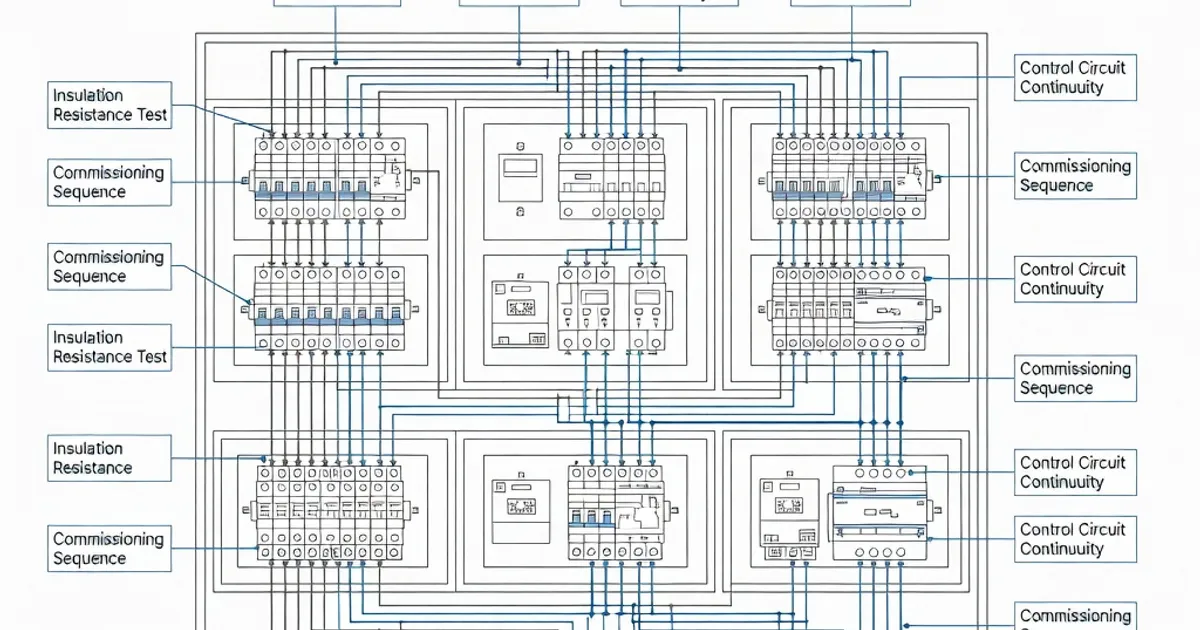
Panel Testing & Commissioning Guide
This guide summarizes the mandatory site testing and commissioning tasks for newly installed low-voltage panel assemblies in accordance with IEC 61439. It condenses the routine verifications required after transportation and installation, explains acceptance criteria and instrumentation, provides a recommended commissioning sequence, and documents best practices and common pitfalls from leading manufacturers and technical guidance. The procedures below apply to assemblies intended to meet IEC 61439-1/2 and are intended for use by commissioning engineers, panel builders, installers, and OEM representatives.
Scope and Purpose
IEC 61439 separates design-stage type tests from site-level routine verifications. Site commissioning verifies that the delivered assembly arrived undamaged, remains compliant with the design, and is safe to energize. Routine verifications on site confirm dielectric integrity, protective bonding, clearances and creepage, mechanical strength, and functional operation before and after energization (as required). These activities reduce risk of in-service failures, confirm protection systems, and form the evidentiary basis for the Declaration of Conformity (DoC) issued by the responsible party after site acceptance (IEC 61439-1 Clause 11) [1][3][8].
Mandatory Routine Verifications (Summary)
Per IEC 61439, the standard routine verifications performed at site include inspections, measurements and tests. The following list captures the routine subset typically performed prior to energization:
- Inspection of clearances and creepage distances vs. design drawings (IEC 61439-1 Clause 10.10.2) [1][2].
- Power-frequency dielectric (hipot) test: 2 × U_r + 1000 V AC for 5 seconds between phases, neutral and protective earth (IEC 61439-1 Clause 10.9.2) [1][4].
- Protective bonding continuity/resistance measurement: ≤0.1 Ω between exposed conductive parts and the PE terminal (IEC 61439-1 Clause 10.7) [1].
- Functional operation checks of protective devices, interlocks, mechanical operations and controls (IEC 61439-1 Clause 10.11) [2].
- Lifting and mechanical strength verification after transport: proof test of lifting points (raise 1.25× shipping weight to 1 m and hold for 30 minutes) (IEC 61439-1 Clause 10.4) [1].
- IP/ingress protection verification where specified, with partial checks per IEC 60529 and IEC 61439-1 Clause 10.6 (visual inspection, accessory fit and, where applicable, IP test) [1].
Typical Acceptance Ranges and Parameters
Use the following numerical acceptance criteria as minimums or typical manufacturer practice. Project-specific requirements may be more stringent; always follow OEM documentation or contractual test sheets.
- Dielectric (power-frequency) test: 2 × U_r + 1000 V AC, 5 s (e.g., for 400 V three-phase systems: 2×400 + 1000 = 1800 V AC, 5 s) (IEC 61439-1 Clause 10.9.2) [1][4].
- Protective bonding resistance: ≤0.1 Ω measured between exposed conductive parts and the PE terminal (IEC 61439-1 Clause 10.7) [1].
- Insulation resistance (typical manufacturer practice): >1 MΩ at 500 V DC for many LV assemblies (as used in manufacturer checklists) [4][6].
- Functional checks: trip times, interlock action, and control logic to match design documentation; CT/PT polarity and relay settings verified per IEC 61869 where applicable [6].
- Ambient temperature during test: average ≤35 °C recommended for reference conditions; derate where site ambient exceeds manufacturer limits [1][2].
Detailed Test Procedures
1. Mechanical and Visual Inspection
Before any electrical tests, perform a thorough mechanical and visual inspection:
- Verify enclosures, door seals, gaskets, fasteners, and hardware; ensure no shipping damage.
- Check clearances and creepage distances against design drawings and bill of materials (IEC 61439-1 Clause 10.10.2) [1][2].
- Torque check on all bolted connections per device manufacturer torque settings (typical torque ranges 20–50 Nm depending on device and conductor size) and mark torque values where required [1][3][6].
- Confirm busbar alignment, support clamps, barriers and phase segregation are intact and installed as designed.
2. Lifting and Mechanical Strength Verification
After installation, verify lifting integrity of the assembly and mounting points. IEC 61439-1 Clause 10.4 specifies a lifting test procedure: raise the assembly using its lifting points to a height of 1 m with 1.25× the shipping weight, and hold for 30 minutes. Inspect for permanent deformation or damage after the test [1].
3. Protective Bonding (Earth) Continuity
Measure resistance between exposed conductive parts (metal frames, doors, removable panels) and the main PE terminal. Acceptance is ≤0.1 Ω (IEC 61439-1 Clause 10.7). Use a suitable low-resistance ohmmeter or micro-ohmmeter; verify bolted joints and bonding conductors. Record measured values for each tested point [1].
4. Power-Frequency Dielectric (Hipot) Test
Apply the power-frequency dielectric voltage between phases/neutral and PE according to IEC 61439-1 Clause 10.9.2. The test voltage is 2 × U_r + 1000 V AC applied for 5 seconds. Typical examples:
| System Rated Voltage U_r | Test Voltage (2 × U_r + 1000 V) AC | Duration | Notes |
|---|---|---|---|
| 230/400 V (LV distribution) | 1800 V AC | 5 s | Common for 400 V 3-phase assemblies; manufacturer examples reference ~1800–1890 V [1][4]. |
| 400/690 V | 2380 V AC (for U_r = 690 V) | 5 s | Adjust test voltage to assembly rated voltage per IEC clause. |
| Low-voltage single-phase 230 V | 1460 V AC | 5 s | Apply between live conductors and PE as required. |
Follow safe test practices: isolate secondary circuits, remove electronic equipment when instructed by manufacturer, and ensure the operator and nearby personnel are clear. Many manufacturers provide specific exclusion lists for parts that must be disconnected prior to hipot testing (e.g., electronics, meters, control receivers) [4][6].
5. Insulation Resistance
While IEC 61439 does not mandate a specific insulation resistance limit for all assemblies, many OEM commissioning documents adopt a practical acceptance of >1 MΩ at 500 V DC for installed circuits as a rule of thumb (ABB and other technical guides) [4][6]. Record insulation values optionally for phase-to-phase and phase-to-PE.
6. Functional Operation and Interlocks
Verify the mechanical and electrical operation of all switching devices, interlocks, mechanical trip/trip-blocks, motorized operators, door interlocks and control logic. This includes:
- Manual operation of breakers, switches and withdrawable units; verify correct staging and racking actions.
- Protection device settings and test trip behavior where possible (secondary injection or simulated faults), CT/PT polarity checks, and relay logic verification per IEC 61869 practices [6].
- Test control circuits and auxiliary power supplies under expected supply conditions.
7. IP and Access Protection
If the assembly claims an IP degree, perform visual and partial verification checks per IEC 60529 and IEC 61439-1 Clause 10.6. For full IP verification, use the appropriate laboratory IP test methods (water ingress, dust ingress). Verify gaskets, door locking, cable gland sealing and any IP-rated external interfaces [1].
8. Energization, Thermography and Load Checks
After de-energized testing and functional checks, apply supply under controlled conditions. Recommended post-energization verifications include:
- Thermographic scan under loaded conditions to identify loose or high-resistance joints; typical limits target temperature rises consistent with design (<70 K rise at connections where applicable) [1][3].
- Earth loop impedance and fault clearance timing checks to confirm protective device coordination.
- Load testing using graded loading and diversity (RDF) to confirm temperature-rise performance if site conditions differ from type-test scenarios; apply Rational Diversity Factor (RDF) where appropriate [1][2].
Commissioning Sequence: Practical Workflow
Follow a structured sequence to minimize rework and improve safety. A recommended sequence is:
- Pre-commissioning review of design documents, drawings, DoC, and manufacturer instructions.
- Mechanical and visual inspection (clearances, creepage, torque checks).
- Lifting/mechanical strength test (if performed on site) and final mounting checks.
- De-energized electrical tests: bonding resistance, insulation resistance (optional), partial functional tests.
- Dielectric (hipot) test where required and safe to perform; disconnect sensitive electronics as per OEM guidance (IEC 61439-1 Clause 10.9.2) [1][4].
- Re-install any removed equipment, reconnect secondary circuits, verify protective device settings.
- Energize under controlled conditions; perform thermography, earth loop and functional checks under load.
- Document all results, capture photos and signatures, and prepare the site Declaration of Conformity or acceptance certificate in conjunction with the manufacturer/OEM if required [5][6].
Instrumentation and Calibration
Use calibrated test instruments appropriate for the measurement task. Typical instruments and notes:
- Micro-ohmmeter or low-resistance ohmmeter for bonding measurements (capable of reading ≤0.1 Ω reliably) [1].
- Hipot tester with adjustable AC test voltage up to at least 3 kV with timer and leakage monitoring (ensure tagout of sensitive circuitry) [4].
- Insulation resistance tester (megohmmeter) 250–1000 V DC for IR checks; record ambient temperature and humidity when comparing to reference limits.
- Thermal imaging camera for post-energization scans; use consistent emissivity settings and compare to baseline data [3].
- Calibrated clamp meters, earth loop impedance testers, and secondary injection sets for relay and protection functional checks (CT/VT polariy tests per IEC 61869) [6].
Manufacturer-Specific Practices (Comparison)
Leading panel manufacturers publish commissioning checklists that align with IEC 61439 routine verifications. The table below summarizes typical manufacturer focal points observed in public manufacturer guides and technical application papers.
| Manufacturer | Typical Site Commissioning Items | Notable Acceptance Criteria / Comments |
|---|---|---|
| Siemens | Dielectric test (2×U_r+1 kV), bonding continuity, functional checks, mechanical racking tests | Follow Siemens NXPLUS/SIVACON commissioning instructions; document DoC after routine tests [4]. |
| ABB | Bonding continuity, insulation resistance (500 V DC typical), operational checks, sequence validation | ABB workbook details practical on-site verifications and test sequences for distribution boards [4][6]. |
| Schneider Electric | Hi-Pot test for 400 V systems (~1800 V AC), earth loop/thermography, sequence of operation | OEM recommends removal of sensitive electronics during hipot; thermography after loading [user context]. |
| Eaton | Dielectric, CT/PT polarity, relay settings, protective device coordination checks | Follow Eaton Power Xpert commissioning and relay configuration guides for protection verification [user context]. |
| Rittal | IP verification, bonding and enclosure integrity, digital verification tools for pre-site checks | Rittal emphasizes enclosure test and corrosion protection for outdoorRelated Panel TypesMain Distribution Board (MDB)Power Control Center (PCC)Motor Control Center (MCC)Power Factor Correction Panel (APFC)Automatic Transfer Switch (ATS) PanelVariable Frequency Drive (VFD) PanelGenerator Control PanelMetering & Monitoring PanelLighting Distribution BoardBusbar Trunking System (BTS)PLC & Automation Control PanelCustom Engineered Panel Frequently Asked QuestionsRequest a QuoteTell us about your panel requirements and our engineering team will get back to you within 24 hours. Email Us [email protected]Call Us +90 232 332 22 78 |