Panel Maintenance Best Practices
Preventive maintenance procedures and schedules for IEC 61439 panel assemblies.
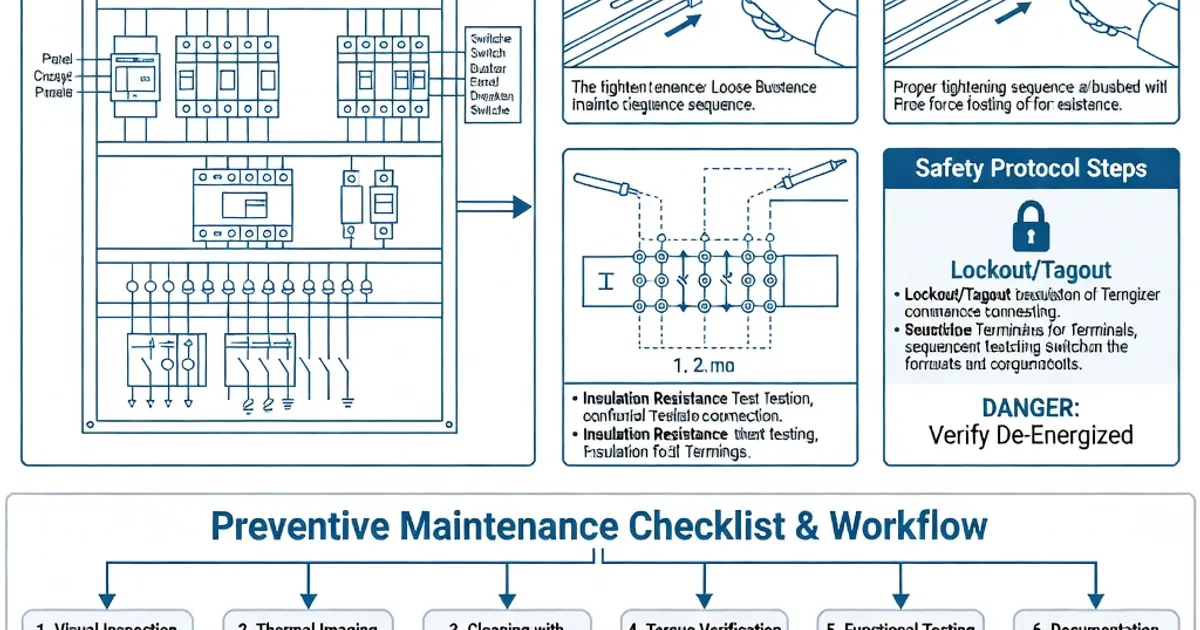
Panel Maintenance Best Practices
This article presents authoritative, practical guidance for maintaining low-voltage switchgear and controlgear assemblies built to IEC 61439 principles. It consolidates published guidance on verification and routine testing, industry best practices for preventive and predictive maintenance, and operational controls that preserve the electrical, thermal and mechanical integrity of panels over their service life. Where the underlying standard or manufacturer guidance is required, we cite source material and recommend consulting the original documents for binding requirements.
Scope and Objectives
Maintenance of IEC 61439-compliant assemblies aims to:
- Preserve safety: prevent electrical shock, arc-flash events and fire risk.
- Maintain performance: ensure rated short-circuit withstand, temperature-rise limits and protection functions remain effective.
- Maximize availability: reduce unexpected outages through planned inspections and corrective actions.
- Document compliance: retain records that demonstrate ongoing conformity to the assembly’s design verification basis and any type-tests performed.
Regulatory and Standards Context
IEC 61439 (general and part-specific documents) defines design verification, type-testing and minimum electrical/mechanical performance for low-voltage switchgear and controlgear assemblies. The standard focuses on initial verification (testing, calculation, comparison) and mandatory routine tests at manufacture, including dielectric strength, temperature-rise, short-circuit withstand and degree of protection (IP) verification. IEC 61439 does not prescribe a single prescriptive maintenance schedule for in-service panels; instead, it establishes performance requirements and test methods that should inform maintenance strategies tailored to the installation and operating environment (see IEC 61439 guidance and panel-builder references) [1][2][3][6].
Because IEC 61439 emphasizes verification of capability rather than maintenance actions, maintenance programs should draw upon:
- IEC 61439 verification test evidence and declared ratings (e.g., rated current, short-circuit withstand),
- Manufacturer maintenance instructions and torque/data sheets, and
- Industry routine-test guidance for in-service switchgear (infrared surveys, contact resistance, insulation resistance, functional testing) [5][8].
Maintenance Philosophy: Preventive, Predictive, Corrective
Implement a tiered approach:
- Preventive maintenance (scheduled): inspections and simple servicing tasks performed at fixed intervals (e.g., quarterly, semi-annual, annual) to prevent deterioration.
- Predictive maintenance (condition-based): techniques that detect incipient failure—infrared thermography, dissolved gas analysis (in certain equipment), partial discharge measurement, trend analysis of power quality and harmonic content.
- Corrective maintenance (as-needed): remedial actions after detecting defects or failures, prioritized by safety and continuity risk.
Safety, Lock-out and Documentation
Always follow local electrical workplace safety rules (e.g., lock-out/tag-out) and arc-flash PPE requirements before performing any inspection or maintenance. Maintain an up-to-date single-line diagram and labeling that matches the physical installation; label ratings and safety notices clearly per the panel builder’s installation instructions [8]. Document all inspections, readings, corrective actions and torque values in a maintenance log; retain type-test reports and design verification documents for reference during troubleshooting and regulatory inspections.
Routine Inspection Checklist and Recommended Frequencies
Below is a practical checklist organized by interval. Frequency must be adapted to site conditions: dusty, corrosive, or high-load environments require more frequent attention. Where possible, align checks to major plant outages or scheduled production stops.
| Task | Typical Frequency | Purpose / Acceptance Criteria | Reference |
|---|---|---|---|
| Visual inspection of enclosure, seals, gaskets, door latches | Quarterly to annually (site-dependant) | No corrosion, intact gaskets, sound hinges/latches; IP rating preserved | [6], [1] |
| Torque check on bolted connections, busbars and main terminals | 6 months to 1 year after installation, then annually | No loose connections; use manufacturer torque values and calibrated tools | [4], [8] |
| Infrared thermography scan under load | Annually, or after load changes | Identify hot spots; corrective action for anomalies | [5] |
| Contact resistance measurement (mΩ) for main bus and critical connections | Initial baseline, then every 1–3 years | Trend stable or improvement after cleaning/retightening; compare to original type-test/builder data | [5], [1] |
| Insulation resistance (megger) test of circuits out of service | Every 1–3 years (or after moisture ingress) | Resistance consistent with manufacturer expectations and site norms | [5] |
| Functional testing of protective devices and control circuits | Annually or per protection vendor guidance | Protection trips and settings verify coordination and settings | [4], [8] |
Electrical Connection Integrity
Loose or high-resistance connections are the most common cause of heating, arcing and failure in panel assemblies. Best practices:
- Use calibrated torque tools and record torque values. Apply manufacturer-specified torque for each terminal and bolt; when manufacturer data are not available, obtain values from the part supplier (terminal, circuit-breaker, busbar) [4].
- Perform a torque-retorque cycle after the first few operating hours under load. Thermal cycling frequently causes fasteners to relax; a re-check after initial load stabilizes prevents early failures.
- Measure contact resistance on main interconnections and protective device contacts; compare to baseline values recorded at commissioning to detect deterioration [5].
- When cleaning conductors, use non-abrasive methods and compatible cleaners to avoid removing plating or causing galvanic effects.
Thermal Management and Temperature Rise
IEC 61439 requires that assemblies be demonstrated to meet temperature-rise limits under declared conditions by test or calculation. In-service maintenance must ensure those conditions remain valid:
- Maintain cooling vents, filters and forced-air systems; replace filters and ensure free airflow paths.
- Monitor and log ambient temperature and loading. Rising ambient or permanent overloads accelerate aging of cable insulation and busbar insulation and can invalidate the original temperature-rise verification.
- Use infrared thermography to locate localized heating before it becomes a failure. Schedule scans when the panel is carrying a representative load (ideally close to typical operating load) to reveal meaningful hotspots [5].
When thermal anomalies are found, investigate and remediate—loose connections, undersized conductors after field modifications, dust accumulation, or degraded contact surfaces cause elevated local temperatures and must be resolved.
Ingress Protection (IP), Enclosure and Environmental Controls
IEC 60529 defines IP ratings; IEC 61439 requires verification of the declared IP degree in the assembly’s type-tests. Maintain IP integrity by:
- Inspecting door seals and gaskets for compression set, cuts or displacement. Replace per manufacturer instructions if hardening or deformation reduces sealing effectiveness [6].
- Repairing or replacing defective cable glands and conduit entries. Confirm threaded gland torque and sealing rings are intact after maintenance.
- Controlling airborne contaminants. Dust and conductive pollution can form tracking paths—install filtration and positive pressure purging where required.
Functional and Protective Device Testing
Functional tests verify that overcurrent devices, relays, meters and control circuits operate as intended. Recommended practices:
- Perform protection relay secondary injection testing or manufacturer-recommended functional tests annually or following major changes.
- Validate settings and coordination whenever protection settings are changed, and after any fault event. Record protections’ event logs and waveform captures for post-event analysis.
- Test trip units and auxiliary circuits’ control wiring for mechanical integrity and continuity; verify status indications and interlocks.
Predictive Techniques and Advanced Testing
Use condition-based techniques to anticipate failures and schedule interventions effectively:
- Infrared thermography: annual or more-frequent scans to identify developing high-resistance connections and overloaded components [5].
- Partial discharge (PD) monitoring: for higher-voltage or critical feeders where PD may indicate insulation breakdown mechanisms. PD testing is typically in specialist scope.
- Online monitoring: install current/voltage/temperature sensors where continuous trending improves detection of overloads, harmonic growth and thermal drift.
Recordkeeping, Labeling and Traceability
Maintain the following documents and records to support safe maintenance and to evidence continued conformity with the assembly’s declared characteristics:
- Type-test reports and design verification documentation from manufacture (temperature-rise, dielectric, short-circuit, IP test reports) [1][2].
- Installation certificate, single-line diagrams, wiring diagrams and connection tables.
- Maintenance log: inspection dates, personnel, torque readings, infrared images, contact-resistance values, insulation-resistance readings and corrective actions.
- Labels on the panel indicating rated current, rated short-circuit capacity, IP rating, protective device settings and safety warnings. Keep labels legible and up-to-date with any field modifications [8].
Manufacturer Guidance and Limitations
Panel builders and component manufacturers (e.g., ABB, Schneider Electric, Siemens) publish specific maintenance instructions and torque tables for their equipment. Always consult manufacturer manuals for:
- Tightening torques for breaker clamps, busbar bolts and terminal screws;
- Recommended lubricants and contact cleaners (compatibility with plating and insulating materials);
- Functional test sequences for electronic trip units and relays; and
- Replacement parts and retrofit guidance where original components are obsolete [4][8].
Where manufacturer documentation is absent, treat the assembly conservatively: rely on baseline commissioning measurements and progressively build condition baselines (torque, resistance, thermal profile) for each installation.
Example Maintenance Schedule (Template)
| Interval | Key Activities | Notes |
|---|---|---|
| Commissioning / First 24 hours under load | Record baseline infrared images, torque re-check, contact resistance baseline | Retorque after thermal cycling; capture all baseline data |
| 3–6 months | Visual inspection, functional tests of protective devices, check seals | Address visible wear or ingress issues |
| 12 months | Full infrared survey, torque checks, insulation resistance test, contact resistance | Annual functional verification of protection relays |
| 1–3 years | In-depth electrical tests (megger, partial discharge where applicable), calibration of meters | Frequency depends on environment and criticality |
Type-Tested Assemblies vs. Design-Verified (Comparison)
| Characteristic | Type-Tested Assembly | Design-Verified / Partially Tested Assembly |
|---|---|---|
| Demonstrated capability | Proven by full type-tests (temperature-rise, short-circuit, dielectric, IP) | Demonstrated by calculation, partial testing and component verification |
| Maintenance implications | Original test results provide clear baseline; maintenance confirms field condition vs test reports [2] | Maintenance must verify conditions assumed in calculations (clear documentation required) [1] |
| Flexibility for field modification | Modifications may invalidate type-test claims and require reevaluation | Lower initial verification margin—modifications can require recalculation or additional testing |
After-Fault and Post-Event Procedures
After any fault (short-circuit, arc, tripping event), perform a structured investigation and repair:
- Isolate and document the faulted circuit and condition. Preserve evidence (photographs, event recorder outputs).
- Conduct a visual inspection for damage to insulation, busbars and structural components; replace or repair affected parts per manufacturer guidance.
Related Panel Types
Frequently Asked Questions
Request a Quote
Tell us about your panel requirements and our engineering team will get back to you within 24 hours.
Email Us
[email protected]Call Us
+90 232 332 22 78