Panel Lifecycle Management
Managing panel assemblies from design through decommissioning.
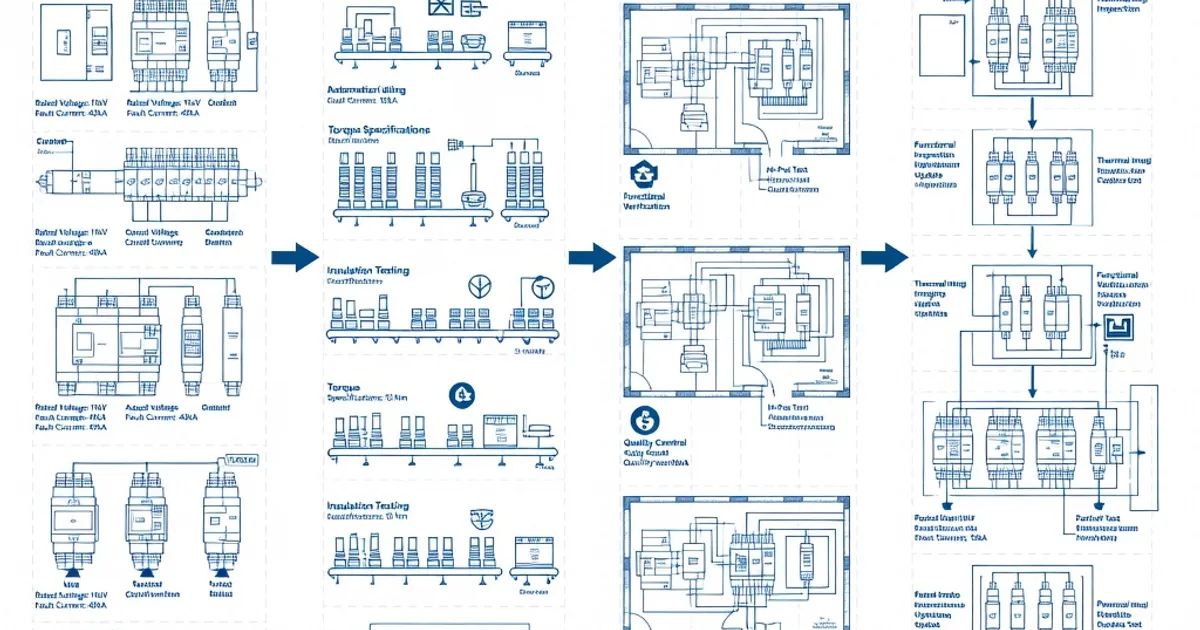
Panel Lifecycle Management
Panel lifecycle management under IEC 61439 is the structured set of activities that the specifier, original manufacturer and assembly manufacturer must carry out from initial concept through decommissioning to ensure that low-voltage switchgear and controlgear assemblies remain safe, available and economical throughout their service life. This article explains the lifecycle stages, the mandatory verifications and tests, the applicable standards and the roles and responsibilities that deliver compliance and lower total cost of ownership (TCO). It references specific IEC clauses and industry guidance so you can map requirements to procurement, design and maintenance programs.
Overview: What IEC 61439 changes about lifecycle responsibility
IEC 61439 replaces the older IEC 60439 approach by introducing the concept of a verified assembly whose electrical and mechanical performance is established by design verification performed by the original manufacturer, then complemented by routine verification by the assembly manufacturer on each built unit (IEC 61439-1:2020). The standard enumerates 12 mandatory design verifications (temperature-rise, short-circuit withstand, dielectric properties, degree of protection, mechanical strength, etc.) and prescribes routine tests that must be performed on each assembled panel before it is placed into service (see IEC 61439-1 and IEC 61439-2) [4][5][9].
Lifecycle stages and key technical requirements
1. Design phase (original manufacturer responsibilities)
During design, the original manufacturer must demonstrate by calculation and/or testing that the assembly meets the functional and safety requirements of the intended service conditions. Key requirements include:
- Rated current and thermal evaluation: Determine rated currents (In) and consider enclosure heating and diversity factor (ρ) when sizing conductors and devices; verify temperature-rise limits with covers, partitions and all functional units in place (Per IEC 61439-1 Clause 10.10). Typical temperature-rise limits include 70 K for certain terminals and up to 105 K for busbars depending on the verification method and location [1][5].
- Short-circuit withstand capability: Verify prospective short-circuit currents and perform short-time withstand and peak withstand verifications per IEC 61439-2 Clause 10.11; this determines busbar dimensions, connections and mechanical bracing required to sustain electrodynamic forces [1][7].
- Degree of protection: Define and verify IP/IK ratings per IEC 60529 and IEC 61439-1 Clause 10.2; ensure gaskets, covers and cable entries achieve the declared protection level in the intended environment [3][5].
- Dielectric and insulation coordination: Check clearances and creepage distances for the rated voltage and pollution degree (e.g., 10 mm air gap for 630 V in pollution degree 3 is an example target—confirm per Clause 10.3) [2][3][5].
- Materials and ageing performance: Select materials that meet thermal stability and fire-propagation tests (glow-wire 960 °C for current-carrying parts where required) and corrosion severity class (A/B) depending on location, per Clauses 10.4–10.5 [2][5].
2. Construction and verification (original manufacturer)
The original manufacturer must provide documented evidence—test reports, calculations and type-test data—showing compliance with the 12 design verifications required by IEC 61439-1. These verifications may include:
- Temperature-rise verification (Clause 10.10)
- Short-circuit verification (Clause 10.11)
- Dielectric properties and clearances (Clause 10.3)
- Mechanical strength and stability (Clause 10.6)
- Degree of protection IP/IK (Clause 10.2)
- Resistance to corrosion and climatic influences (Clauses 10.4–10.5)
Designation as a “verified assembly” means these checks were performed and recorded. The documentation must accompany the assembly to enable correct selection and application by the assembly manufacturer and the end user [4][5].
3. Routine verification (assembly manufacturer)
Every individual assembly built by the assembly manufacturer must undergo routine verification prior to delivery. IEC 61439-1 Clause 11 defines the minimum routine tests and inspections. Typical routine checks include:
- Visual inspection of mechanical and electrical assembly
- Continuity of protective conductors and PE networks
- Insulation resistance measurements at specified voltages
- Functional test of protective devices (overcurrent, earth-fault, interlocks)
- Verification of correct wiring and marking
Routine verification ensures production-quality control and is a mandatory record for CE marking and for the assembly manufacturer’s declaration of conformity [5][6].
4. Commissioning, operation and maintenance
IEC 61439 does not prescribe detailed operational maintenance intervals, but it sets design and access requirements that facilitate safe operation and maintenance:
- Accessibility: Functional units and handles must be accessible so that maintenance personnel can operate and service devices without removing load-bearing parts or exposing live conductors (see Clauses 8.3–8.6) [3][5].
- Thermal monitoring: Where assemblies operate near rated limits or in harsh environments, temperature-monitoring of busbars and critical connections reduces thermal runaway risk. Manufacturers increasingly integrate sensors and digital twins for predictive maintenance (Siemens, Schneider guidance) [6][1][4].
- Connection integrity: Use vibration-resistant connections and periodic torque checks per manufacturer instructions; this preserves short-circuit performance and reduces ageing-related failures [3][5].
- Auxiliary circuits: Protect and label auxiliary circuits separately; demonstrate that auxiliary components will not impair main circuits during fault conditions (Clauses 8.3–8.6) [3][5].
5. Decommissioning and end-of-life
IEC 61439 contains no dedicated clause on decommissioning, but lifecycle management practices influence end-of-life decisions and recyclability. Best practices include:
- Maintain complete documentation and test records to support safe disconnection, asset reuse, or recycling [5].
- Design for disassembly: modular functional units, standardized connectors and labeled wiring simplify safe decommissioning and component recovery [3][4].
- Plan for hazardous-material handling (batteries, capacitors, insulating fluids) and comply with local waste regulations.
Standards, roles and responsibilities
Applicable standards and how they map to lifecycle tasks
Key standards to reference during lifecycle management:
- IEC 61439-1:2020 — General rules, definitions, service conditions, design and routine verifications for low-voltage assemblies (primary reference for lifecycle verifications) [4][9].
- IEC 61439-2:2020 — Requirements specific to power switchgear and controlgear assemblies, including short-circuit and temperature-rise verifications (applies for power distribution panels) [1][7][8].
- IEC 60947 series — Requirements for low-voltage switchgear/controlgear devices installed inside assemblies (circuit-breakers, contactors, relays) and their coordination [1].
- IEC 60529 — Degrees of protection (IP/IK ratings) for enclosures; used to specify environmental protective requirements in Clause 10.2 of IEC 61439-1 [3][5].
- IEC 60204-1 — Electrical equipment of machines: guidance for safety, which complements routine inspection and testing practices in industrial installations [6].
Who does what?
Clear role demarcation reduces non-conformities:
- Specifier/Owner: Defines service conditions, rated characteristics, diversity, IP/IK requirements and Form of Separation (e.g., 1 to 4b) and requests required documentation and lifecycle services in tender [1][3].
- Original Manufacturer (Type/Design Verifier): Performs and documents the 12 design verifications required by IEC 61439-1 and supplies test reports, installation instructions and limits under which the verified assembly applies [4][5].
- Assembly Manufacturer: Produces each unit to the verified design, performs routine verifications (Clause 11), and issues a declaration of conformity for the assembled panel [5][6].
- Installer / Maintainer: Conducts commissioning checks, periodic maintenance using the manufacturer’s documentation and updates asset records for future maintenance and safe decommissioning [6].
Industry implementations and lifecycle tools
Major manufacturers embed lifecycle management into their products and services:
- Siemens integrates lifecycle documentation, digital tools and temperature monitoring into NXPLUS and related ICP systems; Siemens technical guides map IEC 61439 verification and maintenance activities and provide application examples (see testing/verification guidance pp.194–195) [6].
- ABB publishes practical guidance (Technical Application Papers) on construction and verification of LV assemblies that clarifies owner/assembler responsibilities and testing regimes for rated characteristics and IP/IK selection [5].
- Schneider Electric provides application notes on selecting rated current, accounting for enclosure heat and diversity, and on using verified assemblies to reduce lifecycle costs [1][4].
- Rittal, Eaton, Legrand and others supply enclosure systems and whitepapers addressing mechanical protection (IK) and enclosure lifecycle considerations that affect assembly verification and long-term durability [8].
Design and operational best practices
Adopt the following to ensure robust lifecycle performance:
- Start with the verified assembly documentation: Use the original manufacturer’s verification limits for rated currents, short-circuit withstand and supported configurations rather than ad-hoc calculations [4][5].
- Specify environmental class and corrosion severity: For outdoor or coastal installations choose corrosion severity class B or above and specify thermal and UV-resistant materials per Clauses 10.4–10.5 [2][5].
- Plan for thermal margins: Size busbars and protective devices with margin for harmonic heating and ambient temperatures; apply diversity where justified and documented (rho < 1) [1][5].
- Use modular, accessible functional units: Form of Separation choices and modular units reduce downtime and enable safer in-service maintenance (per Clause 8.5) [3][5].
- Implement predictive maintenance: Integrate temperature and current sensors with asset-management systems to detect loose connections and overloads before failure; many vendors supply this as part of their lifecycle offering [6][1][4].
- Document rigorously: Keep test reports, wiring diagrams, torque records and routine verification certificates with the asset throughout its lifespan to support safe modification and decommissioning [5].
Specification and verification comparison table
| Verification / Test | IEC Clause | What it checks | Typical requirement / limit |
|---|---|---|---|
| Temperature-rise | IEC 61439-1 Clause 10.10 | Heating of busbars, connections and terminals under rated currents with enclosure fitted | Design verification to ensure temperature-rise stays within specified K limits (e.g., 70–105 K depending on element) |
| Short-circuit withstand | IEC 61439-2 Clause 10.11 | Electrodynamic forces and thermal effects during short-circuit | Withstand peak and short-time prospective currents declared by design (kA values per application) |
| Degree of protection (IP/IK) | IEC 61439-1 Clause 10.2 / IEC 60529 | Ingress of solids/liquids and mechanical impact resistance | IPxx / IKxx as specified for installation environment (e.g., IP54, IK08) |
| Clearance and creepage | IEC 61439-1 Clause 10.3 | Insulation coordination for rated voltage and pollution degree | Minimum distances per rated voltage/pollution (e.g., 10 mm for certain 630 V cases — verify per clause) |
| Routine functional tests | IEC 61439-1 Clause 11 | Continuity, insulation resistance, device function, wiring checks | Performed on every manufactured unit prior to delivery |
Lifecycle documentation and traceability
Traceability is central to risk management. Maintain the following records for each assembly:
- Original manufacturer’s verification reports and the conditions of applicability (ambient, configuration limits) [4][5].
- Assembly manufacturer’s routine test certificates and wiring/torque records (required for CE declaration) [5][6].
- Commissioning reports, settings for protective devices, and acceptance test records from the installation site [6].
- Maintenance logs, thermal imagery, sensor data and component replacement records to demonstrate continuing compliance with the verified limits [1][3].
These documents enable safe modifications and validate claims during lifecycle events such as returns, warranty claims and regulatory inspections.
Practical implications for procurement and asset ownership
Specifiers and owners should require:
- Evidence of IEC 61439 verification (type-test reports) and explicit statements of the configuration limits the verification covers [4][5].
- Clear handover of routine-test certificates and installation/maintenance instructions with every panel [5].
- Provisions for lifecycle services such as predictive maintenance, spare parts availability and digital documentation transfers (digital twins) to reduce downtime and TCO [6][1][4].
When these elements are contractually enforced, organisations see fewer field failures, reduced corrective maintenance and better asset availability.
Conclusion
Panel lifecycle management under IEC 61439 is a discipline that spans engineering design, controlled production, thorough testing and documented maintenance. By following the standard’s verification and routine-testing regime (IEC 61439-1 and -2) and by leveraging manufacturer lifecycle tools (monitoring, digital twins), owners and specifiers can ensure safe, reliable panels with predictable lifecycle costs. The shift from the old TTA/PTTA model (IEC
Related Panel Types
Frequently Asked Questions
Request a Quote
Tell us about your panel requirements and our engineering team will get back to you within 24 hours.
Email Us
[email protected]Call Us
+90 232 332 22 78