Original Manufacturer Responsibilities
Role and obligations of the original manufacturer under IEC 61439.
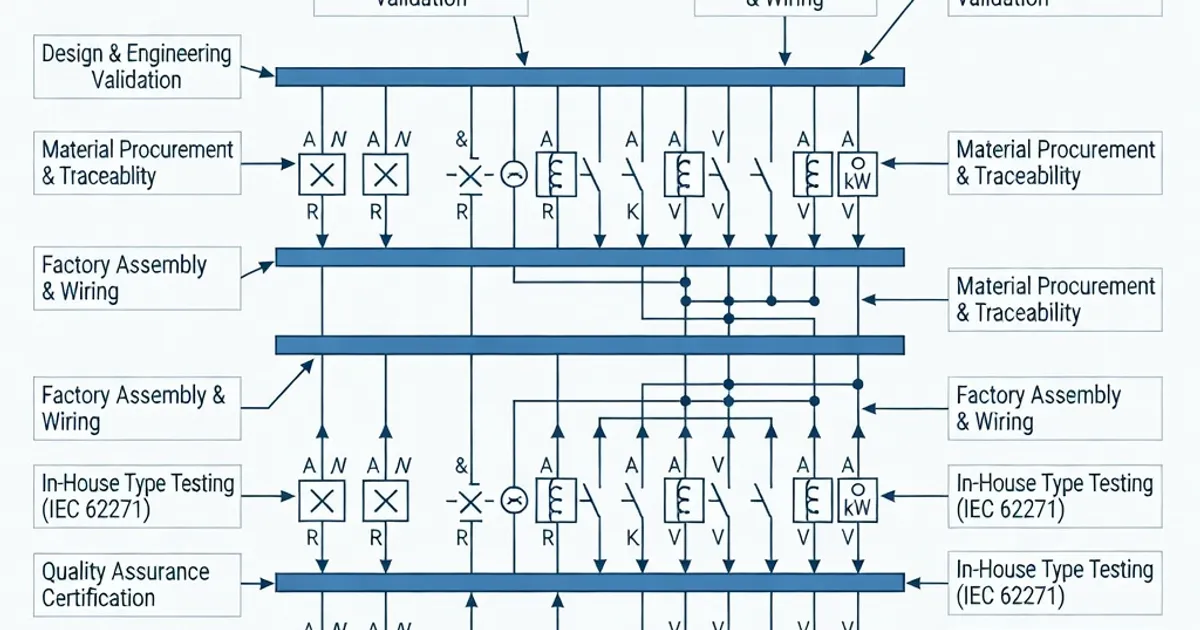
Original Manufacturer Responsibilities
The original manufacturer holds primary responsibility for the design, verification and declaration of conformity for low-voltage switchgear and controlgear assemblies under the IEC 61439 framework. This role encompasses the creation of the assembly design, implementation of the constructional design rules set out in IEC 61439-1, performance of design verification according to IEC 61439-2 (where applicable), and provision of the technical documentation and instructions that enable others to produce compliant assemblies. These duties remain with the original manufacturer even when components or sub-assemblies are supplied by third parties or when manufacture is outsourced (see Kepl India and Schneider Electric for summaries of these obligations). [1] [2]
Summary of the Original Manufacturer Role
- Design authority: Define the assembly concept, constructional rules, and permissible component list.
- Design verification: Prove compliance using testing, calculation, or comparison with a tested design per IEC 61439-series requirements.
- Documentation and instructions: Provide assembly manufacturers with complete technical documentation, installation/assembly instructions and routine verification procedures.
- Conformity declaration and certification: Where applicable, obtain third‑party certification or supply verified design dossiers enabling assembly manufacturers to demonstrate conformity.
Design Verification Obligations
IEC 61439 distinguishes two linked verification activities: design verification (the original manufacturer's task) and routine verification (the assembly manufacturer's task during production). The original manufacturer must validate the assembly design by demonstrating that the proposed construction meets the mechanical, thermal and electrical performance criteria of IEC 61439-1 and the equipment‑specific tests of IEC 61439-2 where relevant. The three permitted verification routes are:
- Type testing (experimental testing) — full or partial testing of representative assemblies under the specified test conditions.
- Calculation (analytical verification) — engineering calculations supported by validated models and referenced standards.
- Comparison with a tested design — showing that the new design is sufficiently similar to an already tested and acceptable design.
Each route must demonstrate compliance with the same essential requirements (short-circuit withstand, temperature rise limits, dielectric withstand, protection against electric shock, mechanical integrity, clearances & creepage, IP and thermal stability). The standard allows combinations of the three methods (for example, calculations to justify deviations from a tested design, with supplemental testing for specific elements). [4]
Verification: Key Tests and Targets
When testing is used, the original manufacturer must ensure the assembly meets the electrical and mechanical tests laid out in IEC 61439-2 and IEC 61439-1. Typical critical tests and targeted performance levels include:
| Verification Item | Typical Test or Criterion | Typical Target / Requirement | Reference |
|---|---|---|---|
| Short-circuit withstand (dynamic & thermal) | Short-circuit making and withstand tests / calculation of peak and RMS electrodynamic & thermal stresses | Withstand declared prospective fault-currents for specified durations (e.g., 1 s RMS or as declared) | IEC 61439-2; manufacturer protocols [2] |
| Temperature rise | Temperature-rise test under rated current and specified measurement points | Temperatures below limits in IEC 61439 (depends on insulating materials and rated currents) | IEC 61439-1 / -2 guidance [5] |
| Dielectric properties | Power-frequency voltage withstand and insulation coordination checks | Clearances & creepage comply with voltage rating / withstand voltage(s) | IEC 61439 series |
| Protection against electric shock | Earthing continuity, barriers, and touch-protection verification | Protective earthing conductors and barriers adequate per construction rules | IEC 61439-1 |
| Ingress protection (IP) | Environmental sealing tests or declared enclosure IP rating verification | IP rating as declared (e.g., IP30, IP54, IP65) | Manufacturer test regimes |
| Verifiable arc behavior | Arc fault containment classification and declaration | Declaration of permissible arcing currents & durations per IEC/TR 61641 and product classification | IEC/TR 61641 (arc fault containment) [6] |
Methods in Practice: When to Test, Calculate or Compare
IEC 61439 permits flexibility but sets expectations for the rigor of evidence:
- Testing remains the most definitive route for new or significantly different constructions. Use full assembly tests where electrodynamic and thermal interaction between components is complex (e.g., busbar systems, adjacent breakers).
- Calculations suffice for assemblies where validated engineering models can predict performance (for example, thermal calculations for temperature rise using conservative assumptions and verified component data).
- Comparison applies where changes are minor and can be demonstrated not to impact critical performance. The original manufacturer must document the rationale that the new assembly is materially equivalent to the tested reference.
Manufacturers commonly combine methods: perform tests for the most demanding parameters (e.g., short-circuit making) and use calculations for parameters that scale predictably (e.g., temperature rise for different conductor cross-sections) (see Unicorn Global Automations and Legrand whitepaper for practical guidance). [4] [5]
Key Responsibilities and Scope — Detailed List
The original manufacturer must:
- Define constructional design rules: Specify busbar layouts, barrier systems, clearances/creepage distances, earthing and mechanical fastening rules to ensure safety and repeatability in assembly production (IEC 61439-1).
- Perform design verification: Execute and record the chosen verification route (test, calculation, comparison) including all assumptions, boundary conditions, and measurement data.
- Produce technical documentation: Supply drawings, parts lists, torque values, assembly sequences, routine verification instructions, and service/maintenance notes so that assembly manufacturers can reproduce compliant assemblies without needing their own full design verification.
- Declare performance limits: Publish declared short-circuit capacities, rated currents, IP ratings, and any arc classification statements (per IEC/TR 61641 where arc classification is relevant).
- Maintain change control: Manage any design changes via documented engineering change procedures and re-verify where changes affect declared performance.
These obligations persist even where original manufacturers use third‑party components: they must ensure that component data and tolerances support the verified design. Major suppliers (Schneider, ABB, Siemens) publish tested component data and compatibility guidance to assist original manufacturers and assembly builders. [2] [6]
Distinction from the Assembly Manufacturer
IEC 61439-1 clarifies the separation of duties between the original manufacturer (design authority) and the assembly manufacturer (the physical panel builder). The assembly manufacturer is responsible for routine verifications — production checks that ensure each delivered assembly conforms to the declared design (for example: continuity of protective earth, correct installation of specified components, and routine temperature-rise verification where required). However, if the assembly manufacturer departs from the original manufacturer's instructions or substitute parts not covered by the original documentation, the assembly manufacturer must perform a full design verification or revert to the original manufacturer for a design update. This contractual and procedural separation removes prior ambiguities from the older IEC 60439 Type-Tested/Partially‑Type‑Tested Assembly concepts. [3]
| Responsibility | Original Manufacturer (Design Authority) | Assembly Manufacturer (Panel Builder) |
|---|---|---|
| Design definition | Creates and publishes design, construction rules, and declared performance | Builds to original manufacturer design and documentation |
| Design verification | Performs design verification (test/calculation/comparison) and records results | Performs routine verification on each produced assembly |
| Component approval | Specifies permitted components and their characteristics | Uses specified components; seeks approval for substitutions |
| Conformity declaration | Declares design conformity; may obtain third‑party certification | Declares production conformity to the original design (routine checks) |
Conformity Assessment and Third-Party Certification
Original manufacturers may elect to have the design verification and declaration validated by an independent certification body operating to IEC/ISO 17065. Third-party certification provides an external conformity assessment and ongoing surveillance, which many specifiers and utilities require for critical installations. Certification bodies commonly require contractual controls over outsourced processes and sub-suppliers to maintain traceability and surveillance efficacy. Where the original manufacturer retains robust design control and documentation, certification bodies can audit the design dossier and production arrangements rather than retesting every product. [1]
Documentation, Traceability and Change Control
Thorough documentation forms the backbone of compliance. The original manufacturer must supply:
- Complete design drawings and bill of materials (BOM).
- Verification reports: test data, calculation records, and comparison justification.
- Detailed assembly instructions, torque values, fastening sequences and alignment tolerances.
- Routine verification procedures and pass/fail criteria for the assembly manufacturer.
- Service and maintenance information and declared limits (e.g., rated operational current, short-circuit capacity, IP rating, ambient temperature limits).
Effective change control ensures that any modification to components, materials or construction triggers an assessment to determine if re-verification is required. The original manufacturer must maintain traceability of critical parts and production batches, especially if a design relies on the performance of particular components supplied by third parties. [5]
Arc Fault Containment and Special Considerations
Arc fault containment is a specialized area where the original manufacturer must declare limits and design intent. IEC/TR 61641 provides guidance for arc fault containment testing and classification. Original manufacturers must declare arcing classification, permissible arcing current and duration, and any enclosure restrictions necessary to
Related Panel Types
Frequently Asked Questions
Request a Quote
Tell us about your panel requirements and our engineering team will get back to you within 24 hours.
Email Us
[email protected]Call Us
+90 232 332 22 78