IP Protection Ratings for Panel Assemblies
Guide to IP ratings and their application in IEC 61439 panel design.
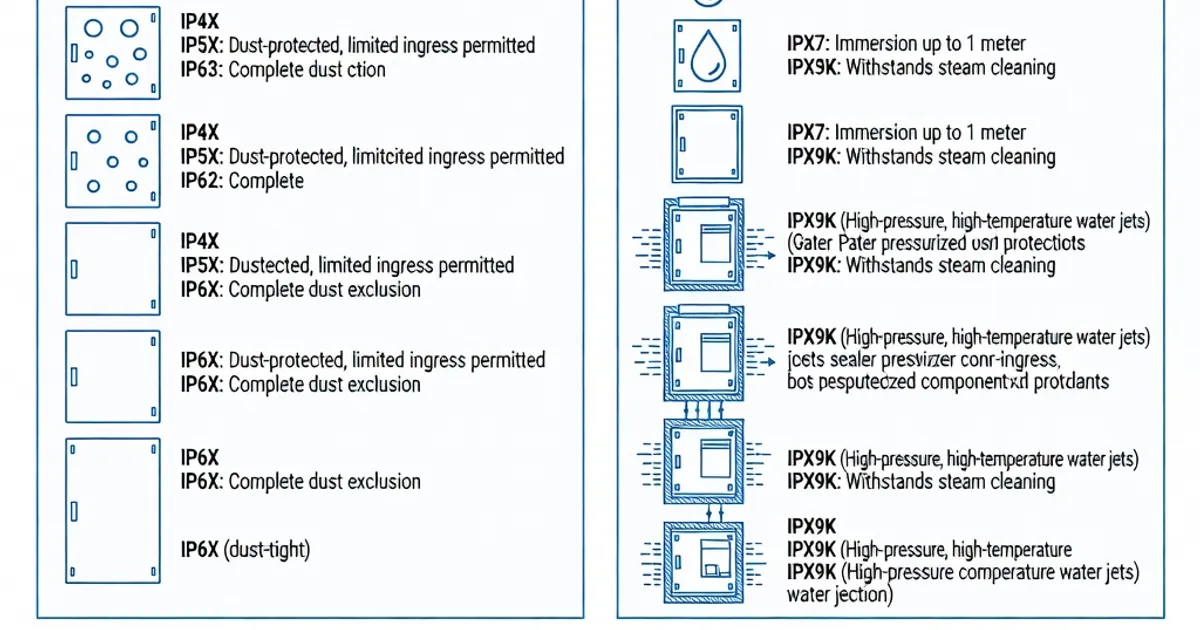
IP Protection Ratings for Panel Assemblies
This article explains how degrees of protection (IP ratings) apply to low-voltage switchgear and controlgear assemblies manufactured and verified to IEC 61439. It summarizes the IP code defined by IEC 60529, clarifies how IEC 61439 requires declaration and verification of IP for finished assemblies, and provides practical guidance, tables, and design recommendations for selecting and testing IP for indoor, outdoor, and construction-site applications. The guidance references the core standards and industry practice to help panel designers, specifiers, and installers make technically correct decisions that balance protection, ventilation, and cost.
What the IP Code Means (IEC 60529)
The IP ("Ingress Protection") code defined in IEC 60529 expresses two separate protections:
- First digit (0–6): protection against solid foreign objects (from no protection to dust-tight).
- Second digit (0–9): protection against water (from no protection to high-pressure/high-temperature jets and immersion classes).
IEC 60529 provides detailed test methods and acceptance criteria for these numerals. Examples commonly referenced in panel assembly selection: IP2X/IPXXC for basic finger and tool protection, IP3X/IP34D for public-area enclosures, IP44/IP54 for splash and light water protection in outdoor or industrial contexts, and IP65 for dust-tight and jet protection in harsh outdoor environments. The numerical water classes include IPX1 (dripping vertically) through IPX6 (powerful water jets) and IPX7/IPX8 for immersion; IPX9 covers high-pressure high-temperature wash-downs per IEC 60529.[3]
IEC 61439 Requirements for Degree of Protection
IEC 61439-1:2020 (general rules) makes the declared degree of protection (IP) part of the enclosure characteristics that must be verified for every assembly. Verification uses the test procedures defined in IEC 60529 and the assembly standard requires that declared IPs be proven on the finished assembly, not merely inferred from component data.[9][6]
Key clauses and points:
- Per IEC 61439-1 Clause 10.11 the degree of protection is a type or routine test item and must be verified on the finished assembly using IEC 60529 test methods where applicable; mechanical impact and access to live parts (IPXXC) are part of degree-of-protection considerations where required.[9][6]
- IEC 61439-1 Clauses 9.1 and 9.2 require that selection of enclosure protection be coordinated with protection against electric shock and creepage/clearance distances for live parts; IP selection affects internal environmental conditions and therefore creepage/clearance and insulation coordination.[9][4]
- Empty enclosures intended for subsequent assembly follow IEC 62208 for declared and tested IPs — manufacturers of empty enclosures must specify the IP and provide verification per IEC 62208 references in IEC 61439 guidance.[2][6]
Failure Criteria for Water Tests
For many IP water tests, IEC 61439 requires that no water contact live or exposed parts occurs. The assembly fails the degree-of-protection test if water penetration leads to contact with live parts or degrades insulation to an unsafe level. This is especially critical for IPX1 through IPX6 test classes where ingress during dripping or jet tests must not reach live components.[9]
Minimum IP by IEC 61439 Part and Application
The IEC 61439 family contains product-specific parts that imply different baseline protection expectations for assemblies used in different applications. The table below summarizes common minimum or typical IP requirements by part and application as documented in standards and manufacturer guidance.
| IEC 61439 Part | Typical Application | Minimum / Typical IP (closed doors) | Notes |
|---|---|---|---|
| Part 1 (General) | All assemblies up to 1000 V AC / 1500 V DC | Manufacturer-declared; tested per IEC 60529 | Assembly declaration must be verified on finished assembly [9] |
| Part 2 (PSC) | Power switchgear and controlgear | Often IP34D or higher for public areas; IP54 commonly used for base protection | PSC assemblies have specific verification requirements; mechanical impact tests may be excluded for some PSC equipment [7][2] |
| Part 3 | Distribution boards (≤ 250 A, household & similar) | Not less than IPX1; IPXXC for direct contact protection where unskilled persons present | Part 3 includes 11-point verification examples for finished assembly [5] |
| Part 4 (ACS) | Assemblies for construction sites | IP5X for base protection; IP44 reduces external pollution from degree 4 to 3 | IP5X helps reduce ingress of dust and coarse particles in high-pollution sites; anti-condensation measures required [2] |
| Part 5 (PDA) | Power distribution assemblies | Commonly IP34D to IP54 depending on public access and location | Higher IP for outdoor/public installations and where dust/water risk exists [2] |
How IP Interfaces with Other Design Parameters
Choosing an IP rating is not an isolated decision. IP interacts with the assembly's thermal management, pollution degree, creepage/clearance requirements, protection against electric shock, and arc- or short-circuit management:
- Pollution degree: Increasing enclosure tightness (e.g., IP5X) reduces ingress of dust and contaminants, effectively lowering the internal pollution degree and allowing less conservative clearances in some designs. For example, IP44/IP54 can reduce external pollution degree 4 to internal 3 under prescribed conditions [2].
- Creepage and clearance: Per IEC 61439-1 Clause 9.2, the declared IP and the actual internal environment must be considered when calculating creepage distances and phase-to-earth clearances; sealed enclosures may trap moisture and require careful insulation coordination [9][4].
- Protection against electric shock: IP selection must support the overall shock protection strategy (e.g., IPXXB/IPXXC for protection against access to live parts) as set out in Clause 9.1 of IEC 61439-1 [9].
- Thermal dissipation: Higher IP ratings (tighter enclosures) reduce natural ventilation and can raise internal temperatures; designers must verify temperature-rise tests (or use forced ventilation or heat dissipation measures) to avoid overheating of components.[1][5]
- Internal arc and short-circuit: Internal arc withstand and short-circuit current ratings are separate verifications from IP; selecting a high IP does not relieve the manufacturer from performing internal arc tests where applicable.[4][6]
Verification: Type and Routine Tests for Degree of Protection
IEC 61439-1 mandates verification of the declared degree of protection using IEC 60529 methods. Verification can be performed as type tests or routine tests depending on the manufacturer's quality procedures and the part-specific rules:
- Type tests verify the degree of protection on representative samples of the finished assembly. These tests follow the IEC 60529 procedures (drip tests, spray tests, jet tests, immersion, and solid-object probes) and are necessary when declaring the IP for a new design or variant.[9][3]
- Routine tests are performed on each finished assembly where required by the manufacturer's scheme or specific IEC 61439 part clauses; routine tests may include visual inspection, verification of seals, and, where specified, simple water tests per the standard.[6]
- Empty enclosures: For enclosures supplied empty, IEC 62208 defines the testing and marking requirements; the enclosure manufacturer must declare an IP and validate it on the empty product (so the assembly integrator retains responsibility to ensure the final assembled equipment maintains the declared IP once equipment and cable entries are fitted).[2]
Practical Notes on Testing
- Always test the finished assembly with all typical cable entries, covers, and gaskets fitted. A tested component or cabinet without its penetrations sealed does not guarantee the finished assembly IP.[1][9]
- For water ingress tests, the failure condition is typically any water reaching live parts or degrading insulation sufficiently to cause unsafe conditions; therefore confirm internal protections and potting where applicable.[9]
- Mechanical impact and IK ratings may be tested separately. Some product families (e.g., certain PSC equipment) may be exempt from specific mechanical impact tests—check the part-specific clauses and manufacturer guidance.[7][2]
Common Industry Products and Typical IP Ratings
Manufacturers offer panels and enclosure systems spanning IP30 to IP65 for IEC 61439-compliant assemblies. The following table presents representative product lines and typical IP ratings found in industry documentation and manufacturer guides.
| Brand | Product Line | Typical IP Ratings | Key Notes |
|---|---|---|---|
| Hager | quadro4 / quadro5 / quadro+ | IP30–IP55 | Floor and wall mount cells up to 2500 A; IP31–IP55 cell options; application guidance in Hager IEC guide [1] |
| ABB | IEC 61439 assemblies | Manufacturer-declared (IPX1+ typical) | Worksheets and practical guidance for IP testing and environmental ranges (-25°C to +35°C) in ABB workbook [3] |
| Schneider / KEPL | IEC 61439 panels | IP ratings per declaration (IP30–IP65) | Includes internal arc considerations; guidance on marking and creepage requirements [4] |
| Eaton / Rittal / Hensel | Distribution enclosures | IP44–IP65 | Outdoor UV-resistant options; IP54/IP55 common for floor-mounted enclosures [5] |
| Elsta | PENDA-O (IEC 61439-5) | IP34D–IP54 | Public-area cabinets; IP34D often used for street cabinets; IP54 for higher protection levels [2] |
| Legrand | Certified PSA assemblies | Manufacturer-declared | 11-point verification examples for finished assemblies per IEC 61439-2 in Legrand documentation [7] |
Practical Selection and Design Best Practices
When specifying an IP for an assembly, consider the operational environment, expected contaminants, access by unskilled persons, thermal dissipation needs, and
Related Panel Types
Frequently Asked Questions
Request a Quote
Tell us about your panel requirements and our engineering team will get back to you within 24 hours.
Email Us
[email protected]Call Us
+90 232 332 22 78