IEC 61439 Compliance Checklist
Step-by-step checklist for ensuring IEC 61439 compliance in panel assemblies.
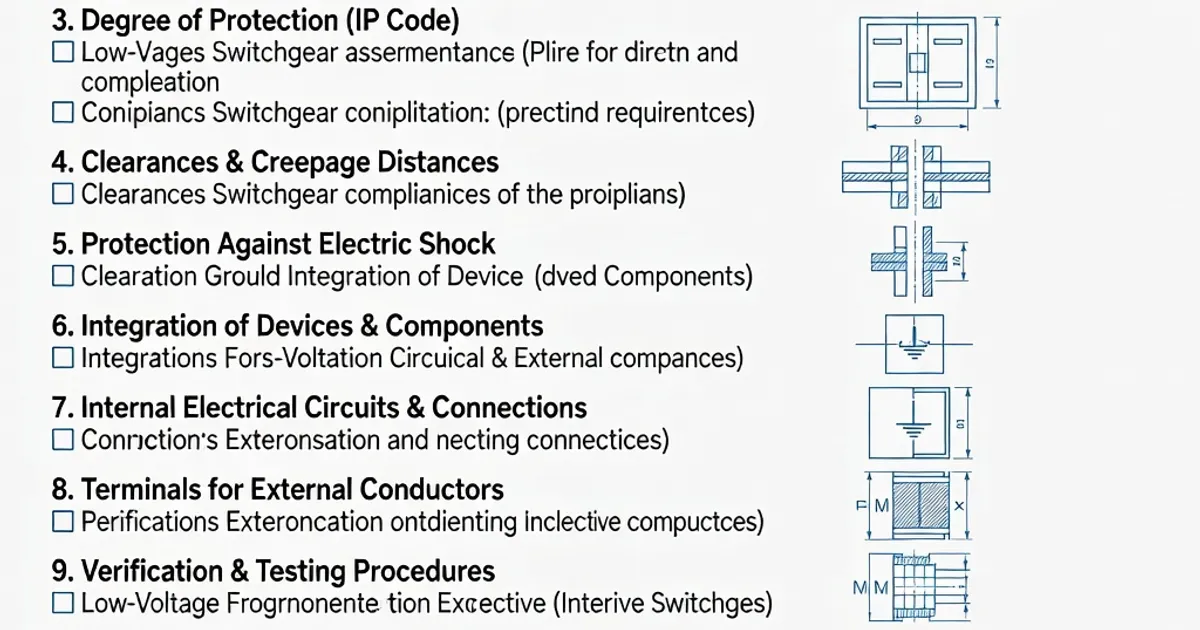
IEC 61439 Compliance Checklist
This checklist summarizes the verification requirements and practical design controls required to demonstrate compliance with the IEC 61439 series for low-voltage power switchgear and controlgear assemblies (PSA). It condenses the core verification framework, the allowable design verification methods, the eleven mandatory verification points performed on the finished assembly, routine verification records, related standards and practical best practices. Use this checklist during design, factory verification and commissioning to ensure your panel meets the standard and the expected safety, continuity of service and user conformity objectives required by IEC 61439.
Core Compliance Framework
IEC 61439 requires verification of eleven key points on the finished assembly; these verifications may be performed by testing, calculation or comparison with a tested design per the options allowed in the standard. The standard emphasizes three core objectives for all verifications: safety (preventing electric shock and fire), continuity of service (mechanical and thermal stability under rated and fault conditions) and end-user conformity (correct markings, documentation and functional performance) (see the IEC 61439 general rules and PSA clauses). For an overview of the construction and certification approach, see the Legrand technical whitepaper on construction certification of assemblies (Legrand).
Design Verification Methods
IEC 61439 permits three validated approaches for each verification requirement. Manufacturers must choose and document an approach appropriate for the assembly and components used:
- Testing: Perform full or partial type-testing and routine tests on the finished assembly under the conditions and methods described in the standard (electrical, thermal, dielectric and mechanical tests).
- Calculations: Use verified calculation methods and standards (for example DIN EN 60890 for temperature-rise calculations and established short-circuit force equations) to demonstrate compliance where physical testing is not performed.
- Comparison: Demonstrate that the design is sufficiently close to a reference assembly that has been tested, using well-documented equivalence criteria (materials, geometry, connections, ratings).
Decide the verification method(s) for each of the 11 checks and document the rationale, inputs and acceptance criteria. For guidance on integrating these approaches in practice, the ABB workbook “The Standard IEC 61439 in Practice” provides worked examples of calculations and verification workflows (ABB).
11 Key Technical Verification Points (Checklist)
Each of the following items must be verified for the finished assembly. The column references below indicate the primary IEC 61439 clause number(s) relevant to each check. Use testing, calculation, or comparison as allowed by the clause.
| Verification Item | IEC Clause | Typical Method(s) | Key Acceptance Criteria / Notes |
|---|---|---|---|
| Temperature rise | 10.3.3 (61439-1/-2) | Calculation (DIN EN 60890), test | Ambient ≤ 35 °C during test; busbar and connections within approved rise limits; diversity accounted for; thermal scans during full-load commissioning |
| Short-circuit withstand strength | 10.3.4, Table 13 | Test, calculation, comparison | SCCR ≥ available fault current at site; forces on busbars and connections verified; non-protected live conductor lengths ≤ 3 m (Table 4) |
| Power-frequency (dielectric) withstand | 10.4 | Test (dielectric), inspection | Clearances and creepage per IEC 60664-1; dielectric test voltages per Table 1–2 |
| Electrical continuity and protective circuit integrity | 10.5 | Resistance measurements, continuity tests | Exposed conductive parts bonded to PE; resistance limits per clause; protective circuit tightness checks |
| Electric shock protection | 10.5 | Visual inspection, IP verification, mechanical operation tests | Access to live parts prevented; IP rating verified (IEC 60529); protective devices operate correctly |
| Mechanical serviceability and integrity | Relevant assembly standard (note on IEC 62262) | Function and mechanical checks | Structure remains intact; IP rating maintained; IK testing not required for LV PSC assemblies per guidance |
| Markings, nameplate and documentation | Clause on markings in 61439 | Inspection | Nameplate with manufacturer ID, rated currents, IP, SCCR, wiring diagrams and durable labels |
| Clearances and creepage | 10.4, IEC 60664-1 | Measurement, inspection | Creepage/clearance distances comply with rated insulation coordination and pollution degree |
| Insulation resistance and dielectric | 10.4, Routine tests 10.7 | Insulation resistance test, dielectric test | Measured values meet limits; dielectric withstand applied per Table requirements |
| Functional operation and protection coordination | Various (components to IEC 60947) | Functional tests, coordination studies | Selective coordination where required; RCDs installed per IEC 60364 |
| Routine verification recordkeeping | 10.7 (61439-2) | Documentation | Dielectric tests, wiring checks, one-line, thermal scans, component certificates retained |
Detailed Technical Guidance for Key Verifications
1. Temperature Rise Verification (Clause 10.3.3)
Per IEC 61439-1 Clause 10.3.3, verify temperature rise of busbars, connectors and components for the expected continuous currents. The standard requires that the average ambient temperature during testing does not exceed 35 °C unless the design intent specifies otherwise. Use DIN EN 60890 or equivalent methods for temperature-rise calculations where tests are not performed. Ensure calculations include realistic thermal arrangements, conductor bundling, surface emissivity and ventilation. Apply diversity factors judiciously and justify them in the verification documentation (ABB).
2. Short-Circuit Withstand Strength (Clauses 10.3.4, Table 13)
Short-circuit verification ensures the assembly withstands electrodynamic forces and thermal effects during fault clearing. Per IEC 61439, the assembly’s short-circuit rating (SCCR or prospective fault current and associated fault duration) must be equal to or greater than the available fault current at the installation point. Verify forces on busbars, bolted connections and conductor supports by calculation or test, documenting conductor cross-sections, spacing and fastening details.
Note critical practical rules: where separate protective conductors are provided per clause 8.4.3.2.3, full short-circuit testing may be unnecessary provided conditions of 10.11.2 are met. Also, non-protected live conductors associated with a short-circuit protective device (SCPD) shall not exceed a total length of 3 m between the main busbar and the SCPD per Table 4 requirements; maintain this constraint in layouts to avoid reduced withstand behavior (Legrand).
3. Power-Frequency Withstand Voltage and Clearances (Clause 10.4)
Verify dielectric strength and electromagnetic insulation coordination. Clearances and creepage distances must comply with IEC 60664-1 for the chosen rated voltage and pollution degree. Perform power-frequency dielectric tests at the voltages specified in the standard tables. For assemblies that include optional withdrawable units or switchgear with insulating barriers, include impulse withstand voltage tests if required. Document insulating material properties and track aging or tracking index where relevant.
4. Electrical Continuity and Protective Circuit Integrity (Clause 10.5)
Measure the resistance between each exposed conductive part and the PE terminal. Verify that protective equipotential bonding is continuous and that protective conductors and terminals can withstand the mechanical and thermal stresses expected during fault conditions. Perform visual checks of basic versus fault protection, torque checks on protective conductors and subject a representative sample to the protective circuit tests referenced in Table 13, clauses 1–6 and 8–10 where required (IEC checklist).
5. Electric Shock Protection (Clause 10.5 and IEC 60529)
Confirm adequate protection against direct and indirect contact. Validate the declared IP rating (per IEC 60529) by inspection and appropriate tests for ingress protection where required. Check interlocks, covers and barriers to ensure live parts are not accessible during normal operation or intended maintenance. Verify operation of protection devices through mechanical operation tests and continuity checks.
6. Mechanical Integrity and Impact Resistance
Assess mechanical assembly integrity, mounting strength, fastener security and functional operation of compartments and interlocks. Although IEC 62262 (IK impact) defines mechanical impact classifications, IEC 61439 guidance indicates that strict IK testing does not apply to LV PSC assemblies in the same way it does to standalone enclosures — however, the assembly must maintain structural integrity and the declared IP rating under foreseeable mechanical events. Document mechanical design margins and perform representative mechanical function checks during routine verification (EEP guide).
7. Markings, Nameplate and Durability
Provide durable nameplates and circuit identification. The assembly nameplate must include, at minimum, the manufacturer identification, rated current(s), rated voltage, rated service short-circuit breaking capacity (SCCR/AIC) and IP rating. Circuit directories, hazard labels and operation instructions must remain legible over the expected service life. Record the marking content and material tests that demonstrate durability against UV, chemicals and abrasion where relevant (Legrand).
Routine Verification and Required Documentation (Clause 10.7)
IEC 61439-2 mandates routine verification and corresponding records for assemblies delivered to the customer. Maintain a verification file for each assembly with at least the following:
- Dielectric test reports and applied voltages
- Insulation resistance measurements (method and values), per IEC 60364-6 or local regulations
- Wiring inspection checklist and clearance/creepage confirmation
- Thermal imaging / temperature-rise measurements during commissioning under full-load conditions
- Functional operation reports for devices, including mechanical operation counts and settings
- One-line diagram and detailed panel schedule with individual device AIC/SCCR values and settings
- Component datasheets, certificates of conformity and manufacturer test reports
- Calculations used for temperature-rise and short-circuit verification, including date and software/tool references
- Assembly serial number, manufacturing date and traceability records for key components
Retain records as part of the technical file and provide the customer with a certified declaration of conformity including the verification method used and the results per clause 10.7 documentation requirements (IEC checklist).
Related Standards and
Related Panel Types
Frequently Asked Questions
Request a Quote
Tell us about your panel requirements and our engineering team will get back to you within 24 hours.
Email Us
[email protected]Call Us
+90 232 332 22 78