Data Center Power Distribution Design
Power distribution architecture and panel design for data center facilities.
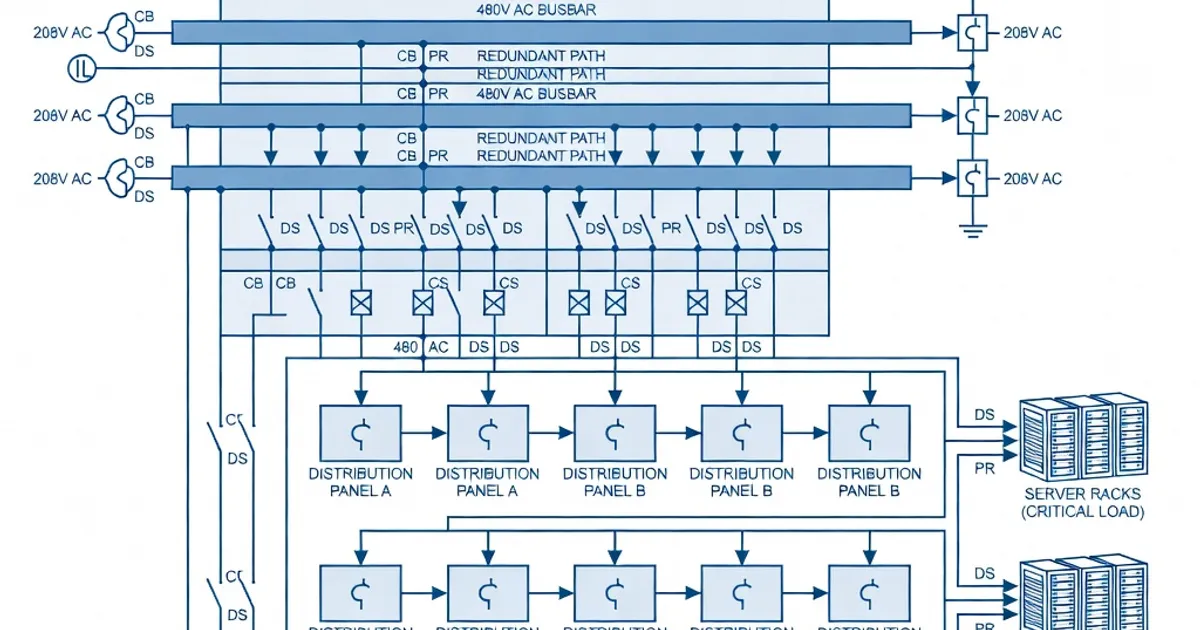
Data Center Power Distribution Design
This article consolidates IEC 61439 requirements, industry practice, and vendor product data to provide a prescriptive guide for designing low-voltage power distribution for data centers. It explains the mandatory design verifications under IEC 61439, quantifies critical parameters (temperature rise, short‑circuit withstand, clearances, IP rating, busbar sizing, and rated diversity factor), and provides practical design, verification and implementation guidance aligned with current manufacturer offerings and best practices. Citations to primary guidance documents and product literature appear inline and in the References and Further Reading section.
Why IEC 61439 matters for data centers
IEC 61439 (the modern replacement for IEC 60439) establishes performance-based verification methods for low-voltage switchgear and controlgear assemblies (LV ASSEMBLIES) up to 1,000 V AC or 1,500 V DC. For data centers, the standard shifts emphasis from factory type‑testing to design verification of assemblies intended to operate under realistic site conditions. This is critical because data center loads (UPSs, parallel generators, high-density IT racks) impose steady thermal, harmonic and short‑circuit stresses that must be verified for each assembly configuration rather than assumed from a type-tested model alone (IEC 61439‑1, general rules) [3][5].
Scope and key objectives for data center panels
- Ensure continuous, reliable power delivery to IT loads and infrastructure with verified thermal and short‑circuit performance under rated conditions (including rated diversity).
- Maintain personnel safety and equipment protection through verified clearances/creepage, arc‑fault mitigation, degree of protection (IP) and adequate separation of phases/earth.
- Enable modularity and scalability using busbar trunking systems and modular switchgear while meeting IEC 61439‑6 requirements for trunking systems where applicable.
- Provide documented verification (tests, calculations, reference designs) for each critical characteristic required by IEC 61439 Clauses 10–13 [3][6].
IEC 61439 verification characteristics relevant to data centers
IEC 61439 requires assemblies to be verified for a set of construction and performance characteristics. For data centers, the following verifications are among the most critical:
Temperature rise (thermal performance)
Per IEC 61439‑1 Clause 10.10, temperature‑rise verification ensures that any live parts, terminals and conductors do not exceed permissible temperatures under rated current and the chosen rated diversity factor (RDF). Typical limits include a maximum terminal temperature-rise of ≤70 K over ambient for terminals and connector surfaces; manufacturers commonly verify assemblies at an average ambient of 35 °C. Where a design verification is by calculation rather than test, IEC guidance and harmonized documents (e.g., DIN EN 60890 for conductors up to 630 A) require conservative assumptions — a common industry rule is to apply a 20% derating when relying on calculation methods to account for uncertainties in thermal coupling and site conditions [1][3][5].
Short‑circuit withstand strength
IEC 61439‑1 Clause 10.11 requires that assemblies withstand prospective short‑circuit currents for specified durations. For data center main distribution assemblies, design target short‑circuit ratings often range to 150 kA rms symmetrical or higher depending on substantiation from utility and generator studies. The standard requires that any unprotected conductor lengths between protection device and connection point be minimized; Table 4 of IEC 61439 limits non‑protected conductor runs to ≤3 m in many verifications to avoid uncontrolled thermal and electrodynamic stresses during a short‑circuit incident [1][3].
Power‑frequency and impulse dielectric properties
Clause 10.9 of IEC 61439 requires verification of dielectric strength at power frequency and impulse levels to ensure the insulation system withstands overvoltages. If clearances and creepage distances are at least 1.5× the Table 4 values for the rated insulation level, the assembly may be exempted from the impulse withstand test; otherwise impulse tests apply. Data center assemblies typically are designed assuming pollution degree 3 and corresponding creepage distances to provide robust insulation margins for long service life [3][5].
Clearances and creepage distances
Clause 10.3 mandates minimum clearances and creepage distances based on the rated insulation voltage and expected overvoltages. For data centers, where environments can introduce dust and pollution, designers should assume pollution degree 3 and select creepage margins accordingly. As a practical target, many designers specify phase‑to‑phase clearances of ≥8 mm for common 400 V systems in high‑reliability installations and follow IEC table guidance for higher system voltages [5].
Degree of protection (IP)
Degree of protection is verified against IEC 60529. Data centers typically require IP54 or higher for distribution enclosures handling IT loads or adjacent to cooling/airflow systems to avoid ingress of dust and water from maintenance procedures or HVAC drift. For outside‑facing or exposed equipment, IP55–IP66 may be required. Selection of IP rating affects cooling strategy, ventilation design and thermal verification results since higher IP often restricts natural convection and mandates forced ventilation [5].
Busbars, conductors and separation
IEC 61439 Clauses 8.6.1 and 8.6.2 require that busbar systems and conductors be sized and arranged to ensure electrical continuity, mechanical support and adequate separation. In data centers designers must include harmonic heating effects (non‑sinusoidal currents from UPSs and power electronics) when calculating thermal performance, verify busbar short‑circuit withstand, and provide insulated or partitioned busbar arrangements for Form 4b segregation where arc‑fault containment and maintenance without shutdown are desired [4][1].
Rated diversity factor (RDF) and load modeling
RDF selection directly affects thermal verification and conductor sizing. IEC 61439 requires the manufacturer or designer to state the RDF assumptions used for verification. For data centers, RDF must account for UPS inverter loading, N+1 or 2N redundancy, and the probability of simultaneous high IT rack demand. Documentation of RDF, simultaneous load curves and how these inputs were used in temperature‑rise and short‑circuit calculations must be maintained with the assembly’s verification dossier [3][1].
Standards and normative documents to reference
Designers must integrate multiple standards while applying IEC 61439 requirements:
- IEC 61439‑1:2020 — General rules for assemblies and clauses 10–13 that specify required verifications and performance characteristics [3].
- IEC 61439‑2 — Requirements specific to power switchgear and controlgear assemblies, applicable to data center main distribution boards (MDBs) [3][4].
- IEC 61439‑3 (Ed.2.0 2024) — Distribution boards for ordinary persons; relevant for sub‑distribution and SMDB panels in non‑access‑restricted areas [2].
- IEC 61439‑6 — Requirements for busbar trunking systems (BTS), recommended for modular rack distribution and flexible floor power [6].
- IEC 60947 series — Requirements for the low‑voltage switching and protective devices (circuit breakers, contactors, RCDs) used inside assemblies [1].
- IEC 60529 — Degrees of protection (IP code) for enclosures, to specify ingress resistance for dust and moisture [5].
- DIN EN 60890 — Guidance for conductor temperature rise calculations up to 630 A, commonly applied when verification uses calculation rather than test [1].
Access to the official IEC publications (e.g., IEC 61439 parts) is required for full compliance; many manufacturers publish application notes and workbooks that interpret the standard for practical designs (examples cited below) [1][3][5].
Industry product examples and specification comparison
Major switchgear manufacturers offer IEC 61439‑verified or verifiable assemblies tailored for data center use. The table below summarizes representative product capabilities and typical data‑center relevant ratings as published by vendors and documented practice.
| Manufacturer / Product | Representative Max Bus Rating | Typical Short‑Circuit Rating | IP / Thermal Features | Data‑Center Focus |
|---|---|---|---|---|
| Siemens — SIVACON S8 | Up to 7,150 A | Up to 150 kA | IP54; temp rise ≤35 K (typical reference design) | Modular, high current, used in large MDBs and distribution aisles [1][3] |
| ABB — UniGear (type‑tested) | Varies by configuration | Configured for high SC withstand; verification per Clause 10.10 | Form 4b options; integrated busbar systems | Workbooks and application notes for data center layouts [1] |
| Schneider Electric — Okken / BlokSeT | Panel versions to 6,000 A (system dependent) | Up to 150 kA (product dependent) | IP42–IP54; integrated monitoring | Form 4b, harmonic‑resistant busbar options [5] |
| Eaton — Power Xpert CX | Up to 6,300 A | Up to 150 kA | Arc‑resistant options; RDF optimization | Data center switchgear with metering and protection [3][4] |
| Rittal — Perforex VX25 | Enclosure system to support high bus ratings | Product dependent; IEC 61439 verified assemblies | IP55 cabinet options; optimized airflow for high‑density loads | Modular enclosures supporting integrated switchgear [7] |
Manufacturers typically publish detailed verification dossiers, reference designs and application notes that document how specific ratings (temperature rise, SC withstand, IP) were achieved and verified per IEC 61439 clauses [1][5].
Design best practices for data center power distribution
Combine IEC 61439 compliance objectives with data center operational priorities (availability, maintainability, safety) using the following proven practices.
System architecture and segregation
- Use TN or TT earthing systems depending on site constraints and local regulations; TN systems reduce fault loop impedance and are commonly used for their operational benefits in data centers [1][4].
- Adopt Form 4b internal separation where feasible to allow safe maintenance on outgoing feeders without exposing personnel to live portions of the assembly (improves maintainability and arc‑fault mitigation) [5].
- Design for N+1 or 2N UPS architectures with clear RDF documentation so that panel verifications account for likely simultaneous loads during normal and maintenance states.
Thermal management and ventilation
- Assume a maximum ambient of 35 °C for standard verification; for hotter environments, perform a bespoke thermal verification or apply forced ventilation to maintain component temperatures within allowable limits (some vendors publish temp‑rise ≤35 K reference designs) [1][3].
- When choosing higher IP enclosures, incorporate active ventilation or cooling because restricted airflow increases conductor and device temperatures and may require derating.
- When using calculation methods, apply at least 20% derating or align with DIN EN 60890 calculation rules for conductors up to 630 A to preserve margin in real‑world conditions [1].
Harmonics, power quality and protection coordination
- Design busbar sizes and conductor ampacity to handle harmonic heating from UPSs and non‑linear loads. Include harmonic current factors in thermal calculations per vendor guidance [4].
- Coordinate protection devices (upstream breakers, feeder breakers, RCDs) following IEC 60947 requirements and verify that breaking capacities meet prospective fault levels on site [1].
- Integrate power monitoring and metering at critical nodes to validate assumed RDF and to support future capacity planning and verification re‑runs after load growth [5].
Modularity, busbar trunking and scalability
- Prefer busbar trunking systems (IEC 61439‑6) for high‑density and modular rack power distribution where flexibility and speed of change are priorities. BTS simplifies future expansion while maintaining IEC verification when designed and installed per manufacturer instructions [6].
- Keep unprotected conductor runs between protective devices and connections to a minimum (≤3 m where specified) to limit unverified electrodynamic stresses during faults [1][3].
Verification strategy and documentation
IEC 61439 requires the assembly manufacturer or the designer to supply a verification dossier that demonstrates conformity. The dossier should contain:
- Declared ratings: rated current, rated insulation level, short‑circuit rating, IP, RDF assumptions and environmental conditions (ambient, pollution degree).
- Thermal verification results: test reports or detailed calculation sheets referencing DIN EN 60890 where calculations are used and showing margins and deratings applied [1].
- Short‑circuit verification: test evidence or calculation of electrodynamic and thermal withstand for busbars and conductors, with details of the maximum allowed unprotected conductor lengths (≤3 m rule referenced where applicable) [3].
- Dielectric test data or clearance/creepage justification including any impulse exemptions (clearances ≥1.5× Table 4 values) [3].
- Single‑line diagrams, cable schedules, device coordination studies, and AR (arc‑flash) mitigation measures if applicable.
For mission‑critical data centers prioritize physical testing for main assemblies and use validated calculations for repeatable subassemblies, ensuring the overall verification strategy provides conservative margins for site variability [1][3].
Implementation checklist for data center LV assemblies
- Define electrical architecture (TN/TT) and redundancy (N+1, 2N) and document RDF and simultaneous load assumptions.
- Select manufacturer/product family with documented IEC 61439 verification or ability to produce a bespoke verification dossier for the intended configuration [1][5].
Related Panel Types
Frequently Asked Questions
Request a Quote
Tell us about your panel requirements and our engineering team will get back to you within 24 hours.
Email Us
[email protected]Call Us
+90 232 332 22 78