Smart Panels & Industry 4.0
How Industry 4.0 and digitalization are transforming panel assemblies.
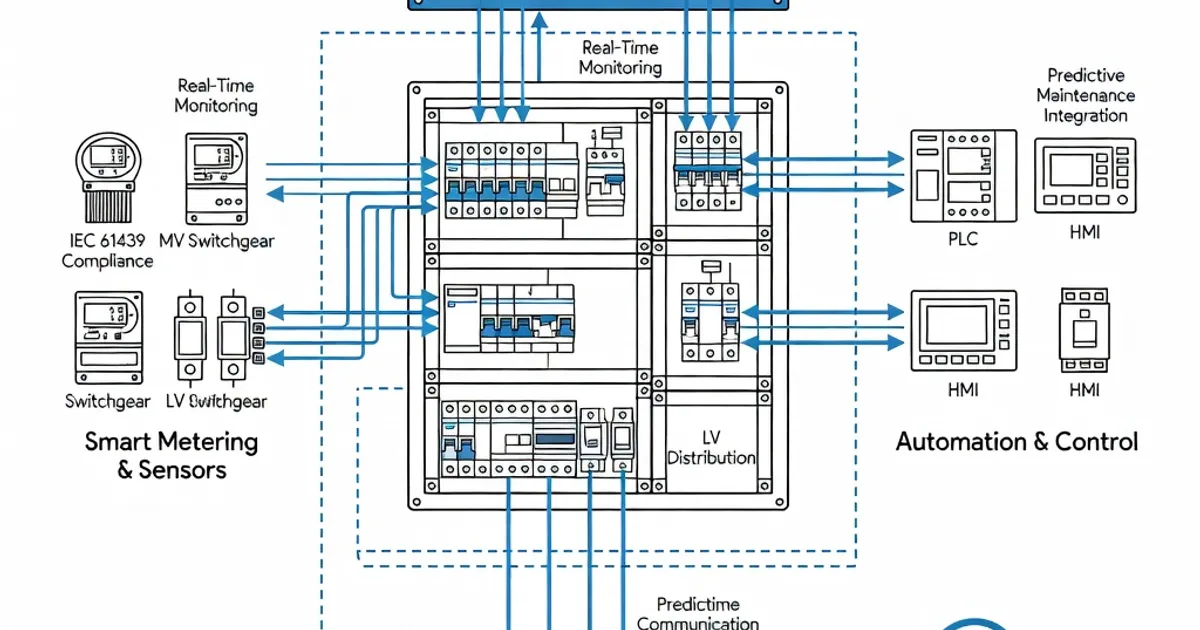
Smart Panels & Industry 4.0
Smart panels combine the established electrical performance and safety requirements of low-voltage assemblies with digital sensors, embedded intelligence, and network connectivity to deliver Industry 4.0 capabilities such as predictive maintenance, energy optimisation, and remote diagnostics. When designed and verified to IEC 61439, smart panels preserve the electrical, thermal and dielectric behaviours required of switchboards and controlgear while adding data streams and control interfaces for modern plant and grid operations [4][2][3].
What is a Smart Panel?
A smart panel is an IEC 61439 compliant low-voltage assembly that integrates:
- Electrical distribution and protection devices (breakers, contactors, fuses) conforming to IEC 60947 series;
- Embedded sensors (temperature, partial discharge, current, vibration) that monitor the condition of busbars, connections and functional units in real time;
- Local intelligence (edge gateways, power meters, protection relays) capable of protocol translation (Modbus, Profibus, Ethernet/IP, OPC UA) and running analytics or forwarding data to cloud platforms;
- Software components such as digital twins, dashboards, and predictive algorithms for maintenance and energy management.
Smart panels therefore act as both electrical distribution hardware and an instrumentation platform that must be verified as an assembly per IEC 61439-1 and the applicable type-specific part (for example IEC 61439-2 for power switchgear and controlgear assemblies) so that the added electronics do not compromise electrical, thermal or safety performance [4][1].
Key IEC 61439 Requirements for Smart Panels
IEC 61439 prescribes design verification methods (testing, calculation, or comparison) and sets mandatory limits and test procedures that apply equally to traditional and smart panels. Integrating sensors and digital devices requires that panel builders demonstrate continued compliance with the following core clauses.
Temperature Rise Limits (IEC 61439-1, Clause 10.10)
Per IEC 61439-1 Clause 10.10, assemblies must limit the temperature rise of busbars, connections and functional units when carrying rated current under worst-case conditions (including enclosure covers and partitions closed). Verification may be by temperature-rise testing or validated calculation methods. Key points:
- Tests are performed with the assembly loaded at its rated current and at the specified ambient temperature (commonly 35 °C), using the reference design and with all covers/partitions in place [3][4].
- The Rated Diversity Factor (RDF) — the factor used to represent non-simultaneous loading — is applied to outgoing circuits. Reference RDFs include 1.0 for incoming feeders, 0.9 for 2–3 outgoings, 0.8 for 4–5, and 0.7 for 6–9 outgoings (see IEC 61439 Annex C and national practice) [4][7].
- Smart components (for example local processors, displays or IoT gateways) must be included in the worst-case thermal model as they can alter internal convective paths and local hotspot formation; sensors and wiring should be mounted to avoid thermally sensitive locations unless accounted for in the verification [3].
Short-Circuit Withstand (IEC 61439-1 Clause 10.9; IEC 61439-2)
IEC 61439 specifies short-time withstand performance expressed as Icw (short-time withstand current) and Ipk (peak let-through), replacing the older Icn notation from IEC 60439. The assembly must withstand internal electrodynamic and thermal forces for the specified time (commonly 1 s) without dangerous deformation or separation of live parts [4][1]. Example figures used in industry product ranges include:
- Assemblies rated up to 630 A commonly designed/tested for Icw around 35 kA (time-dependent; verify to product data) [1].
- Higher-rated switchgear and MCC/PCC panels provide Icw values up to and beyond 50 kA, depending on construction and manufacturer type tests [8].
Smart panels must maintain mechanical integrity for the declared short-circuit ratings even with added digital modules and cabling inside enclosures. Routing of sensor cables and fixation of edge devices must not reduce the assembly’s short-circuit performance [4][8].
Dielectric Properties and Insulation (IEC 61439-1, Clauses 10.7–10.8)
Dielectric clearances, creepage distances and power-frequency dielectric tests remain mandatory. Clause 10.7–10.8 requires verification that internal separations prevent flashover under the declared rated voltage and impulse withstand voltages. Specific points:
- Clearances and creepage distances must conform to the voltage rating and pollution degree appropriate to the installation; partial-discharge detection sensors can be employed to monitor insulation degradation but do not replace design verification [5].
- Power-frequency withstand and impulse tests are applied when type testing; routine manufacturing checks include continuity and insulation resistance tests [5].
- Protective bonding resistance checks verify that exposed conductive parts are tied to earth and that connection resistances meet limits specified in IEC 61439 [5].
Degree of Protection / Enclosure (IEC 60529 via IEC 61439-1 Clause 10.11)
IP ratings for smart panels typically fall in the IP31–IP55 range depending on application (indoor service vs. outdoor/harsh environments). Clause 10.11 requires verification of ingress protection and mechanical strength of enclosures. Considerations when integrating digital interfaces:
- Front-panel displays, sensors and ports must be sealed and tested so that the declared IP is maintained; adding ventilation or cooling units (for embedded computing) affects IP and must be included in verification [1][5].
- Material tests such as impact and paint adhesion are referenced (for example ISO 2409 adhesion ≥50%) and must be passed for the declared environmental class [5].
Design Verification with Digital Integration
IEC 61439 allows verification by testing, calculation or comparison to a reference design. For smart panels, a mixed approach is common: type testing the electrical core and running targeted thermal tests with the digital equipment installed. Routine checks at manufacture (FAT) then verify wiring, interlocks, dielectric strength, labeling and that no retrofits compromise performance [4][2].
Digital Features, Protocols and Platforms
Smart panels embed a mix of sensors and communications hardware to deliver data for analytics and control:
- Sensors: temperature (busbar, ambient, breaker terminals), partial discharge (PD) monitors, current/energy meters, vibration and humidity. PD sensors are often used in higher-reliability assets to detect insulation breakdown early [2][7].
- Edge devices and relays: digital protection relays (e.g., Relion), PLCs and local gateways that aggregate data and implement logic for alarms and local automation [8].
- Protocols and interoperability: Modbus, Profibus, Ethernet/IP, and increasingly OPC UA for semantic data models. Many vendors provide cloud solutions (MindSphere, ABB Ability, EcoStruxure) or support third-party IIoT platforms via secure gateways [9][8][3].
- Digital twins and analytics: Manufacturers supply digital models for configuration, simulation and predictive maintenance. Digital twins help verify thermal loading and cable routing before manufacture and enable lifetime performance tracking once in service [8][9].
Standards Landscape
Smart panels must be compliant with a set of interlocking standards. The table below summarises the most relevant standards and their role in smart-panel design and verification.
| Standard | Scope in Smart Panels Context | Key Clauses / Notes |
|---|---|---|
| IEC 61439-1 (Ed. 2.0, 2020) | General rules for low-voltage switchgear and controlgear assemblies, mandatory verification methods. | Temperature rise (10.10); dielectric (10.7–10.8); short-circuit (10.9); IP (10.11); RDF tables in Annex C [4][7]. |
| IEC 61439-2 (Ed. 2.1, 2020) | Type-specific requirements for power switchgear and controlgear assemblies (PCC/MCC). | Specific short-circuit and temperature rules for switchgear assemblies; complements Part 1 [1][4]. |
| IEC 60947 series | Specification for low-voltage switching devices used inside smart panels (circuit breakers, contactors). | Component-level type tests and interoperability for intelligent breakers and devices [6]. |
| IEC 60529 | Ingress protection (IP) classification for enclosures and access panels. | Used via IEC 61439 for front-panel and enclosure ratings; affects sealing of sensors/displays [1][5]. |
| IEC 60204-1 (Annex B/C) | Electrical equipment of machinery; guidance for wiring, control interfaces and data exchange relevant to automation panels. | Guides safe integration of control and data paths with machinery systems [9]. |
| IEC 62271 series | High-voltage switchgear standards where hybrid solutions or HV interfaces exist. | Relevant if smart panels are part of hybrid HV/LV solutions or subjected to seismic/mechanical strength requirements [6]. |
Current Product Examples and Design Patterns
Major switchgear manufacturers provide Industry 4.0-ready panels that combine IEC 61439 verification with embedded digital ecosystems:
- Siemens: NXPLUS C and SIVACON lines are integrated with MindSphere-ready IoT modules and provide IEC 61439 verified constructions for up to 2500 A and IP43 variants for indoor applications [9].
- ABB: UniGear ZS1 and related digital switchgear incorporate Relion relays and ABB Ability™ Genix cloud analytics; type-tested assemblies with Icw values up to 50 kA where specified [8].
- Schneider Electric: Premset and EcoStruxure Power switchgear include embedded metering and panel-server options for energy monitoring, with explicit attention to temperature-rise verification per Clause 10.10 [3].
- Eaton: Power Xpert and modular MCC solutions provide ForeSee predictive maintenance sensors and modular IoT gateways that support IP31–IP55 enclosures [1].
- Rittal: Ri4Power / Perforex mechanical systems are used as enclosures for smart assemblies with integrated cooling and condition monitoring options [1].
Design Verification and Factory Acceptance Test (FAT) Checklist
Successful delivery of a smart panel requires a robust FAT and verification regime to ensure both electrical performance and digital functionality. Typical checklist items include:
- Visual inspection and mechanical checks: enclosure, hinges, locks, cable entries, IP seals [4].
- Wiring and labeling verification: terminal IDs, phase identification, protective device labeling per IEC 61439 [4].
- Dielectric tests: insulation resistance, power-frequency dielectric withstand where applicable [5].
- Temperature-rise testing or validated calculations with digital devices installed and enclosure closed per Clause 10.10. Monitor busbar, connection and functional unit temperatures at rated current [3][4].
- Short-circuit withstand verification: mechanical inspection for deformation and continuity checks after controlled fault testing where required [1][4].
- Protective bonding resistance and earth continuity checks [5].
- Digital systems validation: sensor calibration, alarm thresholds, telemetry transmission, gateway firewall and authentication, protocol conformance tests (Modbus/OPC UA) [2][9].
- Functional tests: interlocks, remote-control commands, local/remote switching operations and fail-safe behaviour [4].
Implementation Considerations for Industry 4.0
When implementing smart panels in an Industry 4.0 architecture, consider the following:
- Cybersecurity: adopt principles from IEC 62443 (industrial communication network security) to protect edge devices and cloud connections. Harden gateways, use secure protocols and manage firmware updates centrally [2].
- Data modelling and interoperability: favour OPC UA and standardised data models for semantic interoperability. Many vendors provide connectors to their cloud platforms, but standards-based interfaces ease integration [9][8].
- Edge analytics: perform early filtering and event detection at the edge to reduce bandwidth and protect sensitive control loops. Use relays and edge gateways for local protection logic
Related Panel Types
Frequently Asked Questions
Request a Quote
Tell us about your panel requirements and our engineering team will get back to you within 24 hours.
Email Us
[email protected]Call Us
+90 232 332 22 78