Seismic-Rated Panel Assemblies
Design and qualification requirements for panels in seismic zones.
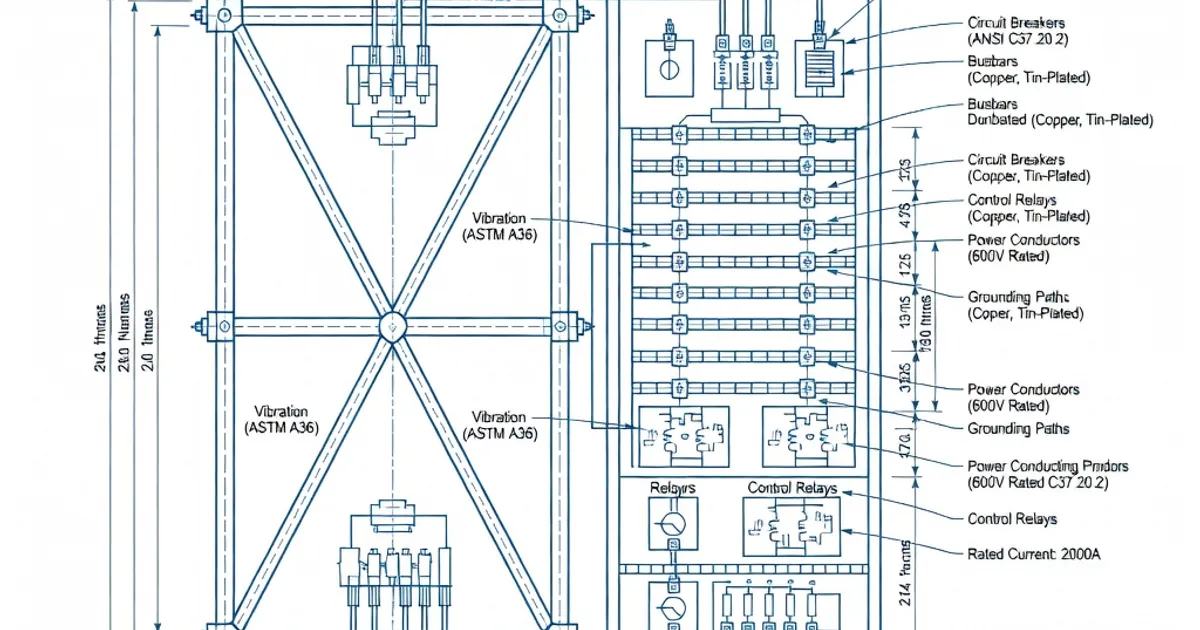
Seismic-Rated Panel Assemblies
This article explains the requirements, design practices, verification tests and typical product characteristics for seismic-rated low-voltage panel assemblies built to IEC 61439 principles. It consolidates the relevant clauses from IEC 61439-1 and -2, applicable complementary standards, test procedures and industry examples to guide designers, specifiers and owners who must deliver panel assemblies that retain structural integrity, electrical functionality and protection degrees during and after seismic events.
Overview
Seismic-rated panel assemblies are low-voltage switchgear and controlgear assemblies that resist earthquake-induced mechanical loads without unacceptable deformation, loss of protective enclosure (IP/IK), electrical failure or reduced short‑circuit and thermal performance. IEC 61439 series defines the general and product-specific construction and verification requirements for low-voltage assemblies; it requires verification of mechanical strength and references other standards for impact, ingress protection and device mechanical durability (for example IEC 60529 and IEC 62262). Since IEC 61439 does not prescribe a single seismic protocol, seismic qualification is commonly achieved by applying seismic-specific standards and test procedures such as IEC 62271-1 seismic guidance, IEEE 693, ASCE 7/IBC criteria or regionally adopted response spectra and acceleration values (Peak Ground Acceleration, PGA) depending on site requirements (for example 0.5g–1.5g for high seismic zones) (Per IEC 61439-1 Clause 10.9; see also IEC 62271-1 and IEEE 693) [3][4].
Why IEC 61439 Requires Mechanical Verification
IEC 61439-1:2020 Clause 10.9 requires assemblies to demonstrate adequate mechanical strength under expected use and stresses, including lifting and impact. Clause 10.9.2 specifically requires lifting verification at 1.25× mass for lifting devices. The standard cross-references IEC 62262 for IK impact ratings and IEC 60529 for IP ratings; both remain critical to demonstrate that vibration or shock has not degraded enclosure protection. For seismic applications, these mechanical requirements form the baseline; designers then augment them with seismic-specific dynamic verification such as sinusoidal vibration, shock and response-spectrum tests to the acceleration levels required by the project or local codes [3][4].
Applicable Standards and How They Apply
Seismic qualification of low-voltage panels uses a combination of IEC 61439 requirements and seismic-specific or device standards. The table below summarizes the most relevant documents and their seismic applicability.
| Standard | Edition (as of 2026) | Seismic-Relevant Clauses | Application to LV Panels |
|---|---|---|---|
| IEC 61439-1 (General rules) | 2020 | Clause 10.9 Mechanical strength; 10.9.2 Lifting; cross-ref. IEC 60529, IEC 62262 | Baseline requirements for mechanical verification, busbar/bracing design, lifting devices and post-test checks (IP/IK unchanged) [3][4]. |
| IEC 61439-2 (Power switchgear/controlgear) | 2020 | Clause 10.9 mechanical strength; Clause 8.6 internal separation requirements | Product-specific requirements for panels up to 6.3 kA; used to verify busbar bracing, separation (forms of separation) and short-circuit withstand under dynamic loads [1][2]. |
| IEC 60529 | 2013+A1:2016+A2:2019 | IP codes (ingress protection) | Verifies enclosure protection after vibration/shock. IP rating must remain adequate post-test (often IP54 or higher specified for seismic zones) [3]. |
| IEC 62262 | 2002 | IK impact ratings (e.g., IK10 = 20 J) | Used to evaluate resistance to mechanical impacts that may occur during or after seismic events; panels often target IK10 for heavy-duty installations [3][4]. |
| IEC 62271-1 | 2021 | Clause 6.104 Seismic qualification (acceleration, response spectrum) | Although a high-voltage switchgear standard, its seismic test guidance (acceleration spectra and response limits) is commonly adapted to LV panels where local codes do not provide LV-specific procedures [4]. |
| IEC 60947 (device standards) | Various (e.g., IEC 60947-1:2021) | Mechanical durability; device vibration and shock | Ensures circuit breakers, contactors and other devices can withstand expected seismic loads and maintain functionality [5]. |
Design Requirements and Typical Specifications
Designing a seismic-rated panel assembly requires addressing frame stiffness, anchorage, conductor bracing, internal separation, device fixation and flexible connections. The next points list commonly used prescriptive measures and numeric targets drawn from industry practice and standards guidance.
- Frame construction: Use welded steel frames, typical plate thickness ≥3 mm for general duty; heavy-duty designs use 5 mm or greater and base plates sized for anchor bolt distribution. Specify steel with yield strength ≥235 MPa. Rigid frames and gusseted corners reduce stress concentrations and maintain natural frequencies above 20 Hz to avoid resonance with typical ground motion spectra [4].
- Busbar bracing: Clamp and brace busbars at intervals of 300–600 mm, depending on section modulus and span. Use tri-point bracing on long runs and flexible braided links at joints to accept differential movement. Busbar insulation and support insulators should meet temperature-rise limits (busbar temperature rise ≤70 K above ambient for conductor parts per IEC 61439-1 Clause 10.10) and dielectric requirements (Clause 10.8) [1][5].
- Lifting and anchorage: Provide lifting eyes and handling points rated to 1.25× mass per IEC 61439-1 Clause 10.9.2. Anchor base plates for seismic loads per local code and design spectra; typical anchor design assumes dynamic inertial loads based on the specified peak ground acceleration (e.g., 0.5g–1.0g or higher for critical facilities) [3][4].
- Devices and internal fixation: Mount circuit-breakers, contactors, relays and auxiliary devices with positive mechanical locks, anti-vibration clamps and retainers. Verify device mechanical durability per IEC 60947 device clauses and avoid reliance on friction-fit mounts alone [5].
- Enclosure protection: Design to maintain the specified IP rating after seismic motion—IP54 is a common minimum for seismic zones; higher values (IP55/IP65) may be required in harsh external environments. Impact resistance to IK ratings should be validated where panel faces could be struck during movement [3].
- Natural frequency: Aim for assembly natural frequencies >20 Hz to reduce the likelihood of resonance with ground input spectra commonly dominant in the 1–20 Hz band. Validate by modal analysis or test [4].
Performance Targets (Typical)
| Parameter | Typical Target | Reference |
|---|---|---|
| Seismic acceleration design | 0.5g to 1.5g PGA depending on zone (common practice: 0.5–1.0g for many specifications) | [4], [1] |
| Sinusoidal vibration | 5–100 Hz, up to 1 g (sine sweep or random as specified) | [4] |
| Shock pulse | Typical shock tests: 15 g, 11 ms half-sine; device shock protocols per IEC 60947 | [4], [5] |
| Short-circuit withstand | Maintain declared short-circuit withstand (up to 100 kA/1 s in typ. panels) after seismic loading | IEC 61439-1 Clause 10.7 [1] |
| Temperature rise | Busbar rise ≤70 K; insulator rise ≤140 K per IEC 61439 Clause 10.10 | IEC 61439-1 Clause 10.10 [1] |
Qualification Tests and Acceptance Criteria
Seismic qualification relies on a combination of laboratory dynamic tests and post-test functional and visual inspections. Manufacturers typically perform type tests on representative assemblies (Type Tested Assemblies, TTA) and supplement with routine checks. Below are the commonly applied tests and the acceptance checks performed after each test.
Common Seismic Tests
- Sinusoidal vibration and random vibration: Frequency sweep (often 5–100 Hz) at specified acceleration levels (0.5 g–1 g) to expose the assembly to sustained resonant and broad-band excitation. Test duration and axes (three orthogonal axes) follow project or standard guidance (e.g., adapted from IEC 62271-1) [4].
- Shock testing (half-sine or shock pulse): Single or multiple shock pulses, commonly 15 g for 11 ms for major shock; local device tests may require higher pulses as per IEC 60947 device mechanical durability clauses [4][5].
- Response spectrum testing: Apply a design response spectrum that represents expected site ground motion (shape and amplitude per local seismic code or IEC 62271-1 guidance). This method evaluates the assembly under a spectrum of frequencies typical for earthquakes [4].
- Operational verification: Functional tests of circuit-breakers, protection devices, control circuit continuity and interlocks to confirm post-test operability.
Post-Test Acceptance Criteria
- No permanent deformation exceeding specified limits (commonly <1–2% of relevant dimensions depending on project). Busbar misalignment typically must be <2 mm to preserve clearance and connection integrity [4].
- No loss of declared IP rating (e.g., IP54 must be retained as per IEC 60529). Visual inspection and ingress tests validate enclosure integrity [3].
- No loss of short-circuit withstand capability. If short-circuit verification cannot be directly performed after seismic testing, mechanical integrity of current paths and connections must be demonstrated to support declared fault levels (per IEC 61439-1 Clause 10.7) [1].
- Devices must remain operational and within their factory calibration limits; protection settings and tripping characteristics need re-checking if devices experienced significant mechanical shocks [5].
Manufacturer Approaches and Product Examples
Major switchgear manufacturers produce seismic-rated panel lines that combine IEC 61439 compliant construction with tested seismic packages. Product offerings typically specify maximum rated currents, the acceleration levels to which the assembly was tested, recommended anchoring arrangements and any optional seismic bracing kits. Representative examples and typical specifications seen across products are:
| Manufacturer / Line | Key Specs | Seismic Certification / Notes |
|---|---|---|
| Siemens — Sivacon / NXPLUS | Up to 4 000 A, welded frame (up to 5 mm), IP54, busbar bracing, depth 600–1 200 mm | IEC 61439-2; manufacturer seismic guides reference IEEE/IBC criteria; tested acceleration up to ~2g for specific product variants [1]. |
| ABB — UniGear ZS1 | Up to 4 000 A, flexible busbar joints, vibration damping, modular cells | IEC 61439-1/2; seismic tests and KEMA reports available for select configurations; common rating 1 g horizontal / 0.5 g vertical as stated in product technical data [5]. |
| Schneider Electric — OKKEN / Blokset | Up to 6 300 A variants, bolted/braced busbars, IP54/IK10 options | IEC 61439-2; offers seismic kits and documented compliance to IEEE 693/zone D in some product ranges [2]. |
| Eaton — Power Xpert UX | Up to 5 000 A, galvanized frame, seismic base kits | IEC 61439-2 and IBC/ASCE 7 adaptations; product documentation provides anchor force data and recommended bracing [6]. |
These product examples illustrate typical industry solutions: welded heavy frames, braced busbars, device retention systems and factory-performed seismic testing to specified acceleration levels. For critical installations (hospitals, data centers, nuclear adjuncts), manufacturers often provide project‑specific type tests and detailed anchorage design assistance.
Design Best Practices and Lessons from Field Experience
Designers and specifiers should adopt an integrated approach that combines mechanical design, electrical integrity and site anchoring strategies. The following best practices align with industry guidance and post-earthquake observations:
- Perform FEA and modal analysis early: Finite element analysis identifies likely modes of deformation and natural frequencies; designers should adjust stiffness, add bracing or change support spacing to raise the lowest natural frequency above ~20 Hz where practical [4].
- Use multiple bracing points for busbars: Support busbars at 300–600 mm spacing and provide braid/flex links at joints to prevent fatigue and concentration of stress at connections; use insulated supports with suitable CTI (Comparative Tracking Index) and creepage distances to minimize tracking after vibration [1][5].
- Avoid cantilevered long unsupported runs: Limit unprotected conductor run lengths (practical guidance often 3 m maximum) and provide intermediate support to avoid dynamic amplification of inertia loads [1].
- Design for maintainability post-event: Provide accessible bolted connections and easy re-torque points so installations can be field-checked quickly after events. Include inspection protocols for busbar alignment, connector torque and device operation in the maintenance plan.
- Anchor sizing and selection: Specify anchor bolts, embedment depth and concrete strength consistent with local seismic design codes. Manufacturers provide anchor load tables for their baseplates; these must be validated with the building structural engineer [3][4].
- Device selection: Choose devices with rated mechanical durability per IEC 60947 and confirmed to operate after specified shock levels. Avoid relying on panel enclosure to restrain devices—secure them to sub-frames or rails with positive clamps [5].
Field experience after significant
Related Panel Types
Frequently Asked Questions
Request a Quote
Tell us about your panel requirements and our engineering team will get back to you within 24 hours.
Email Us
[email protected]Call Us
+90 232 332 22 78