Modular vs Custom Panel Design
Comparing modular type-tested systems with fully custom panel designs.
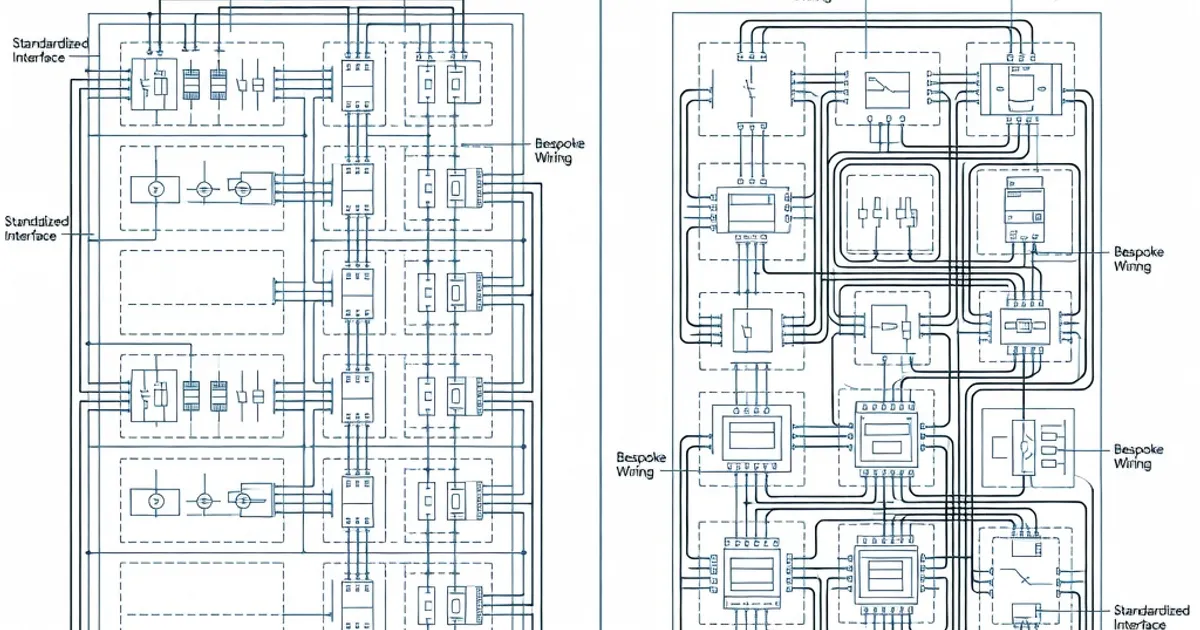
Modular vs Custom Panel Design
This article compares modular type-tested systems and fully custom low-voltage panel assemblies in the context of IEC 61439 compliance. It clarifies the verification responsibilities, technical performance boundaries, practical advantages and limitations of each approach, and industry best practices for design, testing and documentation. Where relevant, the text cites specific IEC clauses and manufacturer guidance to support technical claims.
Overview: Two Approaches to LV Panel Assemblies
Low-voltage panel assemblies are built either from modular, type-tested systems (pre-verified components and sub-assemblies) or as fully custom designs that must be verified as an entire assembly. IEC 61439-1 (General rules) formalizes both approaches: modular systems rely on documented design verification of modules and routine testing for each unit, while custom assemblies require full design verification for the specific configuration under Clause 10 of IEC 61439-1 (2020) before routine tests per Clause 11 are applied on each unit.[3][7]
What IEC 61439 Requires: Key Verification Points
IEC 61439-1 requires verification of both construction characteristics and performance characteristics. For a compliant assembly you must address all relevant items in Clause 10. The standard groups verification around roughly a dozen characteristics that include:
- Construction characteristics: mechanical strength of materials, degree of protection (IP rating per IEC 60529), clearances and creepage distances (IEC 60664-1), shock protection and barriers, correct integration of switching devices (IEC 60947 series), circuits/connections and terminals.
- Performance characteristics: dielectric properties and clearances, temperature rise limits (typically ≤70 K average and ≤105 K for critical parts unless otherwise specified), short-circuit withstand (dynamic and thermal), electromagnetic compatibility (per IEC 61000 series), and mechanical operation/reliability.[1][2][5]
Per IEC 61439-1 Clause 10, every custom panel design must demonstrate compliance for these characteristics by test, comparison with a reference design, or calculation/simulation as allowed by the clause. Modular type-tested systems transfer much of this verification to the original manufacturer's documented design verification and type-testing of the modules; the assembler then performs the unit routine tests specified in Clause 11.[3][5]
Quick Comparison: Modular vs Custom
| Aspect | Modular Type-Tested Systems | Fully Custom Panel Designs |
|---|---|---|
| Verification Method | Design verification and type-testing of modules by original manufacturer; assembler performs routine tests per unit (visual, wiring continuity, dielectric test) per IEC 61439-1 Clause 11.[3][5][6] | Full design verification for the specific assembly required under IEC 61439-1 Clause 10; tests, calculations or comparisons must cover all listed characteristics.[1][3] |
| Temperature Rise | Pre-verified by manufacturer through full-load thermal testing; modular systems offer documented limits and allow limited customization within declared ratings.[3][5] | Designer must verify temperature rise for the exact configuration (Clause 10.10). In switchgear applications IEC 61439-2 provides additional requirements up to defined current ratings.[2] |
| Short-Circuit Withstand | Dynamic and thermal withstand capacities are declared by type tests (examples include systems tested to 50–100 kA peak for specific durations); Form 4b separation is commonly implemented for high-safety modular systems.[2][6] | Short-circuit performance requires full verification per Clause 10.11. Risk of non-compliance increases if the configuration is unproven and conductor layouts differ from validated references.[1][3] |
| Forms of Separation | Modular systems are typically delivered as Form 3b or Form 4b (functional unit and busbar separation), with documented internal separations in the manufacturer's annexes or instructions.[2][4] | Custom designs can meet any Form requirement but must demonstrate compliance by test or calculation if the design differs from standard references.[2] |
| IP Rating | Manufacturer declares IP31–IP66 per IEC 60529 for enclosures; ratings are validated during type testing and documented for the assembler.[5] | IP degree must be verified during design verification (Clause 10.2) for the installed components and assembled enclosure.[1] |
Routine Tests Per Unit (Clause 11)
Even when a modular system is used, the assembler must perform routine tests on every unit as defined in IEC 61439-1 Clause 11. Typical routine tests include:
- Visual inspection and verification of correct assembly and marking
- Wiring continuity and polarity checks
- Dielectric test (power-frequency withstand voltage) to confirm insulation integrity
- Functional checks of moving parts and protection device operation where applicable
| Routine Test | Purpose / Standard Clause |
|---|---|
| Visual inspection | Verify construction against drawings and markings (Clause 11) |
| Wiring continuity & polarity | Ensure correct connections and detect wiring errors (Clause 11) |
| Dielectric test | Confirm insulation withstand to specified voltage (Clause 11) |
| Functional test / mechanical operation | Verify interlocks, door operation, and switching device function (Clause 11) |
Documented routine tests provide traceability and are mandatory even when using modular assemblies whose design verification is provided by the system manufacturer.[3][5]
Why Manufacturers Offer Modular Systems
Major electrical manufacturers (Siemens, ABB, Schneider Electric, Eaton, Rittal, Modutec, etc.) promote modular IEC 61439-compliant products because they reduce design effort, shorten lead times and lower per-unit verification cost for repeatable installations. Manufacturers provide technical guides and validated module combinations that an assembler can use within the declared design envelope — an approach often described as analogous to “IKEA flat-pack” assembly for electrical switchgear.[4][9][5]
- Siemens documents its ICP modular concepts and provides design rules so assemblers can combine modules while remaining compliant (see Siemens ICP technical guide).[9]
- ABB and Schneider publish white papers and workbooks that explain the verification hierarchy — from type-tested modules to routine testing of assembled units — and provide examples for assemblies up to 630 A and higher.[8][1]
- Specialist suppliers such as Modutec and Rittal provide modular enclosures and third-party test reports that help assemblers meet thermal, short-circuit and IP requirements for demanding sites.[6][4]
When Custom Design Is Necessary
You should choose a custom design when modular systems cannot meet a project’s unique constraints: unusual footprint, bespoke busbar geometry, bespoke project switching sequences, retrofit to existing structural conditions, or when layout requires conductor runs and connections that depart significantly from a validated module. In those cases the assembly manufacturer must perform full design verification under Clause 10, including:
- Temperature rise tests or validated thermal simulations for the exact current loading (Clause 10.10).
- Short-circuit verification for the expected prospective fault currents and clearing times (Clause 10.11).
- Verification of clearances, creepage, mechanical strength and IP degree specific to the assembled components (Clauses 10.2 and related requirements).
IEC 61439 allows verification by test, by comparison with a tested reference design or by calculation/simulation where the standard permits, but the burden of proof rests with the designer/assembly manufacturer.[1][3]
Performance and Safety Considerations
Two performance areas demand careful attention whether you use modular modules or a custom build: temperature rise and short-circuit withstand.
- Temperature rise: IEC 61439 specifies limits for temperature rise to prevent premature ageing and maintain current-carrying capacity. Typical acceptance limits are an average temperature rise ≤70 K for busbars and non-critical parts and ≤105 K for critical insulating parts, unless otherwise specified. Modular systems have declared, type-tested thermal performance; custom designs require specific testing or validated calculation (Clause 10.10).[3][5]
- Short-circuit withstand: Both dynamic (electrodynamic forces) and thermal effects must be addressed. Modular systems commonly specify short-circuit ratings (for example, 50 kA or 100 kA for a given duration), and provide instructions for busbar jointing and earthing to maintain the declared rating. Custom panels require verification of fault current withstand for the particular conductor layout and protection device clearing times (Clause 10.11).[2][6]
Designers should prefer higher forms of internal separation — Form 4b when practicable — to enhance personnel safety and limit the propagation of faults, particularly in healthcare, data center and critical infrastructure applications. IEC 61439-2 provides further guidance for power switchgear and applications up to specified current levels.[2]
Practical Benefits: Lead Time, Cost and Maintainability
Industry experience shows modular systems deliver significant project advantages when requirements are repetitive or standardized. Typical benefits include:
- Reduced lead times: Pre-engineered modules allow faster design approval and assembly.
- Lower verification costs: Assemblers rely on the original manufacturer’s design verification for key characteristics and only perform required routine tests per-unit; reports indicate cost reductions in the 20–30% range versus full custom verification for comparable functionality.[3][4][6]
- Improved maintainability: Modular form-factors, interchangeable components and standardized documentation reduce on-site maintenance time and spare-part inventory.
Manufacturers and system integrators report that roughly 80% of standard building and industrial distribution applications can be realized efficiently with modular systems, reserving custom designs for specialized or uniquely constrained projects.[3][4][6]
Design and Verification Workflow — Recommended Sequence
A typical, IEC-aligned workflow for either modular or custom assemblies includes:
- Collect project data: specify ratings (voltage, current, short-circuit prospective current), environment (temperature, humidity, dust), required IP rating, and functional requirements (forms of separation, protective devices).
- Choose baseline approach: determine if modular modules cover the requirements. If so, select validated module combinations and review the manufacturer's declarations and setpoints; otherwise proceed with custom design and plan verification tests or calculations.
- Design per rules: follow the manufacturer's assembly instructions (modular) or design and document conductor arrangements, clearances, creepage, mechanical anchoring and thermal management (custom).
- Verification: execute design verification (Clause 10): tests, results comparison to reference designs or validated calculations/simulations. For modular systems, ensure all module combinations used are within the manufacturer’s validated envelope.[1][3][5]
- Routine tests: perform Clause 11 routine tests on every assembled unit and record results for traceability.
- Documentation and CE Declaration: compile assembly drawings, test reports, and the declaration of conformity as required by EN/IEC harmonized practice; store traceability records and maintenance instructions.[5]
Best Practices and Industry Tips
- Prefer modular for repeatable projects: Data centers, standard plant distributions and commercial builds benefit from modularity and established routine testing processes. Modular systems reduce construction risk and speed commissioning.[3][4]
- Use Form 4b where safety critical: For highest internal separation and safety against arc flash propagation, choose Form 4b designs when budgets and space allow (per IEC 61439-2 guidance).[2]
- Validate thermal performance early: For custom panels, run thermal calculations and consider 2D/3D simulations in early design stages. Perform sample thermal testing before large-scale production.[5][6]
- Plan for realistic short-circuit currents: Use site prospective fault current data when sizing busbars, jointing and mechanical supports; verify device let-through energy and withstand ratings against your calculations (Clause 10.11).
- Maintain clear role definitions: Determine "original manufacturer" responsibilities (design verification, type test declarations) versus "assembly manufacturer" duties (unit routine tests and installation) to ensure legal and technical traceability under IEC 61439.[3][9]
- Keep robust documentation: Record all routine tests, assembly drawings, approvals and CE/EN declarations. Manufacture and site teams rely on this documentation for maintenance and future modifications.[5]
- Consider climate and site specifics: For harsh climates (e.g., Gulf Cooperation Council regions), specify materials and finishes suitable for salt, heat and dust; some jurisdictions require local approvals such as DEWA for UAE deployments.[2]
Product Examples and Manufacturer Guidance
Manufacturer documentation confirms the modular approach and provides practical guidance:
- Siemens ICP — offers modular ICP panel systems and an IEC technical guide that explains how to combine modules and what the assembler must verify on-site. The guide clarifies the role of the original manufacturer in providing validated module data and the assembler’s routine test obligations.[9]
- ABB — publishes an IEC 61439 workbook that details the three verification pathways (test, comparison and calculation) and outlines routine testing and documentation best practices for assemblies up to 630 A and beyond.[8]
- Schneider Electric — provides white papers and technical notes that contrast type-tested modular systems with custom design verification, emphasizing risk reduction when using validated modules.[1]
- Rittal & Modutec — specialize in modular enclosures and switchboards with supporting test data and third-party certification; these products are commonly used as the basis for IEC 61439-compliant assemblies.[4][6]
These manufacturer resources are useful references when documenting the declaration of conformity and the design verification reports required by IEC 61439-1.[1][8][9]
When to Hire Third-Party Testing
Third-party testing and certification is advisable when:
- The assembly is a one-off custom panel with no applicable reference design.
- The prospective fault current or environmental conditions
Related Panel Types
Frequently Asked Questions
Request a Quote
Tell us about your panel requirements and our engineering team will get back to you within 24 hours.
Email Us
[email protected]Call Us
+90 232 332 22 78