Panels for Hazardous Areas (ATEX/IECEx)
Panel design considerations for explosive atmosphere installations.
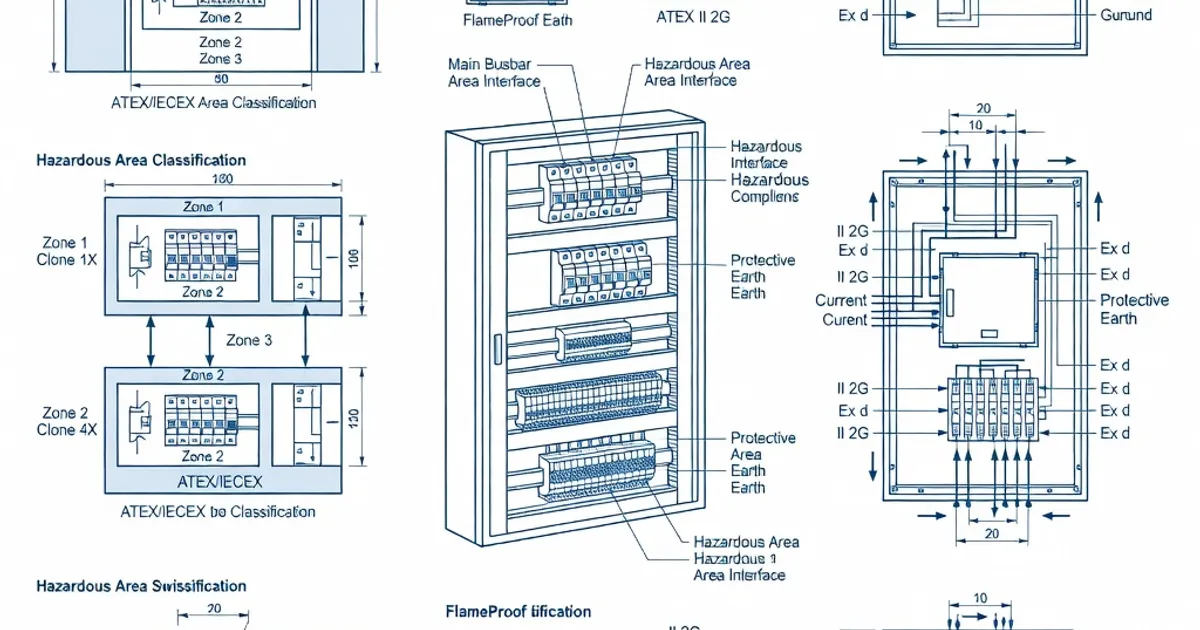
Panels for Hazardous Areas (ATEX/IECEx)
Panels and low-voltage switchgear for hazardous (explosive) atmospheres require a design and certification workflow that integrates the low-voltage assembly rules of IEC 61439 with the hazardous-area protection principles of the IEC 60079 family and the regulatory frameworks such as the ATEX Directive and the IECEx scheme. This article explains how to specify, design, test and document IEC 61439-compliant panels intended for use in gas, vapour or dust hazardous areas, summarizes the common protection methods, and lists practical considerations for manufacturers, specifiers and installation teams.
Overview: Why hazardous-area panels are different
Standard IEC 61439 defines the constructional and verification requirements for low-voltage switchgear and controlgear assemblies (temperatures, dielectric withstand, short-circuit performance, mechanical integrity, IP rating, etc.). However, assemblies intended for explosive atmospheres must also meet additional requirements specific to the type of explosive atmosphere, the protection concept applied to the equipment, and the rules for documentation and independent type examination under ATEX and IECEx regimes.
In practice this means a hazardous-area panel must:
- Comply with IEC 61439 verification tests and documentation applicable to the assembly type (temperature rise, dielectric, short-circuit, mechanical impact, IP and routine tests) (see IEC 61439 guidance) [3][5][6].
- Be designed, manufactured and (where required) certified against the appropriate IEC 60079 family standards for protection concepts (Ex d, Ex e, Ex p, Ex i, Ex n, Ex m, Ex t) and dust standards (IEC 60079-31) or pressurization standards (IEC 60079-2) depending on the chosen method.
- Carry correct regulatory marking, technical file and certification evidence (ATEX type-examination where applicable; IECEx certificate where requested), and include manufacturer and installer instructions for safe use and maintenance.
Applicable standards and certification schemes
Key standards and regulatory frameworks to reference when building hazardous-area panels:
- IEC 61439-1 and parts relevant to switchboards and assemblies — verification, routine and type tests, mechanical and thermal design, documentation and marking (manufacturer’s declaration of conformity to IEC 61439 is required) [3][6][5].
- IEC 60079 series — the primary family for electrical apparatus in explosive atmospheres. Common parts include IEC 60079-0 (general requirements), IEC 60079-1 (flameproof 'd'), IEC 60079-2 (pressurization 'p'), IEC 60079-11 (intrinsic safety 'i'), IEC 60079-7 (increased safety 'e'), IEC 60079-31 (dust), and others.
- ATEX Directive (2014/34/EU) — European regulatory framework for placing equipment into service in potentially explosive atmospheres; requires CE marking plus ATEX equipment marking and, for certain categories, involvement of a Notified Body.
- IECEx certification scheme — international, voluntary certification system providing documented third-party evidence of compliance to IEC 60079 standards; often used for global projects where IECEx acceptance is required.
- National and industry guidance documents — manufacturer application notes, switchboard design guides and industry papers that explain how IEC 61439 verifications interact with hazardous-area protection requirements (see manufacturer technical guides from Siemens and ABB) [7][9].
Type examination and conformity
Equipment intended for hazardous areas typically requires an independent type-examination certificate (ATEX Notified Body or IECEx Certification Body) when used in higher-risk categories (Category 1 or 2 equipment). The certified technical file must show:
- Design drawings and parts list
- Protection concept and applicable IEC 60079 part(s)
- Test reports (type tests and any specific verification testing)
- Instructions for installation, maintenance and where relevant, purge/pressurization and monitoring procedures
When the assembly is built to IEC 61439, the panel manufacturer remains responsible for the assembly verification (type and routine testing per IEC 61439) and for proving that the selected Ex-protection method remains effective after the mechanical and electrical integration (for example, verifying flamepaths on Ex d enclosures, or preserving barrier integrity for intrinsic safety)
Hazardous-area classification and equipment selection
To select the correct panel design you must map the location to a hazardous-area classification and choose a protection method appropriate for the zone and the combustible material:
- Gas/Vapour atmospheres — IEC/EN systems use Zones 0/1/2 or ATEX equipment Categories 1G/2G/3G. The gas group (IIA/IIB/IIC) and temperature class (T1–T6) determine the maximum surface temperature and spark energy allowances.
- Dust atmospheres — Zones 20/21/22 or Categories 1D/2D/3D, covered by IEC 60079-31 for dust and by assembly design decisions to avoid dust ingress and hot surfaces.
- Mining — Equipment Group I and mining specific standards apply for methane atmospheres (usually subject to different national regulations).
Typical selection flow:
- Determine area classification (Zone or Category) and process hazard (gas group, dust type).
- Decide on the protection concept (flameproof, increased safety, pressurization, purge, intrinsic safety, encapsulation, etc.).
- Specify enclosure IP/IK ratings, temperature class, and certification needs (ATEX/IECEx).
- Verify that the final assembled IEC 61439 product preserves the protection method (e.g., cable glands, partitioning, internal wiring and accessories are compatible with Ex rating).
Mapping Zones to Categories — quick reference
| Zone (IEC) | ATEX Category | Typical Use | Design Implication |
|---|---|---|---|
| Zone 0 (G) | Category 1G | Continuous presence of explosive atmosphere | Highest protection, usually certified equipment with independent type-examination |
| Zone 1 (G) | Category 2G | Occasional presence during normal operation | High integrity, type-examination often required |
| Zone 2 (G) | Category 3G | Rare and short duration exposure | Less demanding; can use equipment with manufacturer’s standard declaration |
| Zone 20 (D) | Category 1D | Continuous dust cloud | Dust-tight enclosures, special temperature management |
| Zone 21 (D) | Category 2D | Occasional dust | Sealed enclosures and controlled ingress protection |
| Zone 22 (D) | Category 3D | Rare dust accumulations | Controlled design but lower specification than 1D/2D |
Methods of protection and when to use them
Common protection methods applied to panels and their components:
| Method | IEC reference (typical) | Strengths | Limitations / Typical use |
|---|---|---|---|
| Flameproof enclosure (Ex d) | IEC 60079-1 | Allows internal explosive atmosphere; robust; proven for higher energies | Heavy enclosures; requires correct flamepath machining/sealing; common for motors, junction boxes and switchgear |
| Increased safety (Ex e) | IEC 60079-7 | No sparks, no excessive temperatures; good for terminal compartments | Only for components that can be made “non-sparking”; not suitable where arcs are expected |
| Purge and pressurization (Ex p) | IEC 60079-2 | Allows use of standard equipment inside pressurized enclosure | Operational complexity — requires purge controllers, filters, monitoring and proof of maintenance |
| Intrinsic safety (Ex i) | IEC 60079-11 | Very safe for control and instrumentation circuits; minimal enclosure requirements | Not suitable for power distribution circuits; requires certified barriers and wiring practices |
| Non-sparking / restricted breathing (Ex n) | IEC 60079-15 / IEC 60079-14 | Cost-effective for Zone 2 applications | Limited to low-risk Zones (e.g., 2G / 3G) |
| Protection by enclosure (Ex t / dust) | IEC 60079-31 | Dust-tight designs reduce ingress risk; focus on hot surfaces | Temperature class control and maintenance to avoid dust accumulation |
Design considerations for IEC 61439 panels used in hazardous areas
Designing a hazardous-area panel is an exercise in systems engineering: you must preserve the IEC 61439 assembly performance while ensuring the Ex protection method remains effective after integrating devices, enclosures, cable entries and accessories.
Enclosure integrity and ingress protection
Select an enclosure with the IP rating and mechanical strength appropriate for the dust/gas hazard and for the intended protection method. For dust zones, IEC 60079-31 requires dust-tight designs, normally IP6X, and temperature-management to prevent hot surfaces that could ignite dust (temperature class limits apply). For gas zones, IP ratings and correct gland selection are essential to maintain flamepaths and sealing on flameproof housings.
Cable entries, glands and partitioning
Cable glands are often the weakest link. Use Ex-certified glands suitable for the chosen protection method and gas group. Maintain segregation between circuits where required by intrinsic-safety design or to prevent propagation of faults. For flameproof boxes ensure that cable entries and joint compartments maintain the required flamepath clearances and sealing.
Temperature rise and heat dissipation
IEC 61439 requires temperature-rise verification for current-carrying parts. In hazardous-area panels, you must demonstrate that under worst-case loading the surface temperatures remain below the applicable temperature class (T1–T6) for the gas group, and below ignition temperatures for dusts. This frequently requires derating of devices, ventilation or forced cooling, or selection of devices with lower losses. Manufacturer guidance and thermal verification methods are explained in IEC 61439 technical guidance and industry whitepapers [3][9][5].
Short-circuit and fault containment
Panel short-circuit withstand and fault containment must satisfy IEC 61439 requirements; simultaneously ensure that fault energy cannot create a hazard (e.g., through sparks or heating that violate the Ex protection concept). Where internal arcs are a consideration, coordinate
Related Panel Types
Frequently Asked Questions
Request a Quote
Tell us about your panel requirements and our engineering team will get back to you within 24 hours.
Email Us
[email protected]Call Us
+90 232 332 22 78