VFD Integration Best Practices
Best practices for integrating variable frequency drives into IEC 61439 panels.
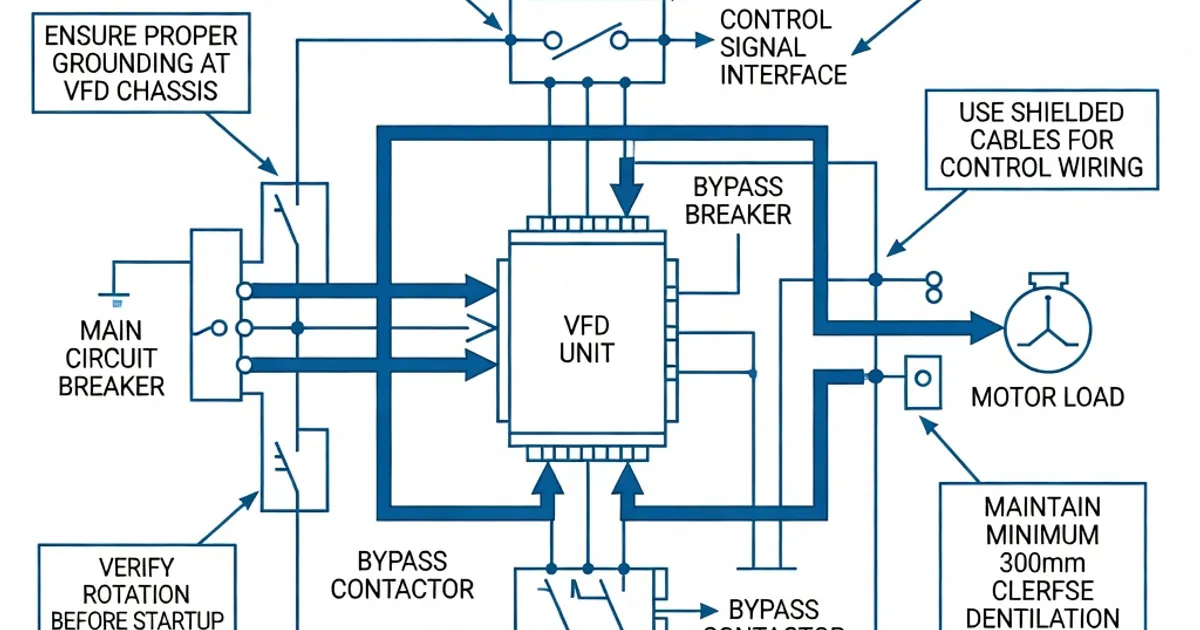
VFD Integration Best Practices
Variable frequency drives (VFDs) are a common source of thermal stress, electromagnetic disturbance and unique short‑circuit coordination requirements inside IEC 61439 low‑voltage switchgear and controlgear assemblies (ASCs). This article summarizes authoritative best practices for integrating VFDs into IEC 61439 assemblies, clarifies the relevant verification limits and tests, and provides practical guidance for design, protection, installation and verification. Where appropriate we reference the IEC 61439 clauses and major manufacturer guidance to help you design compliant, reliable VFD panels.
Scope and Objective
This guidance covers VFDs installed as outgoing functional units or as part of multi‑compartment assemblies in low‑voltage ASCs subject to IEC 61439 series verification. It focuses on the principal verification areas required by IEC 61439: temperature rise, short‑circuit withstand strength, dielectric properties and electromagnetic compatibility (EMC). It also covers practical considerations such as IP rating, grounding, cable lengths, layout and coordination with upstream protective devices.
Standards and Normative References
- IEC 61439-1 and IEC 61439-2 (2020 editions) — General rules and power switchgear/controlgear assemblies: design verification, temperature rise (Clause 10), short‑circuit withstand (Clause 11) and dielectric tests (Clause 12). (See IEC 61439 series) [IEC 61439].
- IEC 60204-1 — Safety of machinery — electrical equipment; relevant when VFDs feed machine drives.
- IEC 60947 series — Low‑voltage switchgear and controlgear; device coordination with VFD downstream circuits.
- IEC 60529 — Degrees of protection (IP ratings) for enclosures housing VFDs.
- Manufacturer guidance from ABB, Siemens, Schneider Electric and others describing practical requirements for grounding, Zs/fault loop measurements and VFD mounting. See References and Further Reading below for links to these manufacturer resources.
Key Technical Requirements for VFD Integration
Temperature Rise and Thermal Management
Per IEC 61439 Clause 10, assemblies must demonstrate acceptable temperature rise under rated conditions. Key points:
- Test ambient conditions are typically verified for an average ambient of ≤35 °C during type tests. Design must ensure internal temperatures and external accessible surfaces remain within allowed limits for components and insulation systems.
- When VFDs are installed, designers must account for additional power losses and heat dissipation. VFDs produce significant internal losses (cooling fans, switching losses) and radiated heat; functional units with VFDs commonly require increased ventilation or forced cooling and spacing between units.
- For multi‑compartment assemblies, the IEC 61439 comparison/verification by calculation route is limited to assemblies with rated currents up to 1600 A (subject to conditions). For larger or custom arrangements, type testing or partial testing is preferred. (IEC 61439: verification limits) [IEC 61439].
- Design rule: maintain the same or reduced power losses as the tested arrangement for any substitution of VFD types or ratings in a pre‑verified assembly. Where losses increase, re‑verification by test or recalculation is required. (Verification by comparison) [IEC 61439 guidance].
Short‑Circuit Withstand and Conductor Sizing
Short‑circuit withstand strength must account for both prospective fault levels and downstream cable lengths and protection. Key requirements include:
- Conductors to VFDs must comply with the maximum allowed unprotected live conductor length across the enclosure. IEC 61439 specifies conductor routing and Table 4 limits; a commonly referenced practical requirement is that non‑protected live conductors not exceed 3 m total length between the main busbar and the short‑circuit protective device (SCPD) feeding the VFD. Keep unprotected runs as short as practicable. (IEC 61439, conductor routing rules) [IEC 61439].
- Coordinate upstream SCPDs with the VFD’s maximum prospective short‑circuit current and the drive’s internal protection. Many manufacturers recommend specific upstream devices or settings to avoid nuisance tripping while ensuring short‑circuit protection. (e.g., manufacturer guides) [ABB, Schneider].
- If the VFD or its outgoing cable is likely to be subjected to high anticipated short‑circuit currents, verify cross‑sectional area, conductor material and lugs for thermal and electrodynamic strength per Clause 11 of IEC 61439.
Dielectric Properties and Clearances
IEC 61439 requires verification of dielectric properties including power‑frequency withstand voltage and impulse voltage tests, as well as sufficient clearance and creepage distances to tolerate VFD‑induced transients:
- Maintain manufacturer‑specified creepage/clearance for DC busbars and power electronics. VFDs can introduce high dV/dt stress; ensure insulation coordination and reinforced insulation where needed, especially in medical or safety‑critical environments.
- Perform dielectric tests appropriate to the assembly configuration after VFD installation or significant modification. Clause 12 of IEC 61439 covers dielectric tests and measurement procedures. (IEC 61439 Clause 12) [IEC 61439].
Electromagnetic Compatibility (EMC) and Grounding
VFDs are a major source of electromagnetic emissions and conducted disturbances. EMC and grounding practices must support both functional reliability and compliance with EMC standards:
- Provide robust protective earth (PE) connections and local bonding of VFD chassis to the enclosure mounting plate. Siemens documentation specifically recommends grounding the frequency converter to the mounting plate or frame (IEC 60417-5020 symbol for chassis) to reduce common‑mode noise and improve fault‑clearing. (Siemens guidance) [Siemens].
- Design bonding and cable routing to minimize exposure of sensitive control wiring to high dV/dt cables; maintain separate wiring ducts or partitions where practical.
- Perform fault loop impedance (Zs) measurements for power drive system circuits in TN systems to verify that protective devices will clear faults within required times. (Siemens / ABB practice) [Siemens, ABB].
- Apply EMC filters, common‑mode chokes or surge protection where required by the product EMC declaration or when site measurements show problematic emissions. Consider line reactors or DC chokes for harmonic or reflected wave mitigation.
IP Rating and Environmental Considerations
Select enclosure IP rating per IEC 60529 to match the site environment and to allow adequate ventilation or filtered cooling. Practical considerations:
- Indoor dry installations often use IP30‑IP54; dusty, wet or outdoor environments frequently require IP55 or higher with filtered forced ventilation for VFD heat rejection.
- Environmental severity categories (IEC 60068) influence material selection, surface treatments and enclosure ingress protection for coastal or corrosive atmospheres. (IEC 60068) [IEC environmental standards].
Design and Layout Best Practices
Functional Unit Definition and Separation
IEC 61439 emphasises defining functional units and separation forms to allow comparison verification and safe maintenance. For VFDs:
- Group VFDs and their switchgear as same functional units for thermal and short‑circuit verification whenever possible. This simplifies verification and reduces thermal interaction assumptions when applying comparison methods. (IEC 61439 verification guidance) [IEC 61439].
- Use dedicated compartments or barriers for power electronics to isolate heat and electromagnetic emissions from sensitive control equipment. Prefer physical separation (compartments) where VFDs operate at high power densities.
Ventilation and Cooling Layout
Plan airflow paths to remove VFD heat efficiently:
- Maintain minimum clearance distances around VFD heat sinks and cooling fans per manufacturer datasheets.
- Where multiple VFDs are installed in one enclosure, stagger units or provide forced ventilation to prevent thermal stacking; measure internal temperatures during type testing or after installation to verify performance.
Cable Routing and Segregation
Good cable routing reduces EMC issues and improves maintainability:
- Segregate power, control and signal cables. Keep inverter output cables (high dV/dt) away from control and communication wiring, and use separate metallic ducts when necessary.
- Minimise unprotected live conductor lengths — keep the cable from the main busbar to the drive SCPD as short as possible (practical limit ≤3 m recommended). (IEC 61439 conductor routing) [IEC 61439].
Protection, Coordination and Settings
Upstream and Downstream Protection
Coordinate short‑circuit and overload protection to accommodate the VFD’s characteristics:
- Choose upstream SCPDs that will reliably clear short‑circuit faults but will not nuisance trip during normal VFD start‑up or regenerative events. Consider motor‑protection relays with VFD compatibility or adjustable thermal/electronic trip curves.
- If the VFD contains built‑in short‑circuit protection, verify how that protection interacts with the assembly’s SCPDs and document the coordination envelope. Where necessary, install selective devices or time‑graded coordination settings.
- For regenerative applications or bidirectional energy flow, ensure upstream devices tolerate DC injection or install appropriate DC protection or limiting devices. Document expected fault currents and protection time‑current curves in the panel files.
Frequency and Motor Considerations
VFD operation changes supply frequency and inrush characteristics; these affect protection and equipment life:
- Most LV equipment and busbars are designed for supply frequency variations within ±2% (i.e., 98–102% of rated frequency); VFD operation outside this band (e.g., substantial low frequency operation ≤16 2/3 Hz or DC/0 Hz) may require special arc quenching measures and verification. (IEC 61439 and manufacturer guidance) [IEC 61439, ABB].
- Take into account the motor thermal capacity when setting overload protection for VFD‑fed motors, because drive torque and current relationship differs from direct‑on‑line starts.
Verification and Testing Strategies
When to Test vs. Calculate
IEC 61439 permits verification by type testing, by calculation, or by comparison with a tested assembly. Practical rules:
- Prefer full type testing for unique or high‑power VFD assemblies, or when changes increase losses, alter airflow or materially change conductor routing.
- Use comparison verification for repeatable production assemblies where the substituted components have equal or lower losses and identical functional unit arrangement. Comparison verification is generally limited by rated current and scope (calculations allowed up to approximately 1600 A for multi‑compartment assemblies under specified conditions). (IEC 61439 verification and comparison methods) [IEC 61439].
- Document all assumptions, loss data, diagrams and test results in the technical file for the assembly; this supports future replacements and maintenance without invalidating the verification evidence.
Essential Tests and Measurements
- Temperature rise test — verify internal temperature distribution at rated current and ambient ≤35 °C where applicable. (IEC 61439 Clause 10) [IEC 61439].
- Short‑circuit withstand test — check thermal and electrodynamic withstand of busbars, conductors and connections for the prospective fault current. (Clause 11) [IEC 61439].
- Dielectric and clearance tests — power‑frequency and impulse tests, clearance/creepage verification for VFD and associated wiring. (Clause 12) [IEC 61439].
- EMC checks — verify EMC mitigation measures, ground continuity, and perform site emission measurements if required by the product EMC documentation.
- Fault loop impedance (Zs) — measure to ensure protective devices clear within required times for the overall installation, particularly in TN systems. (Manufacturer guidance: Siemens, ABB) [Siemens, ABB].
Installation and Commissioning Checklist
- Confirm enclosure IP rating and environmental category (IEC 60529 / IEC 60068).
- Verify VFD grounding to mounting plate and PE continuity to main earthing bar. (Siemens/ABB guidance) [Siemens, ABB].
- Check conductor lengths: non‑protected live conductor runs from busbar to SCPD ≤3 m where practical.
- Confirm SCPD coordination settings, and that short‑circuit current ratings of cables and lugs are adequate for prospective fault current.
- Record thermal losses, airflow requirements and ensure ventilation/fan filters are installed for the operational environment.
- Run EMC checks, including any required filter installations, and document transient suppression measures.
- Complete dielectric tests and temperature rise verification as applicable; update the panel technical file.
Product Examples and Platform Considerations
Major manufacturers provide IEC 61439‑compliant platforms and application notes for VFD integration. Examples and notable features:
| Brand | Platform / Documentation | VFD Integration Features |
|---|---|---|
| Siemens | Control Panels — compliant design guide | Recommendation to ground converters to mounting plates; Zs/fault loop measurement guidance; SCPD coordination advice. (Siemens technical guide) [Siemens] |
| ABB | "The standard IEC 61439 in practice" workbook | Explains VFD frequency impacts, verification routes and practical limits; guidance on protection coordination. (ABB workbook) [ABB] |
| Schneider Electric | IEC 61439-2 application guide (SE6461) | Thermal management and coordinated protection examples for VFD outgoing circuits. (Schneider guide) [Schneider] |
| Chint / Rittal / Eaton | Platform enclosures and tested assemblies | IP‑rated enclosures, pre‑tested busbar systems and documented test reports reduce retrofit verification needs. (Industry manufacturer examples) [Chint, Rittal, Eaton] |
Quick Specification Summary Table
| Requirement | Value / Limit | Reference / Note |
|---|