Marine Panel Requirements & Classification
Classification society requirements for marine and offshore panel assemblies.
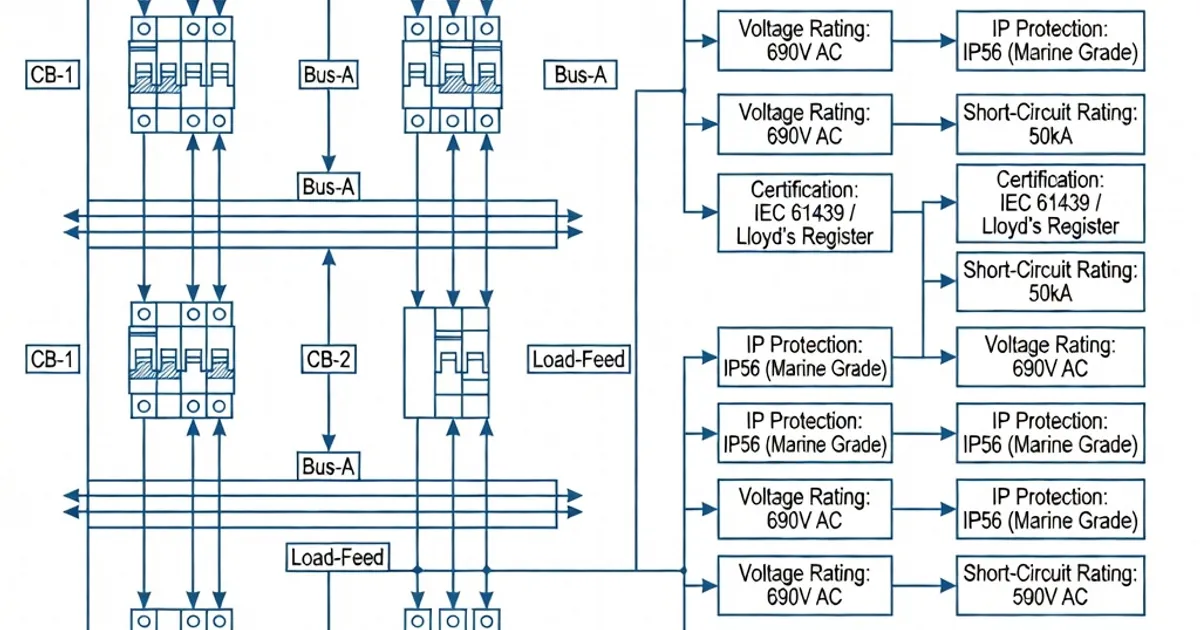
Marine Panel Requirements & Classification
This article summarises the specific design, testing and certification considerations for low-voltage electrical panels intended for marine service, and explains how those requirements overlay IEC 61439 design and verification practices. It does not replace classification society rules or manufacturer datasheets, but it provides a practical engineering framework that panel builders and shipboard electrical engineers can use to prepare panels for review by classification societies (DNV, ABS, LR, Bureau Veritas, etc.), and for compliance with IEC 61439 series verification and testing expectations.
Scope and Applicable Standards
Marine switchboard and distribution panels are low-voltage electrical assemblies that must meet general IEC 61439 design and verification rules for low-voltage switchgear and controlgear assemblies (LV switchboards, distribution boards, controlgear assemblies). In addition to IEC 61439-1 and IEC 61439-2, marine panels require consideration of maritime and classification-specific standards and environmental test regimes.
Key standards and references commonly applied to marine panels include:
- IEC 61439-1 / -2 — Fundamental design, verification and testing requirements for low-voltage assemblies. (See IEC 61439 guidance and design verification methods [3][6][7].)
- IEC 60529 — Degrees of protection provided by enclosures (IP code) for ingress of dust/water.
- IEC 62262 (IK) — Mechanical impact protection ratings, often specified for exposed shipboard equipment.
- IEC 60945 — Maritime navigation and radiocommunication equipment: environmental and general requirements (useful for electronic equipment and installations on ships).
- Classification society rules — DNV, ABS, Lloyd’s Register, Bureau Veritas, RINA, etc., each publish electrical installation and equipment rules that add mandatory requirements for materials, corrosion protection, sea-fastening, fire integrity, testing and certification.
- Manufacturer guides and whitepapers — Practical guidance on complying with IEC 61439, component selection, and test procedures (for example ABB, Legrand, Hensel, and independent guides) [3][4][7].
Why Marine Panels Are Different
Marine environments impose additional constraints that affect material selection, enclosure construction, ventilation, component selection, sealing, and testing:
- Corrosive atmospheres — Salt-laden air accelerates corrosion; materials, coatings and fasteners must be selected for long-term seawater resistance (stainless steels, nickel-plated copper, marine-grade coatings, or non-metallic enclosures where appropriate).
- Seakeeping loads and vibration — Mechanical design must resist continuous vibration and shock from wave action and machinery. Fasteners, busbars and terminal connections require anti-loosening measures.
- Ingress protection — Higher IP ratings (typically IP56, IP66 or better) are required where panels are exposed on deck or in weather-exposed spaces; internal switchboards may use lower IP but must still meet classification rules.
- Thermal and humidity extremes — Marine spaces can experience wide temperature and humidity swings; conformal coatings or sealed compartments may be required for control electronics.
- Fire safety and segregation — Fire integrity, cable routing and segregation to meet SOLAS and classification society fire zone rules.
Classification Society Requirements — What to Expect
Classification societies require that electrical equipment be suitable for the vessel’s intended service and that manufacturers or suppliers provide documentation, test evidence, and sometimes type approval. Typical classification requirements include:
- Documented material certificates and corrosion protection plans for enclosures and parts.
- Type test certificates or test reports (temperature, short-circuit, dielectric, IP, salt spray or corrosion tests where applicable).
- Factory Acceptance Test (FAT) and site inspection provisions; witness testing by the society’s surveyor may be required.
- Evidence of adequate mechanical fixation and vibration resistance, including calculation of fastener strengths for sea-fastening.
- Certificates for components (e.g., MCCBs, switch-disconnectors) showing their suitability for marine or harsh environments.
Because rules vary by society and vessel type, designers must consult the applicable society’s electrical rules early in the project to capture mandatory additional tests (for instance, DNV has specific requirements for electrical equipment in offshore installations and ships). Classification society documents frequently require approval of drawings and test evidence prior to installation.
Enclosure Materials, Corrosion Protection and Coatings
Material choice is one of the most important decisions for marine panels. Typical approaches include:
- Stainless steel (AISI 316 / EN 1.4401/1.4435) for exterior enclosures where direct sea spray exposure is expected. Use marine-grade fasteners (A4 / 316) and provide passivation per manufacturer instructions.
- Aluminium with protective coating for weight-sensitive applications; ensure anodising and suitable top-coating; be mindful of galvanic corrosion between aluminium and stainless steel components.
- Painted mild steel is acceptable in protected spaces if coated with high-performance marine epoxy primers and topcoats and if classification society allowable; maintenance cycles must be documented.
- Non-metallic enclosures (GRP/FRP or engineered thermoplastics) can offer excellent corrosion resistance for certain installations; verify fire performance and temperature ratings for the ship area.
Supplementary corrosion testing may be mandated. JIP33 and other industry guidance document degradation mechanisms in offshore environments and recommend selection and testing of components exposed to corrosive atmospheres [5]. For general guidance on assembly certification and recommended practices consult manufacturer technical papers and whitepapers (e.g., ABB [3], Legrand [4]).
Ingress Protection, Mechanical Impact and Environmental Ratings
Specify IP and IK ratings based on location and service. Typical marine values:
- IP54 — Protected against limited dust ingress and splashing water; used for interior machinery spaces.
- IP56 — Protected against dust and powerful water jets; common for sheltered external areas.
- IP66/IP67 — Dust-tight and protected against high-pressure jets or temporary immersion; used for deck-mounted equipment or highly exposed installations.
- IK10 — High mechanical impact protection for areas at risk of impact from tools or cargo handling.
Specify ingress and impact ratings in the panel’s documentation and demonstrate compliance via test reports where required. Class societies may require salt-fog testing on paint systems or full enclosure salt spray tests for marine-grade certification.
Electrical Design Considerations Specific to Marine Panels
Designers must treat marine panels as mission-critical equipment: faults can have severe consequences. Key electrical considerations include:
- Short-circuit withstand and selective coordination — Perform calculation and type-test verification required by IEC 61439-1 for short-circuit temperatures and electrodynamic forces (see IEC 61439 verification procedures) [3][6].
- Earthing and bonding — Ensure equipotential bonding to ship earth systems and design for continuous bonding paths; use marine-approved earthing conductors and connection methods to prevent corrosion-induced high resistance.
- Segregation and barriers — Physical segregation between busbars, cable ducts, and control circuits reduces risk of fault transfer in confined panels. Maintain IP and fire barrier integrity with proper grommets and seals.
- Thermal management — Ventilation and heat dissipation must account for limited natural ventilation in enclosed compartments; forced ventilation with filtered, possibly conditioned, air or conduction cooling via heat sinks may be required.
- Component selection — Use components with known marine suitability or with protective treatments (plating, seals) and provide manufacturer statements regarding suitability for use in corrosive atmospheres where available.
Verification and Testing — Applying IEC 61439 on Ships
IEC 61439 requires a structured verification process consisting of design verification, type testing and routine testing. For marine panels, expect to add or augment tests to demonstrate suitability for harsh environmental conditions.
Key verification activities include:
- Design verification — Demonstrate compliance by calculation, simulation, or prototype testing of current-carrying capacity, temperature-rise, dielectric properties, clearances/creepage, short-circuit rating, and mechanical strength (per IEC 61439-1). See manufacturer and independent guidance for typical verification methods and reporting [3][6][7].
- Type tests — Per IEC 61439-1 and -2 perform type tests including temperature-rise, dielectric properties, short-circuit withstand, electromagnetic compatibility where required, and mechanical and climatic tests as applicable. Classification societies may require additional type tests such as salt-spray, vibration, or shock testing.
- Routine tests — Every assembly typically receives routine dielectric test (megger), continuity checks, and functional tests of protective devices. IEC 61439 and manufacturer guides specify acceptance criteria [6][3].
- Factory Acceptance Tests (FAT) — For ship applications FATs are usually mandatory and may be witnessed by a surveyor. Include functional testing, interlock verification, control wiring checks, and documentation review.
Document the verification route chosen: type-test based verification is preferred where feasible; if design verification by calculation or routine testing is used, provide detailed calculations, assumptions and acceptance criteria in the technical file. ABB, Legrand and other manufacturers provide templates and examples of required documentation and tests [3][4].
Additional Marine-Specific Tests and Evidence
Classification societies often require, or accept as evidence, some of the following tests and data in addition to IEC 61439 requirements:
- Salt spray / cyclic corrosion testing to show paint or finish performance for exterior enclosures and components exposed to sea spray. Refer to society rules and JIP33 for offshore electrical equipment corrosion guidance [5].
- Vibration and shock testing to marine standards (for example, IEC 60068-2 series tests are commonly used as references for vibration, shock and mechanical stress).
- Thermal cycling and humidity tests to replicate shipboard climate variations.
- SOLAS / fire zone compliance for panels located in protected spaces where fire rating and cable penetrations must maintain compartmentation.
Installation, Maintenance and Lifecycle Considerations
To ensure long service life and classification compliance, address the following early in procurement and installation:
- Documentation pack — Provide full technical file: drawings, material certificates, test reports, maintenance manuals, spare parts list, FAT and SAT protocols and instructions for protective coating maintenance.
- Access and ventilation — Design panels so that inspection and maintenance require minimal removal of protective seals; use removable covers with marine-grade sealing glands.
- Fastener locking — Use lock-washers, Nord-Lock washers, Loctite or approved anti-loosening methods on terminals and structural fasteners subject to vibration.
- Spare parts and replacement components — Specify exact part numbers for breakers, contactors and protection devices; ensure replacements meet the same flange, thermal and corrosion specifications.
Comparison: Industrial (Land) Panels vs Marine Panels
| Characteristic | Industrial / Land | Marine |
|---|---|---|
| Primary standards | IEC 61439, local electrical codes | IEC 61439 + classification society rules (DNV, ABS, LR) and often IEC 60945 |
| Materials & finish | Mild steel with industrial paint | Stainless steel or marine-painted/coated steel; corrosion-mitigating materials |
| IP Rating | Typically IP20–IP54 for indoor | IP54–IP67 depending on location; deck-mounted often IP66/67 |
| Vibration & shock | Standard machinery vibration allowances | Enhanced vibration qualification, locking fasteners, shock testing |
| Additional tests | IEC 61439 type and routine tests | IEC 61439 tests + salt spray/corrosion, vibration/shock per society rules |
| Documentation | Standard technical file | Expanded technical file for classification: material certs, test reports, FAT witness records |
Practical Workflow for Preparing a Marine Panel Project
- Step 1 — Requirements capture: Identify vessel class, location of
Related Panel Types
Frequently Asked Questions
Request a Quote
Tell us about your panel requirements and our engineering team will get back to you within 24 hours.
Email Us
[email protected]Call Us
+90 232 332 22 78