LV/MV Interface in Panel Systems
Design considerations at the low-voltage / medium-voltage boundary.
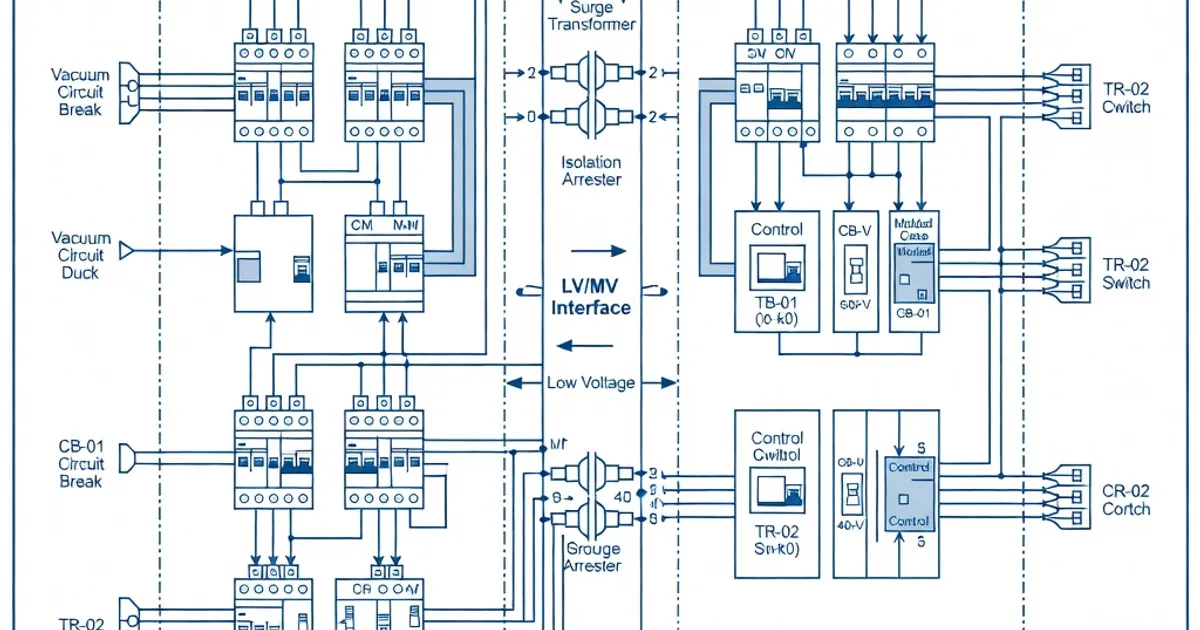
LV/MV Interface in Panel Systems
The LV/MV interface is the electrical and physical boundary where low-voltage (LV) switchgear assemblies (typically ≤ 1 kV AC) connect to medium-voltage (MV) systems (> 1 kV up to 52 kV). Proper definition and verification of this interface ensure the LV assembly operates safely, reliably, and in compliance with IEC standards when coupled to MV transformers, switchgear, or distribution networks. This article describes the required declared characteristics, verification methods, mechanical and environmental considerations, common design practices, and product examples — all referenced to IEC 61439 and related standards.
Overview and Standards Context
IEC 61439-1:2020 (ed. 3.0) establishes the general rules for low-voltage switchgear and controlgear assemblies and explicitly requires manufacturers to declare interface characteristics for assemblies intended to be connected to external systems (see Clause 5: Interface Characteristics) [Per IEC 61439-1 Clause 5; see also IEC 61439-2]. Verification of those declarations can be by type testing or calculation, guided by the verification procedures in Clause 10 of IEC 61439-1 [Per IEC 61439-1 Clauses 5 and 10].
Other standards that define the LV/MV boundary behavior and requirements include:
- IEC 61439-2 — applies to power switchgear and controlgear assemblies and gives application-specific requirements for panel assemblies interfacing MV transformers.
- IEC 60947 series — provides rules for the LV switchgear components (e.g., circuit-breakers) that commonly operate at the LV side of the interface.
- IEC 60529 — describes enclosure IP ratings and degrees of protection, which affect the physical interface for MV cable or busbar entries.
- IEC 62271 series — defines MV switchgear requirements; these values must be coordinated with the LV side for fault withstand and earthing.
Manufacturers and system designers must treat the LV/MV interface as a contract: the LV assembly declaration must match the MV supply characteristics (voltage, fault level, earthing) declared by the MV side or user. White papers and manufacturer guides (ABB, Schneider, Siemens, and others) reinforce that responsibility: the specifier must provide expected external influences and the manufacturer must supply a verification dossier demonstrating compliance [ABB, Schneider Electric product guides].
Declared Interface Characteristics (What Manufacturers Must Provide)
Per IEC 61439-1 Clause 5 and associated technical reports, the manufacturer must declare the values that define the electrical and environmental interface. Key parameters include:
- Rated operational voltage (Ue) — The declared system voltage the assembly is intended to operate at (e.g., 400 V, 415 V, 690 V). The assembly must be suitable for the MV transformer secondary voltage feeding the LV side [Per IEC 61439-1 Clause 5 and Clause 3.8.9.2].
- Rated insulation voltage (Ui) — The long-term RMS insulation capability. For many 400 V systems Ui ≥ 690 V is declared; dielectric tests are applied per Clause 10.9 (power-frequency withstand) — e.g., for 300 V < Ui ≤ 690 V a 1 s test at approximately 3×Ue (typical example: 1890 V for Ui in that band) [Per IEC 61439-1 Clause 10.9].
- Rated current and Rated diversity factor (I_nc, RDF) — Nominal currents for outgoing circuits and busbars (I_nc), plus the Rated Diversity Factor used to determine design currents for temperature rise verification. IEC 61439 requires the manufacturer to state RDF assumptions (e.g., RDF = 0.45 for certain multi-circuit designs) and to compute design current I_B = I_nc × RDF for temperature verification [Per IEC 61439-1 Clauses 3.8.9.4, 5.3 and 10.10].
- Short-circuit withstand (I_cw, I_pk) — The rated short-time withstand current (I_cw, usually expressed for a specific time, commonly 1 s or 3 s) and the rated peak withstand current (I_pk). These must be declared and verified because the LV assembly must survive prospective MV fault currents transferred to the LV side. Values vary widely — typical LV assemblies intended for MV-coupled stations may declare I_cw between 15 kA and 40 kA for 1–3 s and I_pk values commensurate with the MV system peak current [Per IEC 61439-1 Clauses 3.8.10 and 10.11].
- External conductor entries and IP rating — Whether MV or LV cables/busbars enter top or bottom, whether the entry area preserves the declared IP rating (e.g., IP54 for indoor/outdoor compact stations), and whether access to live parts is restricted per IEC 60529 (IP XXB access is minimum to prevent accidental contact). These details affect routing and mechanical interfaces at the LV/MV boundary [Per IEC 61439-1 Clause 5 and IEC 60529].
- Form of internal separation — The declared internal separation form (Forms 1 through 4 per IEC 61439-2) determines segregation between LV busbars, functional units, and incoming MV interfaces. For LV/MV boundaries a Form 4a/4b segregation is often used to isolate MV transformer feeds from LV compartments [Per IEC 61439-2].
Key Electrical Parameters — Technical Details and Typical Values
Designers and specifiers must coordinate the following parameters precisely. The table below summarizes typical values, how they are specified, and the IEC clauses that govern verification.
| Parameter | Typical Declared Value / Range | Verification Method / Clause |
|---|---|---|
| Rated operational voltage (Ue) | 400 V — 690 V (LV side); must match MV transformer secondary | Declared by manufacturer; Clause 5 and Clause 3.8.9.2 |
| Rated insulation voltage (Ui) | Ui ≥ 690 V for many 400 V systems; power-frequency test example: 1890 V / 1 s when 300 V < Ui ≤ 690 V | Dielectric test per Clause 10.9 (Power-frequency withstand) |
| Rated current (I_nc) & RDF | I_nc variable (e.g., 26 A, 63 A, 400 A); RDF examples 0.45, 0.6 depending on arrangement | Temperature rise verification with I_B = I_nc × RDF; Clause 10.10 |
| Short-time withstand (I_cw) | 15–40 kA for 1–3 s typical; manufacturer declares value | Short-circuit verification per Clause 10.11 (test or calculation) |
| Peak withstand (I_pk) | Depends on MV fault profile; may exceed 100 kA peak in large systems | Declared and verified; Clause 10.11 and coordination with MV standard IEC 62271 |
| IP / Mechanical entries | IP20–IP54 typically; cable gland size for conductors up to 70 mm² or higher | Declared per IEC 60529; mechanical construction per Clause 5 |
Verification at the LV/MV Interface
IEC 61439 requires verification that the declared interface characteristics are achieved. Verification can be by type testing, routine testing, or calculation where permitted by the standard. Key verifications include:
- Dielectric testing — Power-frequency withstand voltage tests per Clause 10.9 verify Ui. For example, assemblies with Ui in the 300–690 V band typically undergo a 1 s test around 1.5–3×Ue depending on tabulated requirements [Per IEC 61439-1 Clause 10.9; Schneider Electric guide].
- Temperature-rise verification — Confirm that conductors and busbars do not exceed specified temperature rises when loaded at the design current I_B = I_nc × RDF during the test duration. IEC 61439-1 limits temperature rise to specified values (often ambient + ΔT of 35°C or 40°C depending on design) and requires documentation of RDF used [Per IEC 61439-1 Clause 10.10].
- Short-circuit withstand — Validate I_cw and I_pk by short-circuit testing or validated calculation, ensuring that mechanical integrity and clearances are maintained under prospective MV fault conditions referenced at the LV interface. Coordination with MV-side values (IEC 62271) is critical [Per IEC 61439-1 Clause 10.11].
- Clearances and creepage distances — Measure or calculate to ensure adequate dielectric separation for declared voltage and pollution degree (Clause 10.8). LV/MV boundaries located near busbar entries require particular attention to maintain insulation and separation standards [Per IEC 61439-1 Clause 10.8].
Physical and Environmental Interface Considerations
Mechanical detailing of the LV/MV interface influences safety and serviceability:
- Entrances and conduit placement — Top or bottom entries for MV transformer secondaries, cable gland sizes, and busbar extensions must preserve declared IP rating and permit safe routing without undermining segregation forms [Per IEC 61439-1 Clause 5 and IEC 60529].
- IP ratings and outdoor use — If the LV assembly interfaces with MV equipment outdoors (e.g., compact stations or kiosk installations), the declared IP (commonly IP54 or better) and corrosion/UV resistance must be declared and verified.
- Forms of separation — Internal segregation (Form 1–4) controls both the protection of live parts and the risk of fault propagation between compartments. For LV/MV interfaces, Forms 3b, 4a, and 4b are commonly used to isolate the MV entry zone from LV functional units and provide finger-safe access to LV controls [Per IEC 61439-2].
- Accessibility and IP XXB — Access to parts requiring test or operation must not expose users to live parts; IEC 60529 defines minimum protection against access (IP XXB) to guard hazardous parts in interface zones.
Design Best Practices and Industry Experience
Field experience and manufacturer guidance converge on several best practices for LV/MV interfaces:
- Specify the MV fault level explicitly — The specifier must provide the available MV prospective short-circuit current and earthing arrangement so the LV assembly manufacturer can declare or verify I_cw and I_pk for the interface [Industry guides: ABB, Schneider].
- Coordinate protection devices — Protecting the LV side requires coordination with MV protection (fuse types, breaker settings). Verification by calculation per Clause 10.11 prevents unexpected stresses from MV faults being transferred to LV switchgear.
- Overrate neutral conductors for harmonics and unbalanced loads — In MV-fed LV distributions supplying non-linear loads (e.g., MV-driven VSDs, large capacitor banks), oversizing neutral conductors mitigates overheating and harmonic circulation; rules vary with conductor size (neutral ≥ 50% of phase for conductors > 16 mm², 100% for ≤ 16 mm² depending on regional practice) [Manufacturer application notes].
- Thermal management and RDF selection — Choose RDF consistent with installation type; for multi-outlet MDBs RDF can be as low as 0.45 and is essential in sizing busbars and ventilation to maintain acceptable ΔT under design loading [Per IEC 61439-1 Clause 10.10].
- Prepare a complete verification dossier — Provide drawings, calculations, and test reports that demonstrate the LV assembly satisfies declared interface characteristics. Documentation must include assumed ambient, RDF, conductor sizes, and MV fault levels used in calculations [Per IEC 61439-1 and manufacturer practice].
Product Examples and Comparison
Major manufacturers publish interface declarations for compact MV/LV station solutions. The following comparison (representative, not exhaustive) highlights declared interface parameters and design approaches used in commercial products. All values must be confirmed from manufacturer documentation for the specific product and configuration.
| Manufacturer | Product Example | Key LV/MV Interface Specs | Notes |
|---|---|---|---|
| Siemens | NXPLUS C MV/LV compact stations | I_cw = 31.5 kA / 3 s; Ue = 400–690 V; IP54; Form 4b separation | Direct MV transformer coupling; declared busbar entry top/bottom; product literature aligned with IEC 61439 Clauses [Siemens product documentation] |
| ABB | UniGear ZS1 (MV) + UniLine (LV) | I_nc up to 4000 A; I_pk up to 175 kA; modular MV-LV interface; RDF-optimized | Designed for high fault levels; plug-in MV outgoing to LV incoming options; recommendation to verify short-circuit coordination [ABB guides] |
| Schneider Electric | SM6 (MV) + Okken (LV) | Ui up to 1000 V; I_cw 40 kA / 3 s; IP3X at interface; cable compartments for up to 70 mm² | Enclosures and busbar accessories designed to preserve IP and segregation; consult datasheets for verification dossiers [Schneider Electric guide] |
| Eaton | Power Xpert UX (LV) with xEnergy MV interface | I_nc up to 630 A per circuit; Form 3b/4a options; vertical busbar trunking | Modular LV assemblies with clear MV entry segregation; manufacturer IEC compliance guidance available |
Typical Specification Table for an MV-Fed LV Assembly
| Specification Item | Typical Value / Example |
|---|---|
| System voltage (Ue) | 400 / 415 V (3-phase) — declared to suit MV transformer secondary |
| Insulation voltage (Ui) |