Arc Fault Protection in Panel Assemblies
Arc flash hazard mitigation and protection methods for IEC 61439 panels.
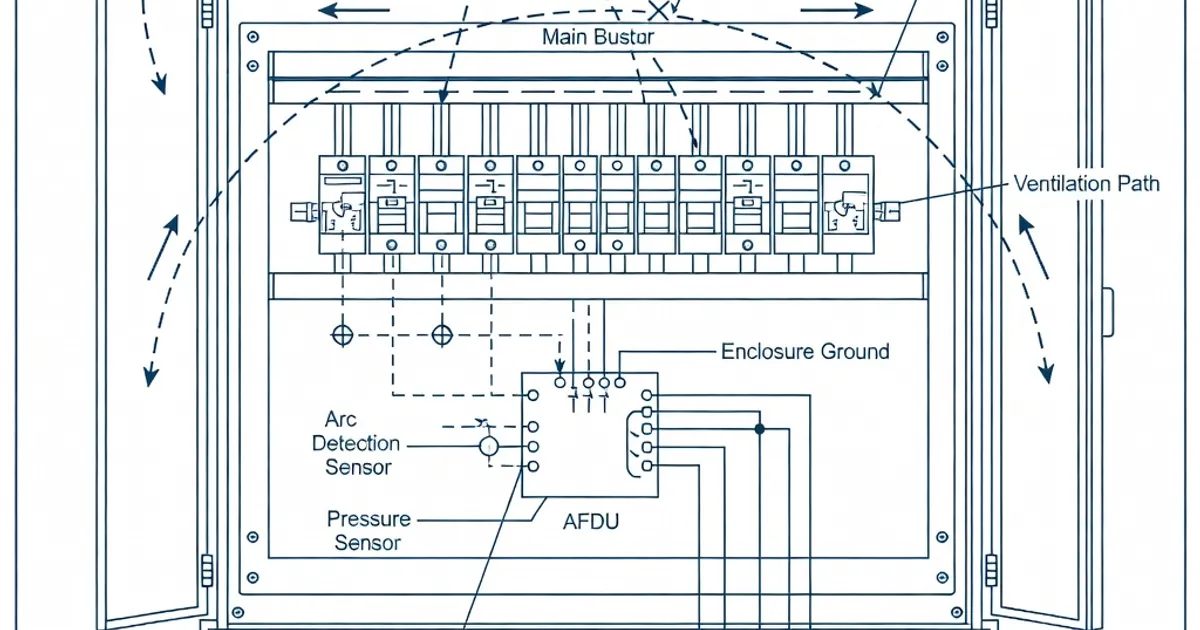
Arc Fault Protection in Panel Assemblies
Overview
Arc faults inside low-voltage panel assemblies present a significant hazard to personnel and equipment. Arc fault protection in IEC 61439-compliant assemblies focuses on three complementary objectives: detect and extinguish the arc as rapidly as possible, limit the energy released during the event, and contain any mechanical or thermal effects so they do not endanger people or other equipment. Design verification for assemblies up to 1 kV AC relies on a combination of standardized type tests, integration of arc-detection and arc-quenching devices, and architectural measures such as compartmentalization and venting to safe zones. Per IEC 61439 series requirements, assembly builders must address temperature-rise, short-circuit withstand, clearances/creepage and functional protection when implementing arc mitigation strategies [1][4][6].
Standards and Normative References
Effective arc fault protection in modern switchgear and controlgear assemblies requires compliance with several interlinked standards. The most important documents are:
- IEC 61439-1 (General rules) and IEC 61439-2 (Power assemblies up to 1 kV AC) — define verification methods for temperature-rise, short-circuit strength, and assembly construction including forms of separation and insulation principles. See Clauses 8.6 (clearances/creepage), 9.3 (short-circuit withstand) and Clause 43 (total insulation concepts) for applicable rules [1][5][6].
- IEC/TR 61641 — provides the internal arc test method used to evaluate assembly performance under a controlled internal arc fault and defines pass/fail criteria such as absence of ejection of parts and no holes in external covers [1][3].
- IEC 60947-9-1 and IEC 60947-9-2 — define arc-quenching devices (quench by current commutation or series impedance) and arc detection systems (light and current sensors, functional tests and immunity requirements) respectively [3][4].
- IEC TS 63107 (2020) — provides technical specifications for integrating active arc mitigation systems in IEC 61439 assemblies, including definitions for arc ignition mitigating systems (IAMS), arc ignition restricting devices (IARD), and the arc-fault mitigation time from detection to extinction [3][4].
- Supplementary documents and manufacturer white papers (ABB, Eaton, Legrand, BEAMA guidance) provide practical guidance on implementation and verification beyond the normative text [2][7][9][3].
Fundamental Technologies
Arc Detection
Arc detection systems typically combine optical (light) and electrical (current) sensing to reliably identify an internal arc event while minimizing nuisance trips. Detection devices complying with IEC 60947-9-2 evaluate features such as sensitivity to low- and high-energy arcs, immunity to transient signals, response to temperature rise, and behavior after re-powering. Modern arc detection relays commonly provide:
- Multi-sensor inputs (fast photodiodes/phototransistors and current transformers or Rogowski coils).
- Adjustable thresholds and timing logic (to distinguish arcs from switching transients).
- Trip outputs to auxiliary contactors, circuit breakers, or dedicated quenching hardware.
Per IEC 60947-9-2 and BEAMA guidance, detection performance must be validated with representative fault waveforms and nuisance-trip testing to ensure reliable operation in the assembly environment [3][4].
Arc Quenching
Arc quenching devices, standardized under IEC 60947-9-1, extinguish the arc rapidly—typically in a few milliseconds—by commutating current into a low-impedance bypass or by inserting a series impedance to reduce arc sustaining current. Key points:
- Arc-quenching devices (often described as internal arc-fault limiting devices, IALD) act to reduce released energy before the upstream short-circuit protective device (SCPD) clears the residual fault current.
- Quenching alone does not replace the SCPD; the upstream SCPD must still clear the remaining fault current in accordance with short-circuit coordination requirements in IEC 61439-1 and -2 [3][4].
- IEC TS 63107 introduces terms and performance metrics to measure the full mitigation chain from detection through quenching to final interruption [4].
Containment and Forms of Separation
Containment limits the propagation and external effects of an internal arc. IEC 61439 defines forms of separation (Forms 1–4, with 4a/4b nuances) that govern segregation between functional units such as feeders, busbars and devices. Practical containment measures include:
- Compartmentalization (Form 3b / Form 4a / Form 4b) to prevent lateral propagation of arcs across compartments and to protect adjacent circuits and personnel [10].
- Designated venting paths routed to safe areas to control hot gas and particulate ejection per IEC/TR 61641 recommendations and manufacturer guidance [1][3].
- Robust covers and mechanical restraints to satisfy the arc test criteria (no holes in external covers, no ejected parts that could harm personnel) [1][3].
Testing and Verification
Verification and testing form the backbone of proving an assembly's arc performance. The IEC framework provides several paths:
- Internal arc testing (IEC/TR 61641) — A direct test that subjects an assembly or representative compartment to a controlled arcing fault generated by specified electrodes and energy levels. The test checks criteria such as thermal effects, mechanical integrity (no ejection of parts), absence of holes in covers and that indicators remain attached. The results are classified into arcing classes (IAC/AFLR, etc.) and inform whether an assembly can be considered “arc-resistant” for operator safety. Note: arc tests are not fully repeatable in every detail; they demonstrate the robustness of the design rather than provide an absolute guarantee of identical performance on every event [1][3].
- Type testing and reference designs (IEC 61439-1/-2) — For temperature-rise and short-circuit withstand verification, manufacturers can perform type tests on full assemblies or justify performance by calculation and reference designs. Clauses 8.6 (clearances/creepage), 9.3 (short-circuit) and thermal limits are central to this verification [1][6].
- Functional validation of arc detection/quenching — Devices conforming to IEC 60947-9 series require functional testing for sensitivity, immunity, quench times, and interactions with upstream SCPDs. BEAMA and manufacturer guides recommend integrated testing within the final assembly environment to confirm overall system behavior [3][2][7].
Design Best Practices and Industry Experience
Industry guidance and best practices converge on an integrated approach: combine physical separation and containment, rapid detection and quenching, and validated protective coordination. Key recommendations include:
- Compartmentalize per IEC 61439 forms of separation (prefer Form 3b or Form 4 variants for high-energy applications) to reduce the chance of arc propagation between circuits [10].
- Integrate detection and quenching so the arc-quenching device receives a reliable trip signal from the detector and acts within the arc-mitigation window defined in IEC TS 63107; typical mitigation response times from detection to quench are in the millisecond range though exact values depend on device class and system fault current [3][4].
- Coordinate with upstream SCPDs — quenching devices limit energy but require the SCPD to ultimately interrupt fault current. Verify coordination and select SCPD characteristics that will clear residual faults in required timeframes as per IEC 61439 short-circuit rules [1][3].
- Limit unprotected conductor lengths — industry practice recommends limiting lengths of conductors that remain unshielded or unsegregated (commonly 3 m or less) to reduce propagation risk and ensure detection/quench effectiveness [2][3].
- Design for venting — provide defined vent routes to a safe zone or ducting and size vents consistent with arc test guidance to avoid unpredictable ejection paths [1][3].
- Document and verify — keep traceable records of type tests, reference designs, device certifications (IEC 60947-9-1/9-2) and system integration tests per IEC TS 63107 to support conformity assessment [4][1].
Product Examples and Implementation
Major switchgear and control-gear manufacturers integrate arc protection measures into their IEC 61439-compliant systems. The following table summarizes publicly documented approaches and feature highlights from several vendors referenced in the literature and manufacturer documents.
| Brand | Product / Example | Arc Classification / Capability | Key Features / Standards |
|---|---|---|---|
| Siemens | NXPLUS C, 8DJH series | IAC AFLR 40 kA / 1 s (arc-resistant designs reported) | IEC/TR 61641-tested solutions, compartmentalization, integrates arc-detection/quenching options [1] |
| ABB | UniGear ZS1, Relion relays | Designed for arc mitigation integration | IEC 61439-2 compliant; arc detection via IEC 60947-9-2 compatible relays; manufacturer application notes on protection measures [2] |
| Schneider Electric | Okken, Blokset families | Assemblies designed for separation forms and AFDD integration | Supports Form 4b segregation, uses AFDDs and arc-relay options for reduced risk; documented in product guides [10] |
| Eaton | Power Xpert / XpertPX | IEC/TR 61641 arc tested reference designs | Whitepapers and application notes describe verification to EN/IEC 61439 and integration of arc detection/quench as per IEC TS 63107 [7] |
| Rittal | Perforex / VX25 | Modular assemblies supporting compartmental arc containment | Modular construction that supports Form 3b/4 segregation and optional arc relays; used in IEC 61439 assemblies [1] |
Typical Specification Table: Detection, Quench and Protection Parameters
The following specification table presents commonly adopted performance targets and limits used by panel builders when specifying arc protection components and assemblies. Use this as a guideline; always verify device datasheets and test evidence for your specific assembly.
| Parameter | Typical Target / Limit | Reference / Rationale |
|---|---|---|
| Detection Method | Light + current sensor redundancy | IEC 60947-9-2 recommends combined sensing for reliable detection [3] |
| Detection Time | < 10 ms (typical sensor response) to few tens of ms depending on logic | Faster detection reduces released energy; validated per IEC 60947-9-2 and IEC TS 63107 [3][4] |
| Quench Time | Milliseconds to tens of milliseconds to extinguish arc current | IEC 60947-9-1 quenching actions occur in ms; final fault clearing by SCPD [3] |
| Upstream SCPD | Required to interrupt residual fault current; specified per IEC 61439 short-circuit rules |