Power Factor Correction Panel (APFC) for Industrial Manufacturing
IEC 61439 power factor correction panel (apfc) assemblies engineered for industrial manufacturing applications. Heavy-duty IEC 61439 switchgear assemblies for factories, production lines, and manufacturing plants requiring motor control, power distribution, and process automation.
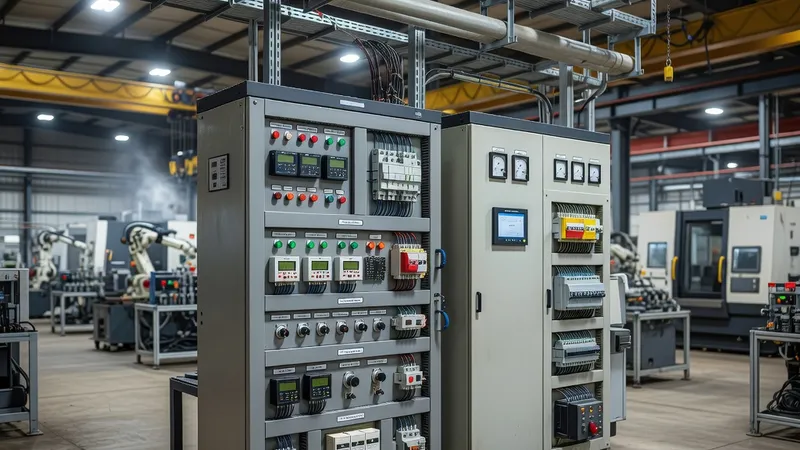
Power Factor Correction Panel (APFC) assemblies engineered for industrial manufacturing must combine IEC 61439 type-tested switchgear practice with application-level features for high short-circuit, harmonic-rich motor loads and continuous-process availability. Typical industrial APFC assemblies are floor-standing, modular switchgear sections comparable to Siemens SIVACON, ABB MNS or Schneider Prisma Set families and are specified per IEC 61439-1/-2 with rated currents up to 800 A and short‑circuit withstand/closing capabilities sized to plant fault levels (commonly 50–100 kA sym). Design features include automatic capacitor step switching driven by digital power factor controllers (with power/VAR and harmonic logging), capacitor contactors with pre‑charge resistors or inrush limiting, and staged switching (6–14 steps) to reach target power factors of 0.95–0.99. Harmonic mitigation is central in manufacturing environments with VFDs and large motor banks. APFC designs use detuned reactors (5.67%–14% detuning) to avoid resonance with 5th/7th harmonics, and may integrate passive tuned filters, tuned damped filters, or active harmonic filters (AHF) depending on harmonic spectrum per IEC 61000-3-2/3 and IEEE 519 guidance. Capacitor protection follows IEC 60831 requirements (capacitor fuse selection, coordination and clearing times), and switching devices are chosen per IEC 60947 series (MCCBs per 60947-2, contactors per 60947-4-1). Neutral switching, unbalance protection and earth-fault coordination are implemented as required by process criticality. Forms of separation are selectable up to Form 4b (functional unit segregation) per IEC 61439-1 to permit safe maintenance and selective isolation. Busbar systems are specified and tested for temperature rise, short-circuit withstand and mechanical integrity; busbar stiffening, bolted connections and dielectric clearances are sized for rated currents and short-circuit levels and validated by type tests. Environmental specifications account for factory conditions: IP31–IP42 is typical, with IP54/IP55 or tropicalization available for dusty, humid or corrosive plants; seismic anchoring, vibration damping and elevated ambient derating are applied per site. Monitoring and communications include power quality meters (e.g., Siemens PAC/Schneider PowerLogic series), Modbus/IEC 61850 gateways for SCADA/EPC integration, and local HMI for step status and alarm logging. Typical configurations: centralized APFC at plant main bus, distributed APFC per production cell, hybrid solutions combining detuned capacitor banks with AHFs, and explosion-rated APFC enclosures per IEC 60079 for hazardous process areas. Engineering deliverables include short-circuit studies, harmonic studies, protection coordination, and factory acceptance testing (FAT) to verify IEC 61439 tests and field commissioning to ensure process continuity.
Key Features
- Automatic capacitor step switching with power factor controller
- Detuned reactors for harmonic-rich environments
- Heavy-duty capacitor contactors with pre-charging resistors
- Capacitor fuse protection per IEC 60831
- Designed for industrial manufacturing operating environments
- Industry-specific protection and monitoring requirements
Technical Specifications
| Rated Current (InA) | Up to 800A |
| Capacitor Stages | 6–14 steps |
| Target Power Factor | 0.95–0.99 |
| Detuning Reactor | 5.67%–14% |
| IP Protection | IP31–IP42 |
| IEC Standard | IEC 61439-2 |
| Target Industry | Industrial Manufacturing |
Frequently Asked Questions
Request a Quote
Tell us about your panel requirements and our engineering team will get back to you within 24 hours.
Email Us
[email protected]Call Us
+90 232 332 22 78