Power Factor Correction Panel (APFC) for Commercial Buildings
IEC 61439 power factor correction panel (apfc) assemblies engineered for commercial buildings applications. IEC 61439 compliant panel assemblies for offices, retail complexes, hotels, and mixed-use commercial developments requiring reliable power distribution and energy management.
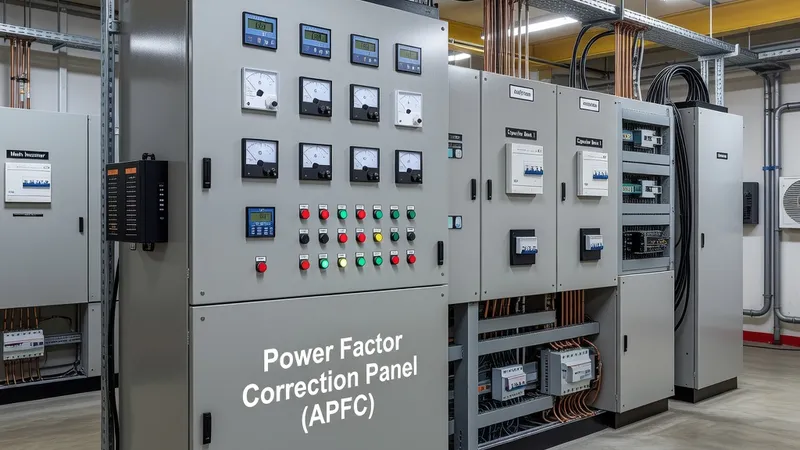
Power Factor Correction Panel (APFC) assemblies engineered for commercial buildings are specialized low-voltage switchgear built to IEC 61439 principles for safety, accessibility, and predictable performance. Typical commercial APFC panels are rated up to 800 A per busbar and include 6–14 capacitor steps to achieve target power factors of 0.95–0.99. Assemblies are commonly integrated into mainstream low-voltage systems such as Siemens SIVACON, ABB MNS, or Schneider Prisma Set lineups, or supplied as standalone IEC 61439-2 floor or riser panels. Design considerations include choice of form of separation (Form 1 through Form 4b per IEC 61439-1/2) to permit safe maintenance and segregation of bus, functional units and circuits. Switching hardware follows the IEC 60947 series: heavy‑duty capacitor contactors with pre‑insertion resistors or controlled switching devices reduce inrush and transients; alternatively, thyristor-switched capacitors (TSC) are specified where fast response and zero‑cross switching are required. Capacitors themselves comply with IEC 60831 for low-voltage power factor correction capacitors. In harmonic‑rich environments detuned reactors (typically 5.67% up to 14% impedance) are recommended to move resonance away from characteristic harmonic orders; detuned banks are often specified per IEEE 519 objectives and IEC 61000 harmonic measurement guidance. Protection and coordination include fused capacitor branches per IEC 60831 and selective discrimination to the building’s main switchgear. Short‑circuit withstand and making capacities are selected to match utility and site studies — common commercial values range from 25 kA to 65 kA symmetrical fault withstand depending on supply characteristics, and must be demonstrated by type and routine tests per IEC 61439-1/2. Environmental and installation considerations include ambient temperature derating, forced ventilation in plantrooms, acoustic attenuation for reactors, and IP31–IP42 enclosures for riser cupboards; IP54 or higher is used where dust or moisture exposure is expected. Controls and metering integrate microprocessor power factor controllers and power monitors (such as Siemens SENTRON/PAC series) with BACnet/Modbus/TCP for BMS integration and logging. Typical configurations for commercial buildings: centralized APFC at the main distribution for building‑level reactive management; decentralized floor panels close to large loads (HVAC, lifts, retail tenant distribution) to avoid nuisance switching; and hybrid schemes combining switched capacitors and active front‑end harmonic filters where distortion and resonance risks are high. Documentation delivered with each assembly includes type test reports, routine test records, coordination studies, harmonic analysis, and maintenance recommendations tailored to commercial building operations.
Key Features
- Automatic capacitor step switching with power factor controller
- Detuned reactors for harmonic-rich environments
- Heavy-duty capacitor contactors with pre-charging resistors
- Capacitor fuse protection per IEC 60831
- Designed for commercial buildings operating environments
- Industry-specific protection and monitoring requirements
Technical Specifications
| Rated Current (InA) | Up to 800A |
| Capacitor Stages | 6–14 steps |
| Target Power Factor | 0.95–0.99 |
| Detuning Reactor | 5.67%–14% |
| IP Protection | IP31–IP42 |
| IEC Standard | IEC 61439-2 |
| Target Industry | Commercial Buildings |
Frequently Asked Questions
Request a Quote
Tell us about your panel requirements and our engineering team will get back to you within 24 hours.
Email Us
[email protected]Call Us
+90 232 332 22 78